
Review: Small, an Eye-Opening Look at the Dangerous Life of a Horse Jockey
Robert Montano’s solo play performs a return engagement off-Broadway.
 |
Off-Broadway
|
|
Off-Broadway
|
June 1, 2026
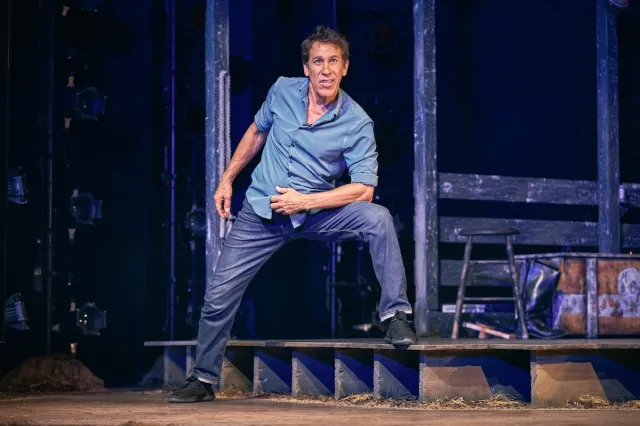
(© Valerie Terranova)
I have often wondered what my life would look like had I pursued athletics over theater. Standing at a slender 5’3”, I would have obviously been hopeless as a football or basketball player—but perhaps I would have thrived as a wrestler, coxswain on crew, or horse jockey.
Robert Montano seriously went after the latter, and I am intensely grateful to him for allaying my fear that I chose the wrong path. His solo show, Small, is an eye-opening look at the way jockeys sacrifice their physical and mental health to win the race—and more broadly how an obsession with a prestige career can nearly derail a life.
This Penguin Rep Theatre production, now performing a return off-Broadway engagement at the Pershing Square Signature Center, greets the audience with energetic ’70s dance music—Earth, Wind, & Fire and Cheryl Lynn. It primes us for what at first appears like a garden variety confessional solo play about growing up in the tri-state area to eccentric immigrant parents, whom the performer naturally portrays with exaggerated gusto.
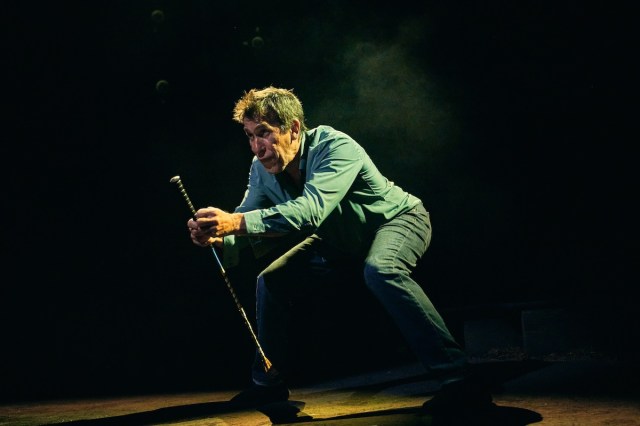
(© Valerie Terranova)
Montano bursts onto the stage with foreshadowing grace as he tells us about how tough it was growing up on Long Island several inches shorter than all the other boys. He idolized Bernardo from West Side Story—Puerto Rican like him (though the actor George Chakiris was actually Greek), but unlike him, tall and muscular. He prayed to God to make him tall too.
At the same time, he developed a fascination with horse racing at nearby Belmont Park. And he couldn’t help but notice that the athletes (the jockeys, not the horses) were all short. After finagling his way into a job at the racetrack, he was taken under the wing of jockey Roberto Pineda. But by his teenage years, Montano’s prayers were maddeningly answered: He kept growing. Still a short king in the streets, by the time he reached 5’7” he was practically an ogre in the stalls, and that drove Montano to desperate measures.
The middle portion of Small is a disturbing first-hand account of a male eating disorder, with Montano describing how he subsisted on minimal calories and speed as he took frequent trips to the sauna (and occasionally the bathroom stall) in a desperate effort to keep his weight down. This is shockingly common behavior among athletes, but rarely discussed as it pertains to men, who are less likely to be motivated by impossible beauty standards than competition for a very limited number of jobs in professional sports. Just to get a sense of how bad this situation is in jockey world, consider that his off-ramp was dance school, where the attitude toward weight was relatively more relaxed (Montano has appeared on Broadway in Cats, Kiss of the Spider Woman, and On the Town).
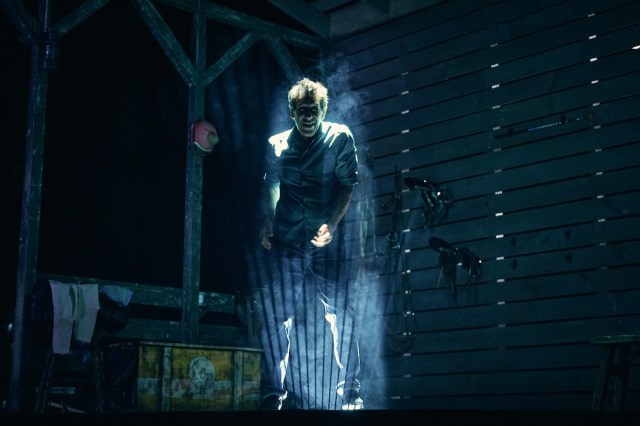
(© Valerie Terranova)
A fun-size burst of joy, Montano is a magnetic storyteller, and director Jessi D. Hill builds off that with a production that complements Montano’s natural gifts. We hear the crowd roar as his voice is suddenly transformed into that of a racetrack announcer, and we’re there are the races (the evocative sound design is by Brian Ronan). Jamie Roderick’s lighting is similarly transformative, taking us from a Catholic church pew to a discotheque, even though we’re always staring at Christopher and Justin Swader’s set depicting a horse stable. No one on this creative team is reinventing the wheel vis-à-vis solo performance, but they do put the best polish on a fascinating story that is unlike anything else playing off-Broadway right now.
By telling his Small story with bracing candor, Montano makes his audience think about the meritocratic treadmill that millions of young people in the developed world must run to have a shot at a career in athletics, the arts, media, and politics. As the years go by and the population increases, the competition only gets fiercer—and, one suspects, the unhealthy habits only get worse.




source on Google
Featured In This Story
Latest Reviews
See all


Latest Videos
Watch the Trailer for Elsinore Starring Andrew Scott
The film is based on the true story of Ian Charleson, who played Hamlet at London’s National Theatre after being diagnosed with AIDS.