
Review: Signature Theatre’s Dazzling Pippin Finds Meaning Beneath the Spectacle
Matthew Gardiner directs the musical in Washington, DC.
 |
Arlington
|
|
Arlington
|
June 3, 2026
(© Daniel Rader)
For a musical about a young man searching for meaning in life, Pippin sure knows how to distract him from finding it.
Stephen Schwartz and Roger O. Hirson’s 1972 musical has always thrived on contradiction, with a hodgepodge of existential crisis, seductive circus act, satire, sex comedy, and theatrical fever dream. The plot barely holds together, the tone shifts on a dime, and half the characters seem to exist purely to tempt the title character into increasingly questionable life decisions. Yet somehow, when Pippin works, it really works.
Signature Theatre’s thrilling revival, directed by Matthew Gardiner, understands that the show’s messiness is part of its appeal. This isn’t a musical you watch for narrative logic. It’s one you surrender to.
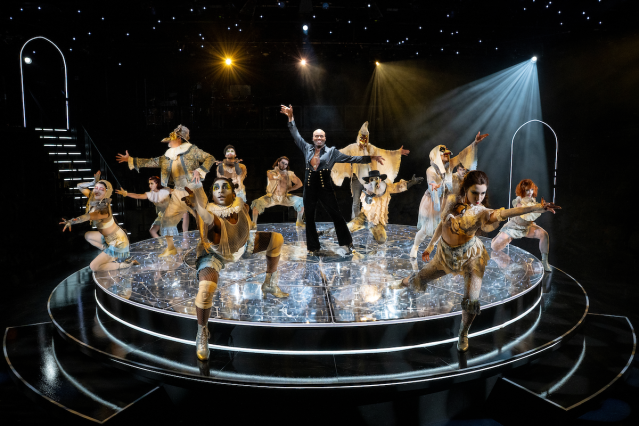
Staged in the round in Signature’s MAX Theatre, the production drops the audience directly into the middle of the chaos, surrounding us with a world of glitter, danger, sensuality, and theatrical manipulation. It’s flashy, funny, occasionally unhinged, and ultimately more emotionally satisfying than you might expect.
(© Christopher Mueller)
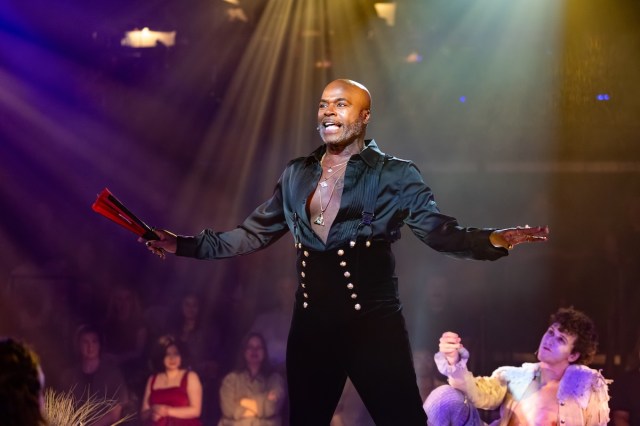
From the opening moments, Cedric Neal establishes total command of the room as the Leading Player, the mysterious emcee guiding both Pippin and the audience through this strange theatrical journey. Neal’s performance is magnetic from start to finish. Vocally, he tears through Schwartz’s score with silky confidence and effortless power, but it’s his physical presence that makes the biggest impression. Every movement feels intentional, whether he’s stalking across the stage with predatory elegance or punctuating a lyric with a sly flick of the wrist. The role famously carries traces of Bob Fosse’s signature style, and Neal channels that influence beautifully without ever slipping into impersonation.
As Pippin, Brayden Bambino smartly avoids trying to force charisma onto a character who is fundamentally lost. Instead, he leans into the prince’s uncertainty, restlessness, and naïve optimism. His early rendition of “Corner of the Sky” feels appropriately tentative, less a bold declaration than a confused plea for purpose. Bambino grows stronger as Pippin’s journey becomes darker and more emotionally complicated. By the second act, he’s fully settled into the role, giving the character a believable emotional evolution rather than simply playing him as an aimless dreamer.
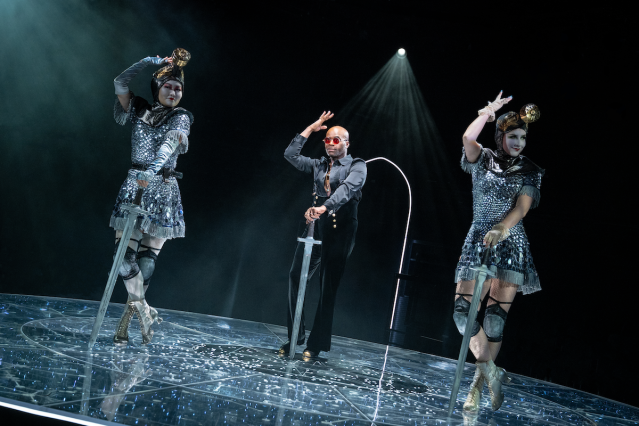
The supporting cast is uniformly terrific. Eric Hissom gets plenty of laughs as Charlemagne, portraying the king as an overgrown ego in royal robes, hilariously committed to the idea that warfare solves basically everything. His “War Is a Science” lands as one of the production’s funniest sequences, aided by Gardiner’s energetic staging and Rachel Leigh Dolan’s athletic choreography.
Maria Rizzo nearly walks away with the entire production as Pippin’s scheming stepmother Fastrada. Decked out in sparkling costumes and weaponized confidence, Rizzo attacks every scene with delicious theatrical precision. Her “Spread a Little Sunshine” is one of the evening’s standout numbers, balancing broad comedy with just enough self-awareness to keep the character from becoming cartoonish. Ryan Sellers is equally entertaining as Lewis, Fastrada’s gloriously dim son, leaning fully into the role’s exaggerated bravado.
(© Daniel Rader)
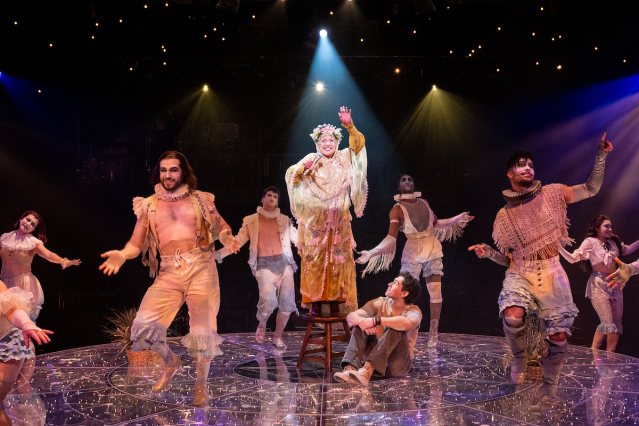
Then there’s Naomi Jacobson, who earns one of the night’s biggest audience reactions as Berthe, Pippin’s wildly uninhibited grandmother. Jacobson turns “No Time at All” into a full-fledged showstopper, effortlessly working the crowd while radiating warmth, confidence and mischief. In a show overflowing with spectacle, it’s one of the few moments that feels genuinely communal rather than performative.
Still, the production’s emotional center doesn’t fully arrive until Awa Sal Secka enters as Catherine in the second act. Too often, Catherine can feel like a narrative afterthought in Pippin, existing solely to teach the title character that ordinary life has value. Secka changes that completely. Her grounded, heartfelt performance gives the show the emotional sincerity it desperately needs by that point in the story. Her vocals on “Kind of Woman” and “Love Song” are gorgeous, but more importantly, she makes Catherine feel like an actual person rather than a symbolic life lesson.
Ellison Bihm is charming as Theo, Catherine’s son, and his final musical moments provide one of the production’s most unexpectedly moving touches.
Visually, the production is stunning. Scenic designers Christopher and Justin Swader transform the MAX Theatre into a glowing theatrical playground centered around a circular platform illuminated from below. Combined with Adam Honoré’s vivid lighting design, the space constantly shifts between dreamy fantasy and aggressive show-business artifice. Erik Teague’s costumes blend burlesque, medieval fantasy, vaudeville, and modern glam into an intentionally heightened theatrical world where virtually everyone looks like they wandered out of an especially stylish psychedelic realm.
(© Daniel Rader)
Dolan’s choreography embraces Fosse’s influence while allowing the movement to feel more contemporary and muscular. The angular poses, rolling hips, and stylized hand gestures are all there, but the choreography avoids becoming a museum piece. Instead, it feels energized and modern, particularly during the ensemble-heavy sequences that transform the stage into a swirling carnival of bodies and movement.
If the production occasionally stumbles, it’s mostly because Pippin itself remains such an oddity. The musical wants to critique spectacle while simultaneously indulging in it. It mocks the pursuit of extraordinary greatness while delivering giant production numbers designed to overwhelm the audience. Gardiner’s production doesn’t entirely solve those contradictions, but it wisely stops trying to. Instead, it embraces the tension between emptiness and entertainment that has always made the musical compelling.
And in 2026, Pippin’s themes feel surprisingly timely. Pippin spends the entire show searching for fulfillment through achievement, pleasure, status, politics, art, and performance, only to discover that none of them provide lasting meaning on their own. In a world increasingly built around curated identities and endless performance, that existential anxiety lands differently than it probably did in 1972.
The show promises magic from the very beginning. Against the odds, Signature Theatre actually delivers it.




source on Google
Featured In This Story

Latest Reviews
See all





Latest Videos
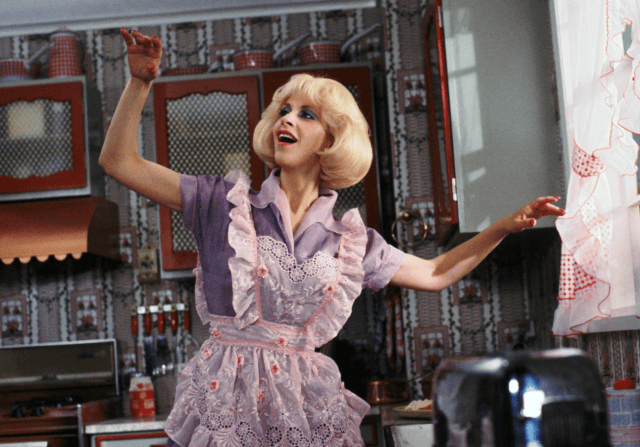
Watch: Ellen Greene Reflects on the Enduring Legacy of Little Shop of Horrors
Frank Oz’s cult classic movie-musical has gotten a new 4K restoration in celebration of its 40th anniversary.