
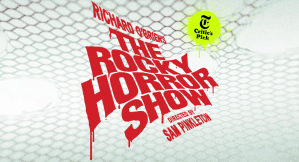
Review: The Rocky Horror Show Receives a Too-Tame Broadway Revival
Richard O’Brien’s cult classic musical gets a new staging from Roundabout Theatre Company at Studio 54.
 |
Broadway
|
|
Broadway
|
April 23, 2026
(© Joan Marcus)
I kissed a man for the first time at a midnight screening of The Rocky Horror Picture Show. I was 16 and he was a member of the shadow cast, the group of regulars who act out the film in front of the screen as we in the audience hurl toilet paper, rice, and witty one-liners. The kiss was part of a “deviriginizing” ceremony for those attending for the first time and it was perfect: not pornographic, but not a grandma’s kiss either. It certainly felt like liberation from the perspective of a closeted gay teen in Bush-era suburban Ohio.
I suspect others have a similar relationship to Rocky Horror and may be looking to recapture that feeling of youthful rebellion from Roundabout Theatre Company’s Broadway revival of Richard O’Brien’s The Rocky Horror Show, now at Studio 54. In delivering a production that features top-tier talent in a scrappy DIY staging, director Sam Pinkleton is partially successful in bridging the widening gap between this licentious rock musical from the freewheeling ‘70s and a Broadway that feels increasingly forbidding to outsiders.
Originally produced in London, The Rocky Horror Show flopped on Broadway in 1975. The film that came out later that year was also not a box office success—at least not initially. But a cult following developed around midnight screenings, not the product of a viral marketing campaign, but good old-fashioned American fandom. Half a century later, screenings are still a gathering place for horny nerds, and even though the stage musical predates the film, any revival must consider that history with as much care as one might devote to O’Brien’s retro rock score and campy sci-fi story.
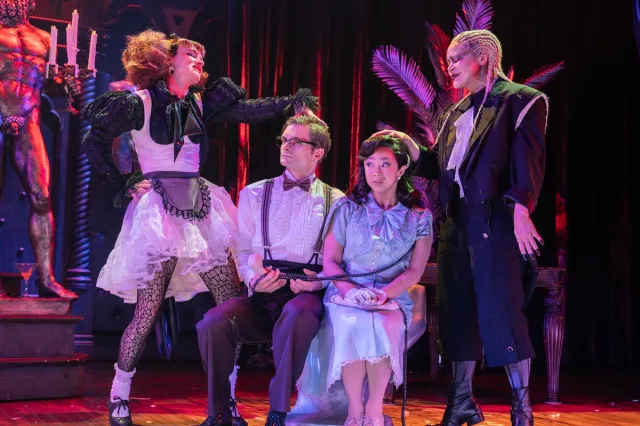
It’s about newly engaged couple Brad (Andrew Durand) and Janet (Stephanie Hsu). Their car breaks down in a storm on the way to visit old friend Dr. Everett Scott (Harvey Guillén) and they seek refuge in a nearby castle occupied by Riff Raff (Amber Gray), Magenta (Juliette Lewis), and Columbia (Michaela Jaé Rodriguez)—all Gothically liveried servants to transvestite mad scientist Dr. Frank-N-Furter (Luke Evans).
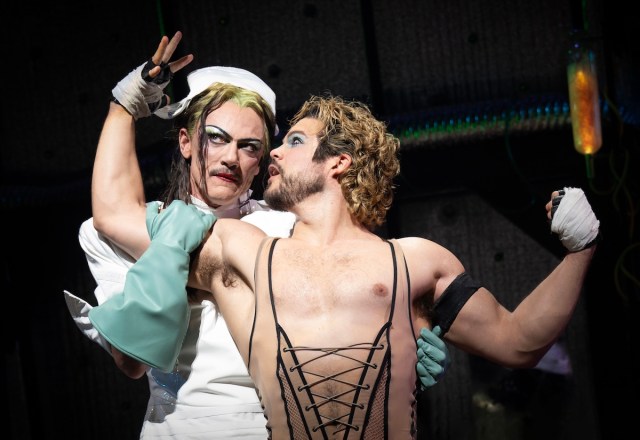
Brad and Janet just want access to a telephone, but they get pulled into the grand unveiling of Frank’s latest experiment, a muscle-bound creature named Rocky (Josh Rivera, beautifully filling out this role both vocally and visually in a singlet). The experience becomes an erotic nightmare that none are soon to forget.
(© Joan Marcus)
Pinkleton’s delightfully low-tech production features actors popping through holes in the curtain and dancers flailing like Muppets from the turrets of the set, which the design collective dots has designed to resemble that of a low-budget Jim Steinman music video (the wonderfully uninhibited choreography is by Ani Taj). Lighting designer Jane Cox and sound designer Brian Ronan conjure thunder, lightning, and all manner of cheesy B-movie effects. Refreshingly, there are no projections, just a giant onstage television box representing Frank’s surveillance system, leading to the most hilarious tableaux of the show.
David I. Reynoso’s costumes lean heavily on vinyl and mesh, the kind you could easily obtain for yourself (I clocked Evans wearing the “roid reaper” top from Strapp Metal). Also for Evans, Alberto Alvarado has designed a wig that suggests a mashup of Charles II and Sharon Stone in Basic Instinct, which feels like a perfect encapsulation of Frank’s personality. It looks like a really good amateur staging starring an extraordinarily talented shadow cast.
Evans leads in a respectable but not revelatory Broadway debut. His Frank-N-Furter is the sexual chaos agent we’ve come to expect: extravagant, British, and mildly terrifying. While Evans never quite escapes the long shadow cast by Tim Curry in this role, he does show off his pleasantly resonant singing voice in a gorgeous rendition of “I’m Going Home,” delivered from the lip of the stage like a great chanteuse of yesteryear.
There are other notable performances. Hsu endows Janet with her special brand of nervous energy, making her character’s sexual awakening feel particularly feral. Guillén wrings unexpected humor out of every line. Grey’s Riff is deliciously rancid and clearly driven by an inferiority complex. While she somewhat recedes as Magenta, Lewis primes the audience perfectly as a mousy purple-haired usherette singing about the “late night double feature picture show.” In that moment, she represents every obsessive weirdo who has ever been drawn to this property. The chorus of phantoms (Boy Radio, Caleb Quezon, Larkin Reilly, and Paul Soileau) contribute to a zany carnival atmosphere in which a diverse range of bodies and personalities come together to enact something marvelously strange.
(© Joan Marcus)
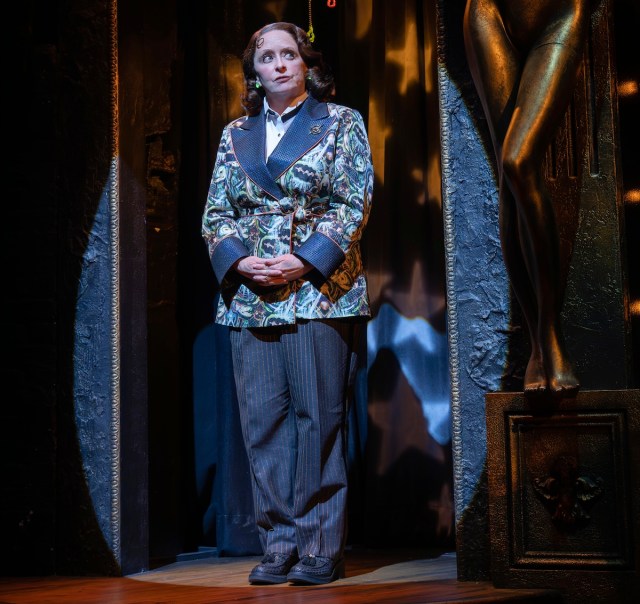
Of all the performers, Rachel Dratch as the narrator is most adept at rolling with and utilizing the audience call-outs, receiving a request for a description of her balls and dryly responding, “heavy, black, and pendulous.” She easily volleys with the audience, which makes the minor controversy that has cropped up around audience participation in this revival somewhat baffling.
Responding to rowdy preview audiences, Roundabout has placed signage reminding ticketholders that they’re in a live theater, not a movie house. A somewhat Orwellian note on the production’s website advises theatergoers to “choose your call-outs carefully” without offering any specific guidance, which means you won’t know where the line is until you’ve crossed it (the 2000 Broadway revival, which ran for over a year at Circle in the Square, was far more encouraging of audience interaction, even selling participation giftbags at the merch stand). At the performance I attended some viewers still shouted sparingly at the stage, but rather than join them I chose to do what I always do at the theater: sit quietly and scribble my notes.
Solidly produced, this revival still feels like a missed opportunity to be the wild must-attend event of the season. It’s Rocky Horror at Studio 54 for crying out loud. If we can’t let loose here, where can we?




source on Google
Featured In This Story
Latest Reviews
See all


Latest Videos
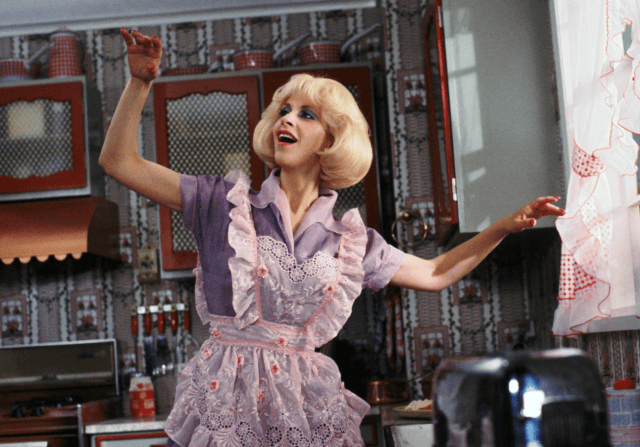
Watch: Ellen Greene Reflects on the Enduring Legacy of Little Shop of Horrors
Frank Oz’s cult classic movie-musical has gotten a new 4K restoration in celebration of its 40th anniversary.