
Review: A Two-Part, All-Asian American Henry VI Returns to the Public Theater
The National Asian American Theatre Company brings back Stephen Brown-Fried’s condensation of Shakespeare’s rarely produced trilogy.
 |
Off-Broadway
|
|
Off-Broadway
|
June 23, 2026
(© HanJie Chow)
Back in 2018, Stephen Brown-Fried condensed all three parts of William Shakespeare’s Henry VI into a two-part, nearly six-hour experience for a National Asian American Theatre Company production featuring a 16-member Asian American cast. The Public Theater has brought that production back, allowing adventurous theatergoers to consider, among other things, whether these rarely produced early Shakespeare plays have as much to say to contemporary American audiences as they did to English audiences in the late 16th century.
Some of the advertising materials for this remount go the extra mile to make a modern-day connection, with this trailer in particular billing Henry VI as “the story that inspired Game of Thrones.” Thankfully, there’s more to contemplate in this formidable undertaking than merely how much George R. R. Martin cribbed from the Hundred Years’ War.
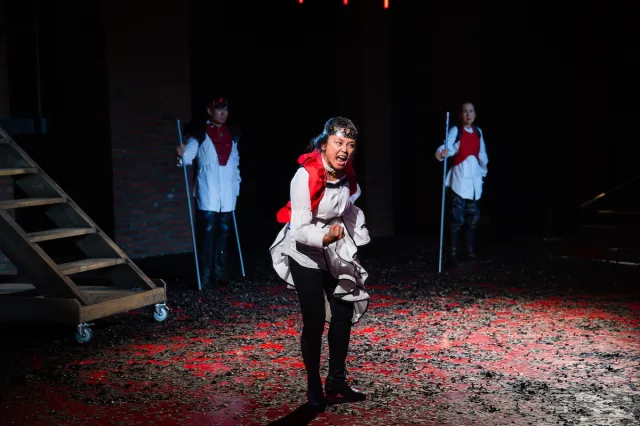
The invocation of that hit television series indicates the soap-opera-like appeal of this “trilogy in two parts.” To put it simply, Henry VI revolves around a series of power plays within and among nations. Part I, subtitled “Foreign Wars,” depicts England’s loss of its French territories to Charles, the Dauphin of France (Đavid Lee Huỳnh), helped in no small measure by Joan of Arc (Myka Cue). More importantly, it details the developing power struggle between Richard Plantagenet (Rajesh Bose) and the Duke of Somerset (Kimiye Corwin) under the rule of Henry VI (Jon Norman Schneider), recently crowned king after the death of Henry V. That conflict eventually metastasizes into the Wars of the Roses, which is the focus of Part II, “Civil Strife.”
(© HanJie Chow)
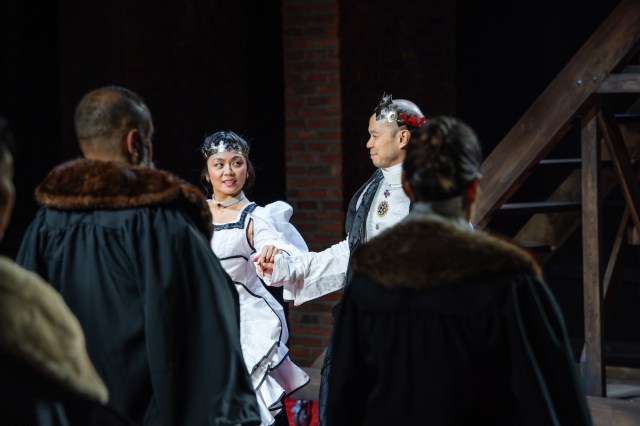
A few dominant personalities emerge from the political machinations and personal betrayals. Plantagenet, later the Duke of York, bristles with thirst for power. By comparison, the devout King Henry VI is meek and restrained, rising to a fury only when he banishes the Duke of Suffolk (Paul Juhn) after learning of his role in the murder of the Duke of Gloucester (Mia Katigbak). One of the Duke of York’s sons, the conniving Richard (Julyana Soelistyo), emerges with force in “Civil Strife,” especially in light of Shakespeare’s later Richard III. Most memorable of all is the French Margaret of Anjou (Teresa Avia Lim), who marries Henry VI and becomes Queen of England. Though she at first seems typically feminine and submissive, it doesn’t take long for her sharp-witted cunning and fearsome ambition to surface.
Unlike Game of Thrones, which had the luxury of multiple TV seasons to develop characters and lay out emotional stakes, this Henry VI has only six hours to burn through decades’ worth of plot. Thus, even as intelligently as Brown-Fried has compressed Shakespeare’s trilogy without losing coherence, the cumulative feeling of the experience is of witnessing a gargantuan history lesson. The emotional involvement of Shakespeare’s less panoramic, more character-based history plays, like Richard III and Henry V, is missing.
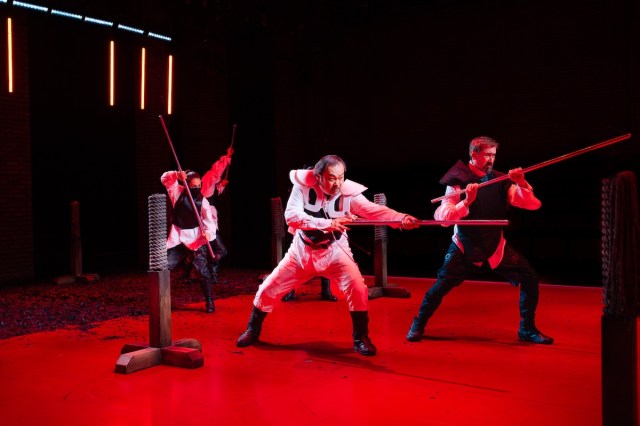
To some degree, Brown-Fried’s spare direction exacerbates that feeling. The scenic design, by the collective “dots,” consists of little more than a handful of columns and gray leaves on a blood-red floor, with some hanging LED lights offering opportunities for visual and emotional coloration (Mextly Couzin is the lighting designer). Fashion house threeASFOUR’s costume design uses basic colors to differentiate between warring factions: black-and-white clothing for the English versus all-white for the French; and red vs. white between the Houses of York and Lancaster as per the colors of their respective roses. And Orlando Pabotoy and Corwin bring enough invention and variety to their movement direction and fight choreography, including having the actors use katanas, for the battle scenes to have an impact despite their brevity.
(© HanJie Chow)
One of the upsides of Brown-Fried’s de-emphasis on visual spectacle is that it gives us the mental freedom to fully contemplate just how little has changed from the bloodthirsty vengefulness, hunger for power, and Machiavellian strategizing on display. The Duke of York’s introduction of populist demagogue Jack Cade (Orville Mendoza) to stir up a rebellion in England, for instance, can’t help but remind us of similarly opportunistic and unprincipled figures holding the reins of power in America today.
Ultimately, though, this Henry VI is most noteworthy as a showcase for some of the finest Asian American stage talent working today. Standouts include Bose, bringing visible relish to the Duke of York’s cutthroat maneuvering; Schneider, bringing genuine tragic pathos to his portrait of a royal who’s in way over his head; Lim, evoking a sense of quiet cunning even at her most seemingly nonthreatening; and Soelistyo, making a convincing case for spearheading a Richard III production all their own. But really, there are no weak links in this ensemble, going a considerable way toward warming up an experience that threatens to buckle under the weight of the immense history it chronicles.




source on Google
Featured In This Story

Latest Reviews
See all






Latest Videos
Watch: Ellen Greene Reflects on the Enduring Legacy of Little Shop of Horrors
Frank Oz’s cult classic movie-musical has gotten a new 4K restoration in celebration of its 40th anniversary.