
Review: The Reservoir, a Young Man’s Struggle With Alcoholism
Jake Brasch’s play makes its off-Broadway debut with Ensemble Studio Theatre and Atlantic Theater Company.
 |
Off-Broadway
|
|
Off-Broadway
|
February 24, 2026
(© Ahron R. Foster)
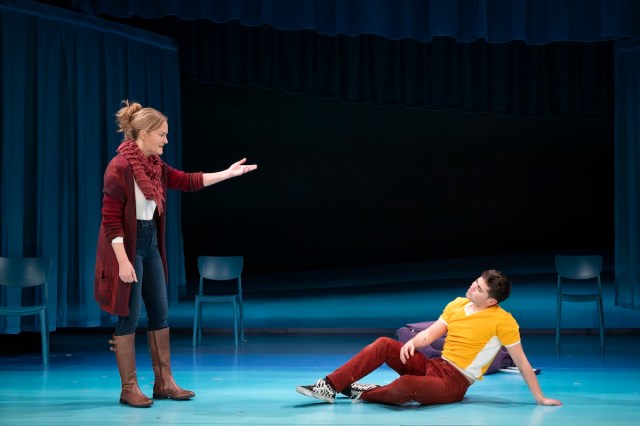
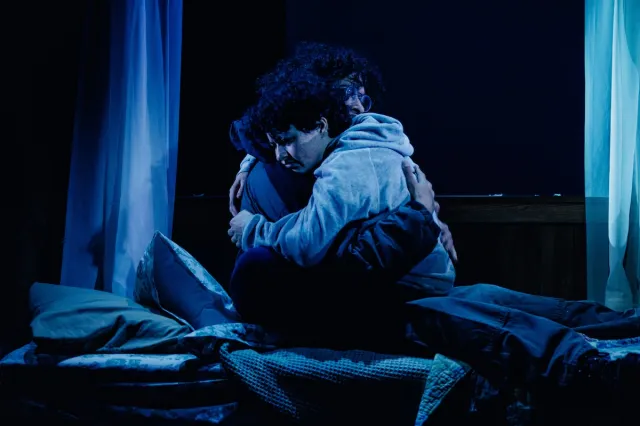
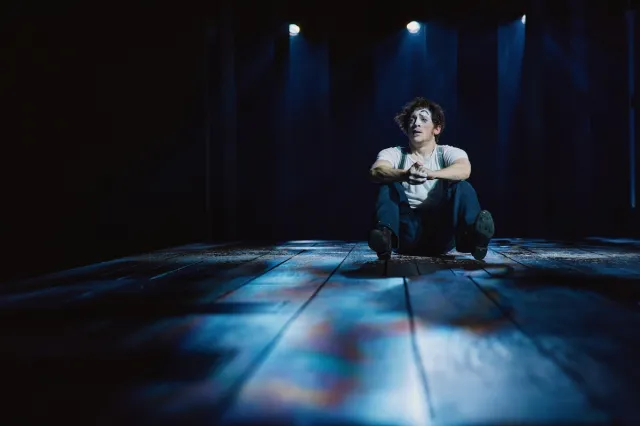
Addiction is always sad, but it feels particularly tragic in the young—even if, for them, the stakes feel as low as a video game that you can always restart. We know that Josh (Noah Galvin), the narrator and protagonist of Jake Brasch’s off-Broadway debut play The Reservoir, is still in college when he wakes up on the banks of the Cherry Creek Reservoir in suburban Denver. Unsure of how he got there, or where he received the giant gash on his arm, he is at least secure in the knowledge that much of his family lives nearby and will be there to pick his drunk ass off the floor.
On medical leave from NYU drama school (he explained on a form that he was “2 drunk 4 this”), he is supposed to be in rehab. He cannot remember the details of how he left, but ventures a guess: “They caught me fermenting grapefruit juice in the boiler room.”
While he dries out, his exasperated mother (a wounded and wary Heidi Armbruster) gets him a part-time job shelving at the independent bookstore where she works as a buyer. But his brain fog is so severe that he struggles to remember the alphabet. Inconsistent with that fact, he also spends a lot of his on-the-clock time browsing books on cognitive science. All of this is extremely irritating to his middle-aged manager Hugo (Matthew Saldívar), who resents the nepo baby who gets paid for the extra work he’s doing.
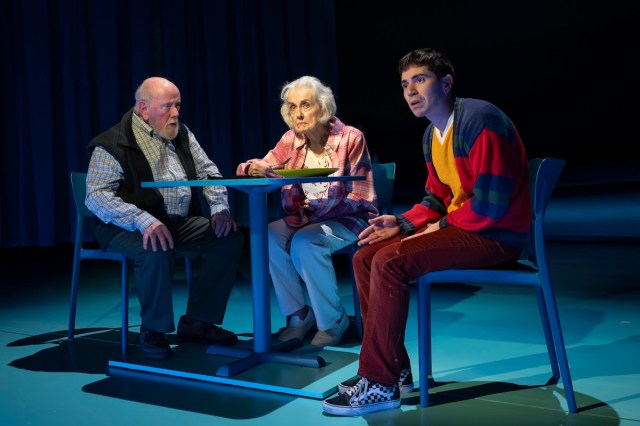
“I’m sorry I care more about my family than alphabetizing and dusting,” Josh brattily retorts. While he is distressed about the state of his own brain, he was incensed to learn that his Nana Irene (Mary Beth Peil) has slipped fully into senility without anyone telling him. Surely science has an answer to their mutual problem, some super-food or exercise that will strengthen their cognitive reserves so Josh can spend more quality time with his four living grandparents, whom he had hitherto been neglecting in favor of Smirnoff Ice benders.
(© Ahron R. Foster)
It’s easy to imagine the meeting at Atlantic Theater Company (which is co-producing this off-Broadway debut with Ensemble Studio Theatre) where The Reservoir was programmed into the season. “We need a play that will appeal to young people,” I hear artistic director Neil Pepe telling a small conference room of nervous not-for-profit administrators, “but one that also connects with our members who are … not as young.”
It’s a nice idea, but in practice The Reservoir repels more than it attracts. Part of this is Brasch’s writing, which isn’t as funny as it wants to be. The other part is Galvin, who despite considerable effort cannot fully sell this material or get us to truly invest in Josh’s sobriety journey. To really get milage out of a deeply flawed character who uses humor as a defense mechanism, one must actually disarm the audience with humor. But from the very first scene the laughs Galvin earns are the polite sort one affects to satisfy an amateur comedian, hoping that he will tire of the chuckles and move on to a new target. Brasch and director Shelley Butler are aiming for a 21st-century Torch Song Trilogy, full of witty asides and bracingly honest confessions, but their leading man does not possess the charm of a Harvey Fierstein (or even a Michael Urie).
At least The Reservoir offers a platform for excellent performances from some of New York’s very best veteran actors. Chip Zien is effortlessly hilarious as Shrimpy, Josh’s foul-mouthed Jewish grandfather who is studying for his second bar mitzvah (remembering the Hebrew becomes one of Josh’s cognitive exercises for Gramps). Peter Maloney heartbreakingly conveys the loneliness of a man whose life partner is suffering from severe dementia, an emotion mostly deflected through forced conversation about sports. But Peil lets us know that there is still something of the old Irene in there when she stands up at the nursing home cafeteria and sings a showstopping rendition of “O Come All Ye Faithful.”
(© Ahron R. Foster)
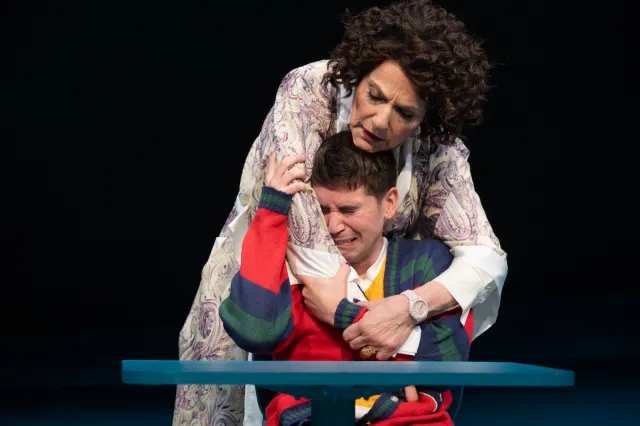
Caroline Aaron gives the standout performance as Grandma Beverly. Long divorced from Shrimpy, she has her own history with alcoholism, which she reveals to Josh after he relapses on vanilla extract. “If she can ask for help, if she can forgive herself, if she can go to meetings with her two toddlers in between shifts,” she speaks of herself in the ’60s, “you can surely muster the strength given your subsidized suburban lifestyle to extract your head full of shitty thoughts right out of your ass.” Aaron is the embodiment of tough love, a dab of grandmotherly spit on Josh’s soiled collar.
Butler delivers a brisk staging on Takeshi Kata’s versatile yet hideous set, its aggressively cerulean sheer curtains an ever-present reminder of the river metaphor that meanders through this play. Lighting designer Jiyoung Chang facilitates the scene changes without the need for too much scenery, as does sound designer Kate Marvin. We know we’re viewing the mainstage of Josh’s brain. He may not recall all the details, but he remembers with great accuracy what everyone is wearing (nuanced contemporary American costumes by Sara Ryung Clement). This story is clearly very significant to Josh, even as it becomes a slog for the viewer.
But part of growing up is realizing that one’s personal struggles ultimately aren’t that interesting to most people—not even the family members who previously seemed to have unlimited time to listen. I hope that The Reservoir fills its audiences with hope and insight, especially those struggling with addiction. But I found my patience drying up by the end.




Featured In This Story

Latest Reviews
See all

Latest Videos
Watch: Operation Mincemeat Stars Perform Live Concert in Honor of Final Performance
David Cumming, Claire-Marie Hall, Natasha Hodgson, Jak Malone, and Zoë Roberts played their final show on February 22.