
Review: The Disappear, a Comedy of Cringe
Erica Schmidt’s play makes its world premiere with Audible.
 |
Off-Broadway
|
|
Off-Broadway
|
January 15, 2026
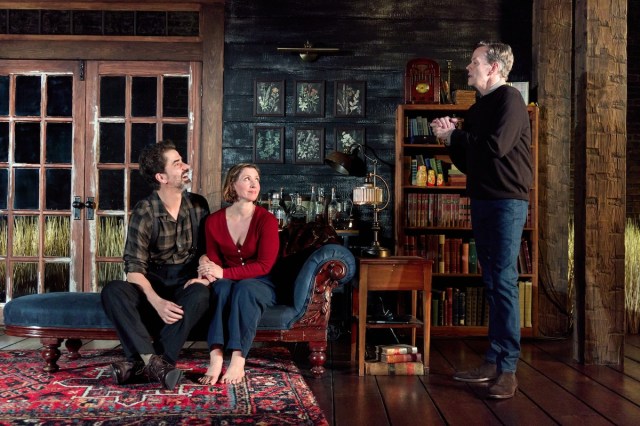
(© Jeremy Daniel)
It is our destiny as Americans to shop for a nice home, for low-priced consumer goods (on Amazon, naturally), and apparently for our spouses—even after we’re already married. The unspoken but immensely powerful assumption that the market is never really closed undergirds the drama in Erica Schmidt’s The Disappear, now making its world premiere with Audible Theater at the Minetta Lane Theatre. A mildly farcical comedy of cringe, it will certainly leave you and your significant other with a lot to chew on.
It is set entirely in the Hudson Valley home shared by novelist Mira Blair (Miriam Silverman), filmmaker Benjamin Braxton (Hamish Linklater), and their teenage daughter Dolly (Anna Mirodin). It’s an upstate refuge from modernity, furnished with antiques and leather-bound books, with nary a screen in sight. Under Cha See’s warmly incandescent lighting, Brett J. Banakis’s gorgeous set perfectly conjures the atmosphere of rustic Chekhovian longing that Schmidt seems to be aiming for. It also palpably clashes with the very contemporary obsession with youth and dopamine-fueled lust expressed by our paterfamilias.
For while Ben is well into his 50s and therefore too old for a midlife crisis, he will be denied nothing, specifically sex with the young actress Julie Wells (Madeline Brewer), whom he insists star in his next picture. “She’s mental,” protests Ben’s long-suffering producer, Michael (Dylan Baker). And we know he’s right the instant she arrives wearing a straw bonnet like she’s Dame Judi Dench in Cranford.

(© Jeremy Daniel)
But Ben will not be dissuaded, even when his initial film is shelved and Michael improbably gets him a meeting with hot young A-lister Raf Night (Kelvin Harrison Jr.). Raf is a superfan of Mira’s work and will only work with Ben if she writes the screenplay. Though Mira seems to be on the precipice of her own spicy fling with Raf, it’s not enough for Ben to have his own discrete affair like an adult. “I think I really – love her – Michael,” he confesses after just one meeting with Julie, leaving us to wonder, do all successful male artists exist in a state of suspended adolescence?
Linklater is the ideal actor for this role, his salt-and-pepper beard adorning a still-boyish face. His resonant voice suggests a general accustomed to commanding an army of actors and technicians, yet it so easily slips into a toddler’s whine, occasionally chased by a rolling-on-the-floor tantrum. He’s a marvelously intuitive physical actor, and costume designers Jennifer Moeller and Miriam Kelleher shrewdly understand that if you put Linklater in a pink shorty kimono, magic will transpire.
Less over-the-top, Silverman still matches Linklater in intensity and gives us someone to root for. Their contrapuntal fugue of a spousal fight is the most realistic segment of a play that regularly strains credulity.
Luckily, the excellent cast of The Disappear helps us overlook some of Schmidt’s more eyebrow-raising contrivances. As Raf, Harrison makes a compelling case that aspiring actors should ditch drama school in favor of a season working as an escort. Baker affects the plummy accent and unflappable manner of an old Brit who has seen it all. Mirodin expertly summons the anxious rage of a 16-year-old with supremely self-involved parents. And Brewer comfortably inhabits the manic pixie lunacy of a young performer who might just have a method behind her ostensible madness.
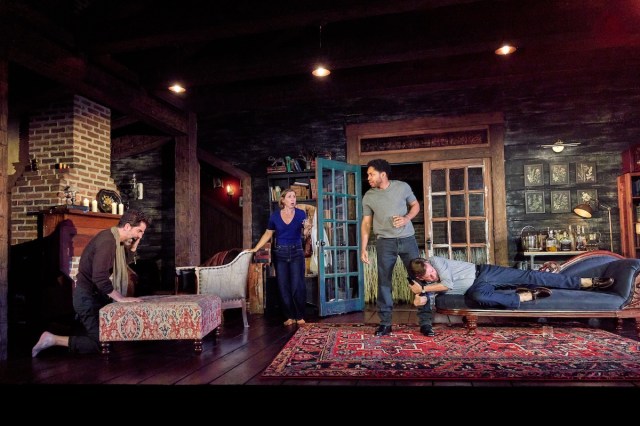
(© Jeremy Daniel)
It still doesn’t quite explain how she escaped from set and arrived at the Hudson Valley house still wearing her VFX suit and a tulle skirt (presumably they’re shooting nearby). Nor does any amount of narcissism excuse the way these cultural luminaries leave the upstage French doors open, like they’re sipping top-shelf whisky in a barn. And I will never be convinced that, after the harrowing events of the play, these people could ever be persuaded to sit down in the same room again, as they do in the denouement. I do understand the practical need to limit the action of the play to the living room, but that is typically something to be hammered out between the writer and director pre-production.
Schmidt, who directs her own work here, does not seem bothered by these earthly concerns. A feminist Zeus, she is content to throw lightning bolts at her hubristic male protagonist from her perch on Olympus. But she undermines her own God-like power as a dramatist in the final moment of the play, which takes place so far upstage as to render it invisible to most of the audience. As I have previously argued, Schmidt really needs to find a director who will refine her dramatic vision into the shock to the system she wants it to be.
The Disappear probably won’t leave you quaking with laughter or shaking with grim recognition of your own frail mortality. But it will give you a few laughs and will hopefully make you consider the way your identity as a consumer infects all aspects of your life, including the way you treat those most dear. We should always be thinking about that.




Featured In This Story

Latest Reviews
See all






Latest Videos
West End vs Broadway: Oh, Mary!—From an Angry Inch to an Angry First Lady, With John Cameron Mitchell and Mason Alexander Park
Mitchell and Park celebrate a decade-long friendship in our latest installment.