
Review: The Dinosaurs, a Time-Jumping Recovery Meeting With Kathleen Chalfant and Elizabeth Marvel
Playwrights Horizons premieres a new play by Jacob Perkins.
 |
Off-Broadway
|
|
Off-Broadway
|
February 16, 2026
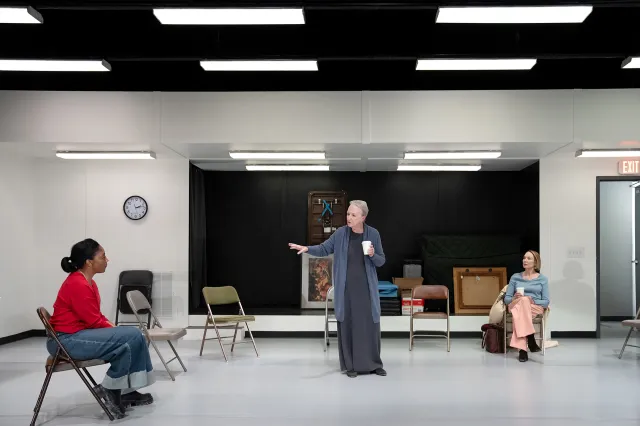
(© Julieta Cervantes)
The Dinosaurs joins an off-Broadway roster of very recent plays that take place in support group meetings (The Fears, someone spectacular, and The Voices in Your Head come to mind). In this case, Jacob Perkins’s group of choice is Saturday Survivors, a community of female recovering alcoholics, who recently voted to eliminate men from their ranks. The play follows the structure of a meeting, complete with setting up the chairs and putting out the Dunkin’ boxed coffee. The support group genre offers a particular challenge because the play’s exoskeleton is already in place: with the timer running, how do you make the play go beyond padding out the structured minutes of the agenda?
Perkins has a sort-of solution. In counterpoint with the regimented three or five-minute testimonies from individual women, The Dinosaurs bends away from linear storytelling, interspersing moments from past or future meetings, or jump-cutting to years ahead. In Les Waters’s low-key production, part of Playwrights Horizons’ new cost-saving “Unplugged” initiative, there are no light or sound cues to indicate these leaps, but the subtlety of these moments undercuts their impact. With the timeline’s curves too sinuous to graph, it’s difficult to locate the point, if there is one beyond dramatizing how sustaining sobriety can feel cyclical or eternal.
Perkins’s time-travel device is most expressive when explicit. In one gently harrowing sequence, Elizabeth Marvel’s Joan introduces herself over and over by sharing how many days she’s been clean, while the play seemingly snaps from meeting to meeting. The number of days diminishes as she struggles more and more to extend her sober streak. Joan has seemed to be the most committed to the rules, the most tightly wound of the women, and this tour through her timeline reveals her vulnerability by zooming out. It’s the rare moment that the play’s hazy structure sharpens its characters.
But for the six women at the meeting, and especially for the audience, the outside world never really threatens to intrude meaningfully. One woman struggles with her son’s sexuality. Another may have transgressed mightily and slept with an underage student. But because we never have a solid sense of where we are in time — the monologue we just heard could already be a decade old — it’s safest to worry about the women only in the context of their unflappable support group. Since The Dinosaurs strips its characters of everything but their relationship to addiction and to the community that helps them fight it, there’s not much chance to get to know them.
Fortunately, the cast anchors the production with some of the detail that the script withholds. The play’s early humor stems from each actor’s crisp naturalism as the group navigates crosstalk and coffee stains, alliances and hostilities breaking out in miniature across the conversation. Kathleen Chalfant’s firm, forgiving Jolly is the group’s beloved sponsorship coordinator. Keilly McQuail’s ferally anxious Rayna is the newest recruit, hovering terrified on the threshold. And though April Matthis brings her expected trenches of feeling to Jane, who always arrives first, she’s done dirtiest by the play. The group literally runs out of time for Jane to share, so whatever’s behind the extraordinary flashes of untilled sorrow in her eyes stays secret. The near-identical character names, which include Jane, June, Joan, and Joane, are indicative of Perkins’ several pseudo-absurdist gestures that make the play harder to follow without clarifying the tone.
The Dinosaurs never fully probes the fascinating contradiction at its core. The rules of Saturday Survivors are rigid and sometimes coldly impersonal, as if beyond the control of the members who impose them, but it’s also that staunch sense of unbreakable ritual that holds the women together and ensures they come back.
“She knew she was in trouble whenever she thought she could do this on her own,” Joan shares about another member. “This ability to say ‘I need you’ … it’s the only thing that keeps me going.” Perkins convincingly makes the case that support groups like these can be lifelong life rafts for the people that need them, but, when it comes to his audience, The Dinosaurs runs out the clock without welcoming us in.




Featured In This Story
Latest Reviews
See all
Latest Videos
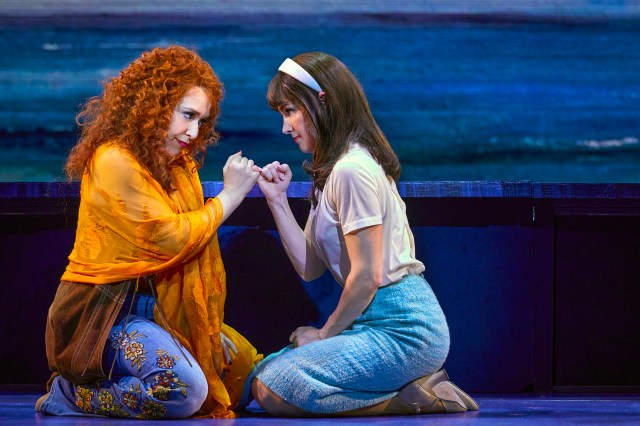
Watch Jessica Vosk and Kelli Barrett Sing a Song From the Upcoming Broadway Musical Beaches
Broadway performances start on March 27 at the Majestic Theatre.