
Review: Stereophonic, Now on Tour, Is Not Not About Fleetwood Mac
David Adjmi’s Tony Award-winning play lays its tracks across the country.
 |
Los Angeles
|
|
Los Angeles
|
December 16, 2025
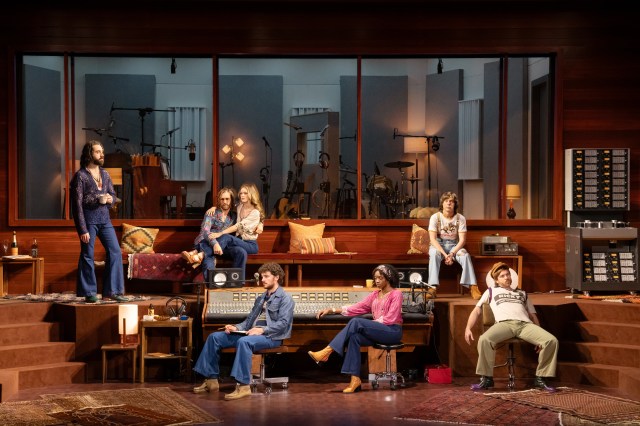
(© Julieta Cervantes)
ABBA, The Mamas and the Papas, Fleetwood Mac: the recording industry has a long history with bands in which married couples fracture even as they create art that endures long after the dust has settled. During the mid-’70s, an unnamed band spends a year recording an album, but nerves fray and relationships fragment due to clashes between married couples Peter and Diana (Denver Milord and Claire DeJean) and Reg and Holly (Christopher Mowod and Emilie Kouatchou). Drummer and band founder Simon (Cornelius McMoyler) must referee, dragging two inexperienced engineers (Jack Barrett and Steven Lee Johnson) into the proceedings. Drugs, alcohol, passive-aggression, and petty competition rip this dysfunctional family apart just as they’re on the precipice of worldwide fame.
Stereophonic, the national tour of which is now at the Hollywood Pantages Theatre, is a raw look at the mechanics of nurturing talent without allowing human nature to screw things up. Writer David Adjmi brilliantly dramatizes the grind of assembling an album. We see the evolution of a song, the dynamics of layering the vocals to the music, and the painstaking drudgery of each member fighting for their vision.
The cast is transcendent. DeJean progresses through the night from a shy extension of her husband into a proudly independent and often combative artist. Milord threads Peter’s passive-aggressive arguments with such persuasion that it’s easy to see how his character has managed to maintain command for so long. Kouatchou’s seductive monologue about Nicolas Roeg’s film Don’t Look Now electrifies her performance.
Mowod, as the prodigy on a drug-fueled self-immolation, is heartbreaking and yet touchingly funny, finding insight within a clouded mind. Johnson is hilarious as the naive junior engineer whose name can never be remembered, bouncing off Barrett’s brash performance as lead engineer Grover, who faked his résumé and is now undergoing trial by fire. McMoyler, who appears on the fringes for most of the play, kills with his final scene, extinguishing the combustion that’s destroying the band even as it powers its artistic output.
The play provides snippets of the band’s album, and the original songs by Will Butler of Arcade Fire reverberate with a ’70s album rock bravado that effectively communicates why the kids in this studio are about to become megastars.
Director Daniel Aukin gives the cast breathing room, allowing emotions to linger. Silence is deployed for both comic effect and dramatic tension. Scenic designer David Zinn’s studio has an authentic feel and captures the technology of the 1970s while giving the characters multiple spaces in which to interact. Enver Chakartash’s costumes—bell-bottomed jeans, relaxed button-down shirts, and peasant blouses—set the vibe perfectly, backed by Robert Pickens and Katie Gell’s hair and make-up. Ryan Rumery’s sound design presents the music through playbacks, tape recordings and live performances that effectively illuminate the band’s artistic progression.
Adjmi and Aukin have reproduced the intimate mood of a Robert Altman movie onstage, a lived-in quality in which people talk over one another as we eavesdrop, silent witnesses of how human frailty can easily take everything away.




Featured In This Story




Latest Reviews
See all
Latest Videos
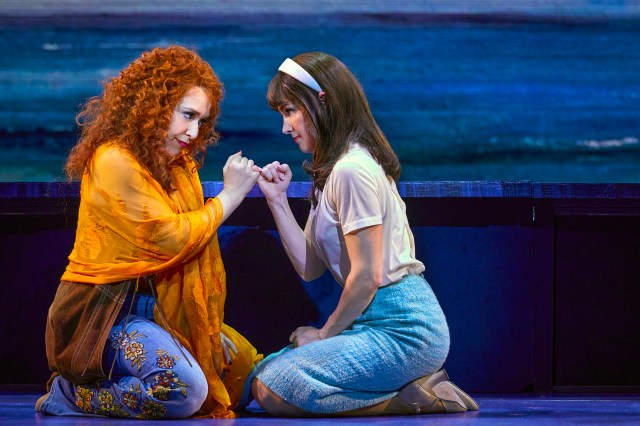
Watch Jessica Vosk and Kelli Barrett Sing a Song From the Upcoming Broadway Musical Beaches
Broadway performances start on March 27 at the Majestic Theatre.