
Review: Every Step Has Meaning in Anne Gridley’s Watch Me Walk
The Soho Rep production is currently running at Playwrights Horizons.
 |
Off-Broadway
|
|
Off-Broadway
|
January 26, 2026
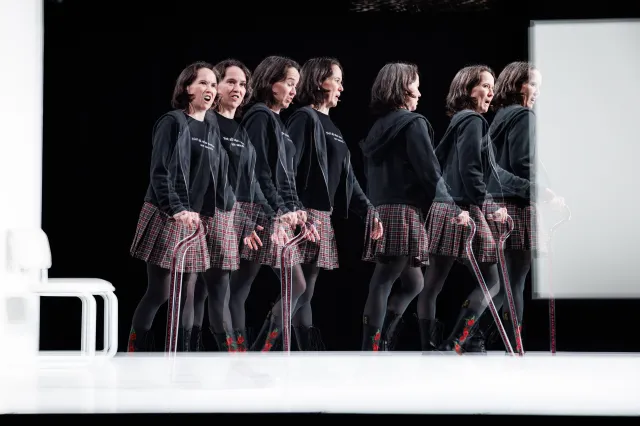
(© Maria Baranova)
“I’m climbing on a ladder and it’s making you feel nervous,” sings Anne Gridley, “and, yes, that is the point.” Gridley, a performance artist with a long history of experimental theater, isn’t hiding her disability in Watch Me Walk. She’s not interested, as she calls it, in “pulling an FDR.”
But she’s asking audiences not to hide their anxiety or discomfort about her body, either. She creates ample space for audience members to consider their own thoughts and reactions in counterpoint with her performance. For many minutes at the top of Watch Me Walk, the title says it all: Gridley, after introducing herself, uses her walking stick (she disdains the word “cane”) to travel lap after lap back and forth across the length of the stage, more or less in silence. Gridley, we learn, has a type of hereditary spastic paraplegia, a rare, degenerative genetic condition that impacts mobility.
In a Soho Rep production (which presents this show with the now-concluded Under the Radar Festival) replete with mesmerizingly repetitive stage behavior, this walk might be the most successfully radical of them all. The sense that we’re waiting for something to happen fades away eventually—at best, we get bored by how utterly ordinary this perambulation is. Why should we be fascinated by another human walking?
At the same time, though, Gridley’s life with a disability isn’t ordinary. Not when researchers show extraordinary disinterest in studying “orphan diseases” like hers (cue the Little Orphan Annie costume) that don’t affect enough people to garner funding or attention. And certainly not when she’s constantly coming up against extraordinary doubt and belittlement from people who question her capacity. She claims it’s her own internal bully who’s leading the charge. “I’m the biggest ableist of them all,” she belts in one of the show’s handful of ebulliently ironic musical numbers (written with Noah Lethbridge) and shared with a pair of apparently able-bodied backup singers (Alex Gibson and Keith Johnson) in short-shorts.
Gridley’s takedown of ableist rhetoric, especially when it comes from medical professionals who ought to know better, finds her humor at its most biting. A physical therapist, she shares, once told her to smile more when she walks: “It was a woman so I didn’t punch her in the face.”
Once she’s acclimated us to seeing her body in action, Gridley navigates a series of piercing vignettes to reveal herself further. She responds to a Q&A with an unseen voice about navigating disability, including her catalog of bedazzled walking sticks (“I’m the Imelda Marcos of mobility”) and her thoughts on health insurance (“Viva Luigi!”).
Dressed later in a tentacled costume as “Dum-Dum, Anne Gridley’s degenerating motor neuron,” she delivers a slideshow interrogating her family history to understand “Whose Fault Is It Anyway?” That’s a genetic question but also a psychological one: her mother, who had the condition too, told her she regretted giving birth when Gridley was diagnosed as an adult.
Under Eric Ting’s light-touch direction, each of these sequences builds gently to the show’s finale, save for a less engaging monologue in which Gridley’s childhood duck, Ping (Gibson), explains her neurological function at the cellular level. Jian Jung’s seemingly simple set reveals some fun surprises.
Ultimately, it’s Gridley’s wry, warm delivery and her oft-mischievous grin—she opens the show in a shirt that reads “Look out, it’s contagious!”—that allows her to bring the storytelling to very dark places and then lead us back to the light.
Early on, Gridley purposefully falls down, then challenges the audience to ask her if she needs help and to accept her saying no. When she falls again, during a dance sequence movingly intertwined with the story of her mother’s death, we’ve learned to trust her. She’s got this, obviously, and she’s got us where she wants us now, too.




source on Google
Featured In This Story
Latest Reviews
See all





Latest Videos
Watch the Trailer for Elsinore Starring Andrew Scott
The film is based on the true story of Ian Charleson, who played Hamlet at London’s National Theatre after being diagnosed with AIDS.