
Review: Laowang Cooks Up a Shakespearean Tragedy in Chinatown
Primary Stages presents the world premiere of Alex Lin’s striking Chinese riff on King Lear.
 |
Off-Broadway
|
|
Off-Broadway
|
November 17, 2025

(© James Leynse)
The inspiration for Laowang couldn’t be clearer, since it’s subtitled A Chinatown King Lear, with “laowang” Chinese for “old king.” Some of the fun of this new play lies in seeing the ways playwright Alex Lin has transposed the characters and plot points of William Shakespeare’s classic tragedy to New York City. But thankfully, Lin’s play, making its world premiere via Primary Stages, has enough of a distinctive profile to stand on its own.
Margaret Choy (Wai Ching Ho)—referred to throughout the play as A-Poh, the Chinese term for maternal grandmother—is Laowang‘s Lear equivalent. She’s the owner of China Bull & Bear, a long-running restaurant in Chinatown that has been closed for a few months at the start of the play. Real-estate developer Wesley Chiu (Daisuke Tsuji), who worked as a dishwasher there as a kid, is angling to buy the building and redevelop it into condos and a museum commemorating the restaurant. The ever-prideful A-Poh plays hardball with him in negotiations, suggesting a counteroffer far above Wesley’s initial pitch.
Even before the deal has been finalized, two of A-Poh’s three grandchildren see dollar signs in their eyes. Both Amy (Cindy Cheung) and Steven (Jon Norman Schneider) have long since moved away from New York, with only Lai-Fa (Amy Keum) still living near A-Poh. The heated exchanges all three of them have with each other throughout suggest a host of familial resentments. To Amy and Steven, Lai-Fa was clearly A-Poh’s favorite, since she was spared the ill treatment they received from her when they both worked at China Bull & Bear as children. Thus, they are especially driven to snatch power of attorney over the restaurant for themselves while Lai-Fa desires to keep the establishment. Wesley, additionally motivated by personal reasons revealed later in the play, manipulates these tensions for his own gain.
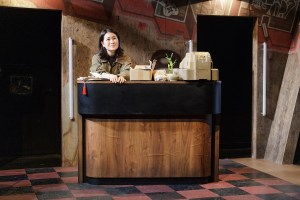
(© James Leynse)
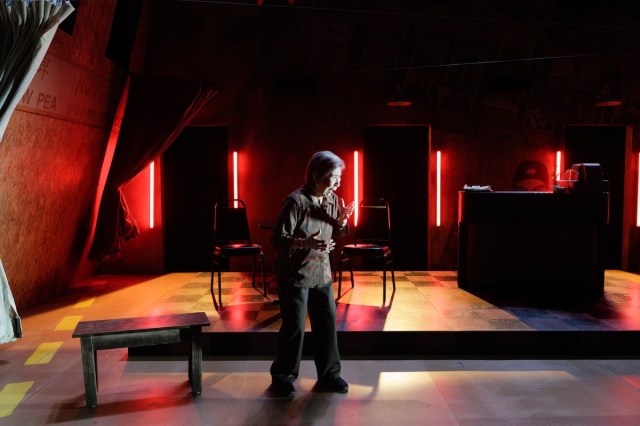
If we consider these characters in the shadow of King Lear, Amy and Steven are the conniving Goneril and Reagan to Lai-Fa’s devoted Cordelia, with Wesley roughly standing in as its Edmund equivalent. And as with Lear, A-Poh is stricken with a madness of her own, diagnosed here as dementia. However, A-Poh’s mental decline is used as a pretext to offer glimpses into her past: the beginnings of her life in New York as an immigrant from Hong Kong; the scrappy genesis of her restaurant, and the ruthlessness with which she ran her business, including firing her head chef and replacing her with young Steven. (Cheung, Schneider, Keum, and Tsuji all double as an array of additional characters, with Cheung playing a younger version of Margaret and Schneider playing her late husband Jeffrey.)
It’s in these flashbacks that the cultural specificity of Lin’s riff on Shakespeare shines through most brightly. Through them, we see glimpses of an immigrant who felt a need to risk forsaking her Asian identity, including adapting Chinese cuisine in her restaurant for American palates, to survive amid the dominant white culture. That hardly excuses the shortcuts she took, including using free child labor, to maximize profits. As objectionable as some of the behavior is, though, Lin always takes care to make their motivations understandable. She also brings refreshing glints of raucous humor to the proceedings; some of Wesley’s methods of manipulating both Amy and Steven are memorably, hilariously bawdy in nature.
(© James Leynse)
Sharp performances help bring out the standout personal qualities in Lin’s writing. As the resentful Amy and Steven, Cheung and Schneider attack some of Lin’s funnier lines with screwball gusto, while Keum radiates innocence and concern as the devoted Lai-Fa. Tsuji smartly downplays Wesley’s villainy, thereby allowing the play’s inner concern with the perils of gentrification to come through lightly yet unmistakably. And Ho brings a balance of warmth and arrogance to A-Poh that makes the character magnetic even at her most imperious.
Joshua Kahan Brody’s direction keeps the play’s mix of comic and tragic tones nicely in fulcrum. Wilson Chin’s scenic design cleverly uses curtains to indicate A-Poh’s dementia-induced flashback episodes, as does Reza Behjat’s lighting design. Costume designer Tina McCartney makes sure to clothe the characters in outfits appropriate to their personalities and cultural identities. Sound designer/composer Nicholas Drashner uses whispers at one point to hauntingly evoke A-Poh’s addled mental state.
Laowang is the first of two plays by Alex Lin this season, the second being Roundabout Theatre Company’s upcoming production of Chinese Republicans. This affecting King Lear variation suggests she has a genuinely fresh perspective—warm and wise but also tough-minded and wickedly funny—to bring to depictions of the Asian-American experience in theater.




Featured In This Story
Latest Reviews
See all

Latest Videos

Watch the Trailer for the Stranger Things Series Finale
The final season of Stranger Things is giving a box office boost to Stranger Things: The First Shadow on Broadway.