
Review: Let's Make Amahl and the Night Visitors a Holiday Staple Again
Lincoln Center Theater, in association with the Metropolitan Opera, revives Gian Carlo Menotti’s once-popular nativity opera in a new production featuring Joyce DiDonato.
 |
Off-Broadway
|
|
Off-Broadway
|
December 18, 2025

(© Julieta Cervantes)
There are a few pop-culture perennials to expect every holiday season. Charles Dickens’s A Christmas Carol is the most enduring of all (represented by two off-Broadway adaptations this month). But also, television networks will air It’s a Wonderful Life, A Charlie Brown Christmas, A Christmas Story, and Home Alone for the umpteenth times. And that debate over whether Die Hard is a Christmas movie will continue with no end in sight.
Back in the 1950s, there was another tradition, at least for a few years: Amahl and the Night Visitors, a short English-language opera by Italian composer Gian Carlo Menotti that premiered on NBC in 1951 and was a staple on the network until 1966. Notwithstanding one NBC revival in 1978, though, it has mostly fallen out of public consciousness. Lincoln Center Theater’s new production of the work, then, is of some significance. Thankfully, the interest is more than just historical.
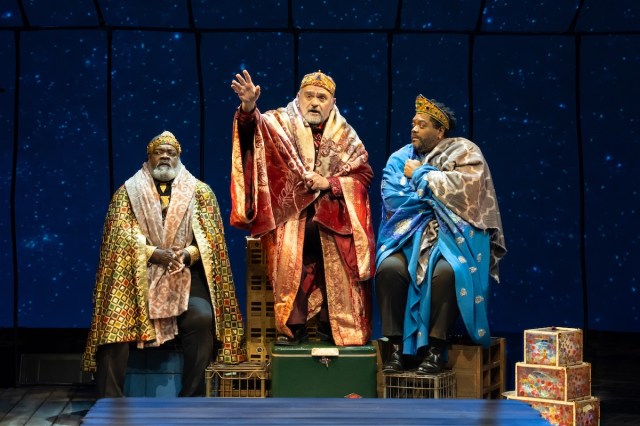
Young Amahl (Albert Rhodes, Jr.) lives with his mother (opera star Joyce DiDonato). Though he can’t walk without a crutch, and though he and his mother live in poverty, Amahl still sustains himself with his active imagination, a fact that occasionally exasperates his constantly worrying mom. But one of his tall tales turns out to be true: not only the bright star he sees one night, but the three kings who subsequently come to their door. They are the Biblical Magi, Kaspar (Bernard Holcomb), Melchior (Todd Thomas), and Balthazar (Phillip Boykin), stopping at their place on the way to see the baby Jesus. They bear gifts, including gold, which tempts Amahl’s long-suffering mother until she breaks down and tries to steal it. Though the kings’ page (Johnathan McCullough) catches her, Amahl’s impassioned defense of his mother leads King Melchior to allow her to keep it. When the mother refuses and admits she has no gift of her own to offer Jesus, Amahl offers up his crutch, which leads to the opera’s climactic miracle.
(© Julieta Cervantes)
Amahl and the Night Visitors is Menotti’s version of a nativity play. But as with the best holiday fare, there’s plenty for non-religious audiences to enjoy. There’s Menotti’s score, for one thing: Though it’s slightly disappointing to hear a two-piano-plus-oboe reduction instead of the composer’s lush full-orchestral arrangements, the score’s Puccini-like tunefulness still comes through beautifully (Nathaniel LaNasa and Riko Higuma are the pianists, Jesse Barrett the oboist, all led by music director Steven Osgood).
Its depiction of poor characters struggling to maintain their dignity draws real blood: DiDonato uses her rich mezzo-soprano voice to potently convey the mother’s desperation, with Rhodes offering a heartening contrast with his seemingly boundless optimism. A midpoint scene in which a bunch of their neighbors swing by to offer the kings gifts and entertain them with dance (choreographed by Ioana Alfonso) acts as a balm of joyful shared humanity amid troubled times.

(© Julieta Cervantes)
Director Kenny Leon has stealthily brought the opera into modern times with a few judicious choices in casting, performance, and design. His most noteworthy intervention is in not only casting a young Black performer as Amahl, but in changing the racial makeup of the three kings from two white men and one Black man to two Black men and one white man. Accordingly, Amahl’s observation to his mother in Menotti’s original libretto that “one of them is Black” has been tweaked for this production to “one of them is white.” And at the end, Leon has Amahl and the Magi embrace each other with hand gestures—a fist bump here, a dap there—that come off as contemporary and race-specific.
Derek McLane further unmoors the production from specificity of time and place with his scenic and projection design: the scaffolding of Amahl and his mother’s house stands before a backdrop full of stars until the sun rises at the very end. And Emilio Sosa emphasizes the vast differences between the working class and royalty in his costume design, with the kings donning colorful, luxurious robes compared to the rest of the cast’s dirtier, rougher attire.
Though Menotti was a popular composer during the ’40s and ’50s—his operas The Consul and The Saint of Bleecker Street, for instance, not only won Pulitzers, but also found success on Broadway—by the ’60s his reputation was starting to wane, his tonal style falling out of favor with more progressive-minded critics. Whether this mounting of Amahl and the Night Visitors represents the beginning of a general reassessment of Menotti’s nearly forgotten oeuvre remains to be seen. At the very least, though, this charming production makes a solid case for re-establishing Amahl and the Night Visitors as a holiday staple.




source on Google
Featured In This Story

Latest Reviews
See all









Latest Videos

Watch the Trailer for Elsinore Starring Andrew Scott
The film is based on the true story of Ian Charleson, who played Hamlet at London’s National Theatre after being diagnosed with AIDS.