
Review: Kramer/Fauci Unearths a Significant Exchange about the AIDS Crisis
Daniel Fish presents a staging of a 1993 discussion between Larry Kramer and Anthony Fauci at NYU Skirball.
 |
Off-Broadway
|
|
Off-Broadway
|
February 17, 2026
(© Maria Baranova)
Oh, to return to the relatively sedate, normal politics of the 1990s, when America was on a victory lap following the fall of the Soviet Union and most debates were between the center left and center right—over tax policy. As an elder millennial, I have often been seduced by the delusion expressed in the previous sentence. So, I’m glad there are artists in the theater like Daniel Fish, eager to review the evidence and disabuse me.
His new project at NYU Skirball, Kramer/Fauci, lifts its script entirely from a November 1993 joint appearance on C-SPAN by the playwright-turned-AIDS activist Larry Kramer (Thomas Jay Ryan) and the longtime director of the National Institute of Allergy and Infectious Diseases, Anthony Fauci (Will Brill). This is decades before the Covid pandemic, when Fauci would become a living saint for half the country and Satan himself for the other half. Back then, he was tasked with facilitating communication between scientists and political leadership while securing and allocating funding for AIDS research. But with the AIDS crisis in its 12th year and the annual death toll still rising, Kramer is obviously displeased with Fauci’s politely bureaucratic approach.
“Every time Tony wants to go to the toilet, 10 committees have to vote about giving him permission,” Kramer states bluntly, his playwright’s intuition telling him that a little vulgarity is just the thing to break through C-SPAN’s soporific forcefield. Fauci is clearly listening: When Kramer says that Fauci’s “hands are tied,” the doctor reflexively unclasps his hands from behind his back, eager to show that he’s not like all the other public health bureaucrats.
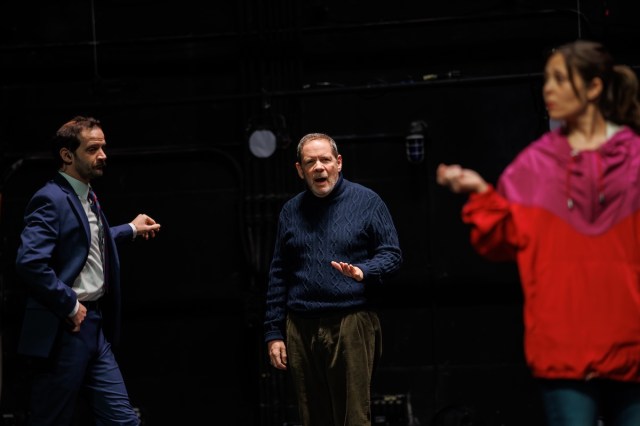
Brill perfectly captures Dr. Fauci’s muted Brooklyn cadence, a controlled diction that mirrors his emotional restraint. No matter the insult or outrage Kramer throws at him, he responds with measured words and a gentle smile, and this only serves to further infuriate Kramer.
(© Maria Baranova)
“Tony, if you start that business about science isn’t done that way, I’m gonna come on there and slap your face,” Kramer interrupts. Ryan stalks the stage like an irritable gay panther, his tense shoulders a vacuum-sealed lid on his rage. When unleashed, it is incandescent, and reasonably so. Kramer has seen hundreds of friends and acquaintances die over the previous decade, and it has convinced him that the government’s inaction is part of an intentional “genocide” of gay men and other undesirables disproportionately affected by HIV. Nothing short of emergency powers, treating AIDS with the same priority Washington would give a war, will satisfy him.
Kramer’s repeated use of the phrase “emergency powers” made me think about the extraordinary measures our government took in response to Covid, and how a succession of crises (including 9/11 and the 2008 crash) and Congress’s panicked response to them has helped to create the imperial presidency that today menaces both Greenland and Minnesota. Once the Golem is created, can we be certain it won’t turn on us? I wondered how often Kramer’s words rang through Fauci’s head in the ensuing years, and how pressured he felt to get it right this time in 2020.
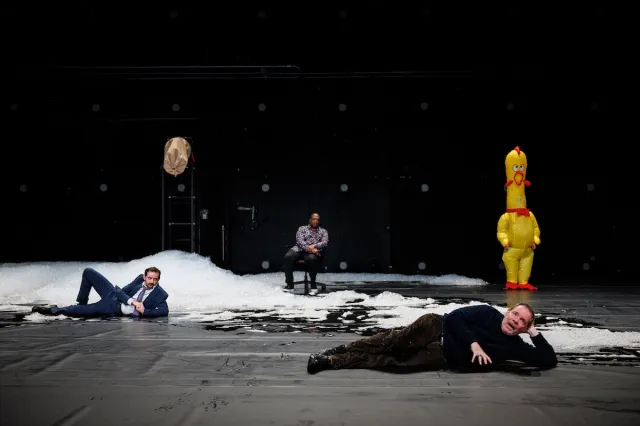
Fish gives us space to contemplate with an extended interlude, during which a machine spews soap suds, creating a mountain of lather that expands across the empty stage (this is the largest element of the otherwise minimal scenic design by Jim Findlay, Josh Higgason, and Amy Rubin). Brill and Ryan trudge through the bubbles as they debate, their costumes dampening (Terese Wadden outfits Fauci in an inexpensive business suit, while the navy sweater she has selected for Kramer gives him a monkish quality). The fluffy creeping metaphor slowly dissolves throughout the second half of the play, leaving Kramer to angrily mop up what’s left.

(© Maria Baranova)
Fish’s other directorial flourishes (at one point an actor appears in an inflatable chicken suit) are more baffling, but at least they provide comic relief to an otherwise grim discussion.
Greig Sargeant plays the moderator, without fail reining it back to baseline C-SPAN whenever Kramer reaches for the operatic. Jennifer Seastone plays all the callers, masterfully filtering various regional dialects through that aggressively sober tone. Somehow, the suggestion that “alternate lifestyles” are to blame for HIV is even more enraging when expressed dispassionately (something for today’s rightwing influencers to consider). We can feel the fury radiating from Ryan’s eerily still body at in these moments.
Kramer’s otherwise uncompromising posture make his few moments of grace even more notable. “I want to say something about Tony Fauci because I think the world must think I hate him or something,” the playwright says, as we in the audience hold our breaths, “He is a man, an ordinary man who is being asked to play God and he is being punished because he cannot be God. And that is a terrible situation to be in, to be the lightning rod for all of us.”
It’s a role Fauci would again find himself playing in 2020, the year that Kramer died, from pneumonia, at the age of 84. Channeling our rage at an individual is much easier than considering the vast system in which that individual functions. Even in our allegedly post-Christian society, we’re still searching for someone to die for our sins. It’s hard not to admire Fauci for showing up to be crucified.




Featured In This Story

Latest Reviews
See all



Latest Videos

Watch Jessica Vosk and Kelli Barrett Sing a Song From the Upcoming Broadway Musical Beaches
Broadway performances start on March 27 at the Majestic Theatre.