
Interview: John Douglas Thompson Charts a Path Between Hedley and Lear
Thompson discusses his current project, Seven Guitars, and his upcoming one, King Lear.
 |
Off-Broadway
|
November 19, 2026
“John Douglas Thompson is the best Hedley I’ve ever seen,” Constanza Romero–August Wilson’s widow–told me as we ran into each other at Lincoln Center right before I was going to see Thompson in Seven Guitars at the Newhouse. Of course, she was right.
Over the past 25 years, Thompson has been the highlight of many shows, earning raves and awards for such plays as Satchmo at the Waldorf, Endgame, The Emperor Jones, The Iceman Cometh, and Wilson’s Jitney, for which he earned a Tony Award nomination.
TheaterMania recently spoke to Thompson about his love of Wilson’s work, how he approached the difficult role of Hedley, and his respect for director Ruben Santiago-Hudson.

(© Tricia Baron)
This interview has been condensed and edited for clarity.
You once said you would never have considered acting if you hadn’t seen Joe Turner’s Come and Gone when you were 29. What was it about that play that moved you to change your world?
Honestly, I hadn’t seen many plays in my life before then. When I was going to see Joe Turner I had no idea what I was getting into. I was just trying to impress my date—who didn’t show up—by going to the theater. The central thing that struck me about the play was how August centralized characters who were marginalized. I saw people I know and who represented my legacy and ancestry. It was like being baptized. More importantly, it became a whole paradigm shift for me, so I decided to study acting.
We’re not given that much information on Hedley’s past. Did you create your own complete backstory for him?
Yes, I wanted to create a backstory, but one that is based on what August provides in the play. I think there is a running theme in August’s work about the relationship between fathers and sons, so I built my characterization on the central trauma in Hedley’s life: how he thinks his father stole money from him, and how he’s tried to heal himself from that trauma. I think Hedley’s journey is all about closure, and wanting forgiveness and to be forgiven. I also think is Hedley is like a lot of people walking around who suffer from trauma, yet we don’t pay attention to them. As Arthur Miller wrote in Death of a Salesman, attention must be paid.
I really believed all of you on stage had known each other for years, even though you’ve only worked together for a few weeks. How did you all make that happen?
I credit Ruben for that. He is always unlocking keys and bringing August into to the room based on their history. Ruben is both quite intellectual and spiritual, and what he does so well is to have each actor make a personal connection to his or her role and then, after that, make sure we create relationships with the other actors. I’ve met or worked with most of this cast before, but I feel like I knew everyone intimately after our second week and that allowed us to build a greater history with each other. As a result, we are all enjoying being out there every performance and creating this idea of community.
You’ll be playing King Lear for Theatre for a New Audience early next year. Is there a relationship between August Wilson and William Shakepeare?
Absolutely. Doing Shakespeare has prepared me for August, and vice versa. Both write larger-than-life characters with plots that resemble Greek drama. I think August’s work may be harder and more complex than doing Shakespeare, because Shakespeare’s poetry is not how real people speak, but people do speak like August’s characters.
Since I am doing Lear next, I do spend time thinking if there are similarities between Hedley and Lear. They’re both howling in the wind in some ways. And they both end up at some point with this feeling of powerlessness. I am trying to figure out how I can transfer those feelings from one character to the other.
You told me you’d be happy the rest of your life only doing August Wilson and Shakespeare plays. But what’s left in Shakespeare once you’ve played King Lear?
I can still do some of the comic roles like Falstaff and Malvolio. Just once I’d like to laugh my way through a curtain call.
Finally, what’s it like being married to Audra McDonald on The Gilded Age?
One of the great honors of my time as an actor is playing her husband. She is fascinating, elite, tasteful; she is the epitome of Black excellence. But working with her, you also realize how down to earth and funny she is. Audra has made this experience so joyful for me, and I’m truly grateful.
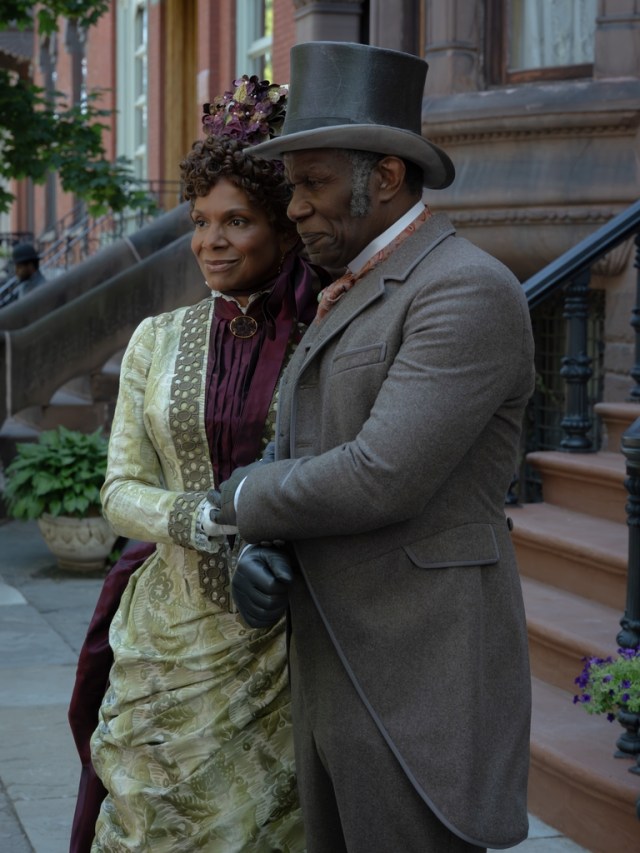
(© Karolina Wojtasik/HBO)




source on Google
Featured In This Story

Latest Reviews
See all






Latest Videos
Watch the Cast of Benjamin Button Sing "When E're She Looked at Me"
The musical is currently running at the Public Theater through December 20.