
Interview: Ben Levi Ross Finds the Fire in Ragtime’s Younger Brother
The actor delves into the the modern echoes of Ragtime and the catharsis of performing a revolution every night.
 |
Broadway
|
|
Broadway
|
November 6, 2025
When Ben Levi Ross first stepped on stage in the New York City Center gala revival of Ragtime in 2024, he didn’t really know much about the show beyond its sweeping score by Lynn Ahrens and Stephen Flaherty. But he’s managed to find surprising resonance in the disaffected rich kid he plays—Mother’s Younger Brother—one whose political awakening throughout the course of Terrence McNally’s prescient script feels eerily contemporary.
In this conversation, Ross (previously seen in Dear Evan Hansen and The Connector) unpacks the yearlong evolution of his take on Younger Brother, the strange parallels between 1905 and 2025, and what it’s like to perform a show about a fractured America within our deeply fractured America.

(© Matthew Murphy)
This conversation has been condensed and edited for clarity.
How well did you know Ragtime going into this process?
A little bit. City Center was the first time that I really sat and read the actual script. There’s something about the music of Coalhouse and Tateh and Mother that, if you’re listening to it, you can sort of familiarize yourself with what’s happening in their lives. Whereas Younger Brother, even though there’s that narration in “Night That Goldman Spoke,” you’re sort of like, “What’s happening here?”
How much of the novel did you rely on?
I read the novel in between City Center and Broadway. Whether or not there are things I took from it that are influencing the actual scene work, it was just really helpful in terms of creating an undercurrent to the person. I feel like a lot of people want to play on his burning desire, his fire, but underneath it all, there’s a little bit of boredom with life. He reminded me of a lot of wealthy people that I grew up with who don’t have to worry about certain financial limitations.
And he goes from disaffected kid to burn it down anarchist.
Something that immediately stuck out to me was that this person reminded me a lot of the young men in America who got radicalized on the internet. There’s this pipeline that pounces on individuals like Younger Brother when he’s at the top of the show. But, instead of having the internet at his fingertips where he very well could have been radicalized into the far-right pipeline, he has Emma Goldman who radicalizes him in a completely different way.
I wanted there to be the biggest tonal change possible in his energy from the beginning of the show to the end. In the whole beginning section with Evelyn Nesbitt, I wanted to play into the dopiness, the horniness, and I wanted to make sure that, in the moment where she rejects him, you see does have that capacity for violence. He joins Emiliano Zapata and commits his entire identity to a revolution in another country. In the novel, he actually dies pretty quickly after that.
Also, there’s a turning point that I’ve been exploring on Broadway, watching Coalhouse and Sarah’s love happen in “New Music.” Coalhouse is showing up over and over, and I wanted it to be clockable that Younger Brother is learning that what he had with Evelyn Nesbitt was strictly desire, not love. “New Music” is the moment where he sees what an actual connection is between two people.

(© Joan Marcus)
This production has lived through such fraught political times, starting with the City Center run during last year’s Presidential Election. How have you sort of compartmentalized it all?
I was a little nervous going into it, honestly, because there was something deep down in me that…I never wanted to voice it, but I sort of felt like…We felt it. And I was like “You are either going to have doing this show feel oppressive post-election, or really lean on the people around you and use it as catharsis.”
Here’s the thing. A lot of theater actors, when something crazy happens in the world that has a tie to the show they’re doing, talk about how therapeutic it was to do it. Honestly, it was depressing. Like, it was really sad. As an actor, did I want to get on stage the next day and perform in front of 2,000 people? Not really. I wanted to stay in my house and play under the covers.
How does it feel now, a year later?
It’s been surprisingly exciting to me. I haven’t done a long run of a show since Evan Hansen; everything else has been two or three months. Getting to the place of “This is what you’re doing, so you better find things that make this interesting to you” has been thrilling. It’s just such good material. I’m hearing things in different ways every night.
Like what?
Younger Brother is one of those tracks where a lot happens kind of solitary. I will say, the fight with Father is so fun to explore every night. It’s the best catharsis of the show.
I led the applause the night for that moment when I saw it.
I have to say, this is not me patting myself on the back, but it pretty much happens every single show. I think it’s emblematic of our times; people are begging for someone to scream at the most belligerent racist. They’re begging for it. It’s fun for me to play. There are some nights where I try it like I’m a bleeding heart, who’s astounded at this person’s inability to see past it. And then, depending on my mood, I can kind of fuck with him a little. There are so many ways that you can go about it.
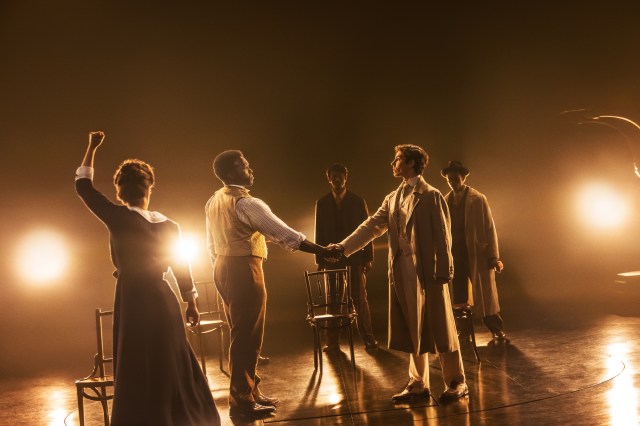
(© Matthew Murphy)




Featured In This Story
Latest Reviews
See all

Latest Videos
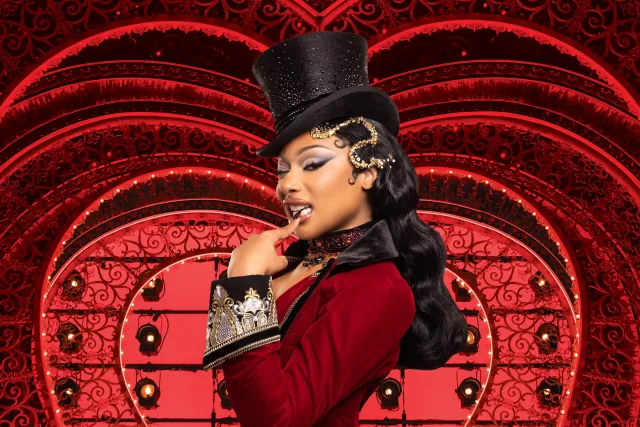
Get a First Look at Megan Thee Stallion as Zidler in Moulin Rouge! on Broadway
Megan Thee Stallion starts performances on Tuesday, March 24.