
Review: Well, I’ll Let You Go Explores the Truth About Death and Marriage
Bubba Weiler’s hit drama gets a remount at Studio Seaview.
 |
Off-Broadway
|
|
Off-Broadway
|
May 14, 2026
(© Emilio Madrid)
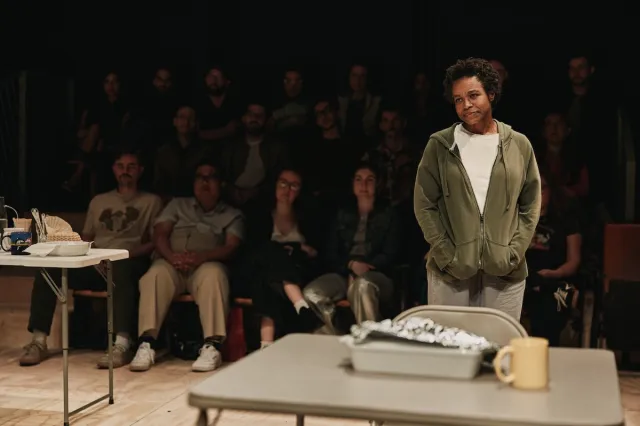
Maggie looks exhausted. Subsisting on a diet of coffee and casserole, she pads between the kitchen table and front door as she entertains a parade of unannounced visitors offering their condolences (and more casserole). Her husband, Marv, is dead. While the neighbors recall a kindly smalltown lawyer who died heroically while charging an active shooter at the community college, Maggie’s memories are more complicated, as is her mourning—not just for a husband, but possibly the myth undergirding their decades-long marriage.
That’s the basic premise of Bubba Weiler’s Well, I’ll Let You Go, which is now playing a return engagement at Studio Seaview following its world premiere in Brooklyn last summer. Featuring most of the original cast, it is still a must-have ticket if you want to see some of the best actors in New York perform a smart and sensitive drama brimming with unexpected humor.
Quincy Tyler Bernstine fully inhabits Maggie, her hunched shoulders and raspy voice conveying both fatigue and admirable restraint. So much of what she leaves unsaid is communicated in her teeth, through grits, grimaces, and the occasional radiant smile. Bernstine paints a vivid portrait of a woman overburdened by regret, grappling with the knowledge that her late husband loved her more than she loved him back (or at least so it seemed) but also with the nagging thought that she denied her own desires in a way that he never did.
(© Emilio Madrid)
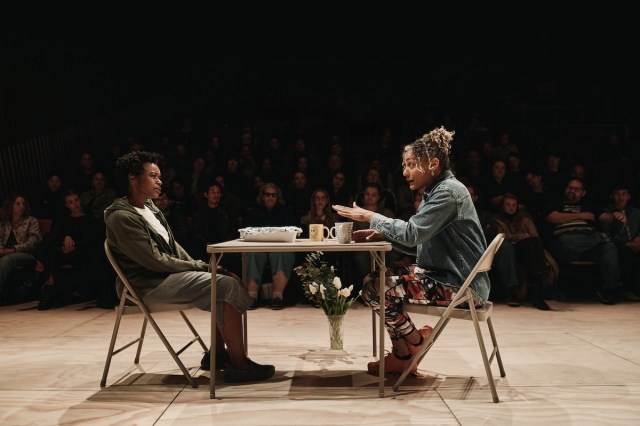
That notion becomes an obsession following a visit from her sister-in-law Julie, whom Amelia Workman endows with genuine sisterly concern that tiptoes up to the edge, and then sneakily leaps over the border of irritation. She questions why Marv was even at the community college when he doesn’t teach there. She also informs Maggie that his Silver Camry was spotted in parking lot of the Planned Parenthood. “You know this is the last thing I need,” Maggie responds, briefly letting her rage explode, “Aside from your fucking flowers this is the last thing I need.”
While it is impossible to know the full truth of a marriage from the outside, Weiler lets us piece it together alongside Maggie through a succession of gripping two-person scenes: We meet Marv’s screw-up cousin, Wally (Will Dagger heartbreakingly captures the furious overcompensation of a middle-aged man who is dependent on others). We also encounter Marv’s brother, Jeff (Danny McCarthy offers us tantalizing glimpses of the little boy hiding beneath decades of male emotional armor). Emily Davis tempers palpable, sweaty anxiety with subtle fortitude as a mysterious woman with secret information. Cricket Brown conveys bracing emotional intelligence through Gen-Z parlance as her daughter. And in the funniest scene in the play, Constance Shulman plays Joanie, a sales rep from a local funeral parlor, beautifully changes keys from comedy and tragedy, never missing a note.
Off-Broadway veteran (but newcomer to this play) Matthew Maher initially seems like the one casting misstep (his role was originated by Michael Chernus). His Our Town-like narration feels unbalanced and goofily removed from the high emotional stakes of the drama. But his performance grew on me as the play progressed, revealing a character who uses humor as a defense mechanism. A late scene when he finally lets his guard down in front of Maggie feels particularly devastating.

(© Emilio Madrid)
Director Jack Serio has reblocked the production for a thrust stage, placing spectators on both sides of the action in addition to the audience in the house (it was previously staged in traverse, with the audience on just two sides). That makes this remounting feel more intimate, like we’re in Maggie’s living room.
Frank J. Oliva’s scenic design still evokes a rehearsal set (complete with mini fridge and coffee station) that gradually transforms into a full production under Stacey Derosier’s gently resolute lighting. Avery Reed’s costumes (the men wear cargo shorts with crocs and socks) undeniably place us in the Midwest. Sound designer Brandon Bulls ensures that every line is pristine (it’s the kind of amplification that you don’t even notice until you see the mics on the actors). And Avi Amon’s original music pulls us into the deep end of Maggie’s grief as she peers toward the horizon of a life without her husband by her side.
A gorgeously written and extraordinarily well-acted new play, Well, I’ll Let You Go doesn’t shy away from the ancient building blocks of great drama, earning more than one collective gasp from the audience as it reveals the messy truth behind a story we think we’ve got figured out. It’s no surprise that Weiler has attracted such superstar stage talent to this script. He understands the itchy complexity of people in a way few of his contemporaries do.




source on Google
Featured In This Story

Latest Reviews
See all










Latest Videos

Watch the Trailer for Elsinore Starring Andrew Scott
The film is based on the true story of Ian Charleson, who played Hamlet at London’s National Theatre after being diagnosed with AIDS.