
Review: The Receptionist, a Bush-Era Workplace Comedy About the Banality of Evil
Adam Bock’s 2007 play receives a new revival starring Katie Finneran.
 |
Off-Broadway
|
|
Off-Broadway
|
May 7, 2026
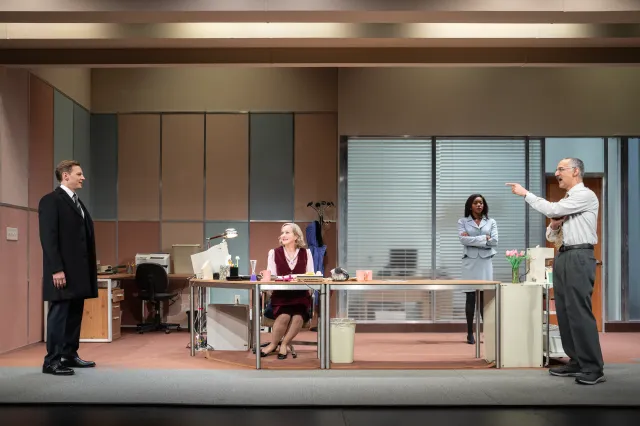
(© Joan Marcus)
Once upon a time, TheaterMania had an office. There was a big, imposing security desk in the lobby that alerted us to guests; we all wore badges that scanned us in and out; and my little corner of the world overlooked Times Square. Corporate sent bagels every Wednesday and wine every Friday; we had meetings in a conference room with a Ping-Pong table. Then Covid happened, and my office became whichever room in the house my kids weren’t in. These days, I could use a receptionist just to warn me that my 4-year-old is en route to demand my attention.
The receptionist is the epicenter of any workplace, the person who knows everything about what’s going on. But how much do they really know, and how much do they choose not to? That question, which echoes Hannah Arendt’s notion of the banality of evil, lurks below Adam Bock’s deceptively simple 2007 play The Receptionist, now receiving its first New York City revival via Second Stage. At once a sharp satire of office life and an unsettling parable about the mundane complicity that allows harm to flourish, Sarah Benson’s take on Bock’s intentionally disorienting script leans into the humor of the quotidian, at the expense of the darker currents peppered throughout.
Bock’s receptionist is Beverly Wilkins (two-time Tony-winning comic genius Katie Finneran), a fastidious whiz at answering phones, ordering birthday cakes, and shredding documents. Beverly has problems of her own—her husband has just spent that month’s phone-bill money on their teacup collection, and their daughter has unspecified social issues—but she’s far more invested in advising her co-worker Lorraine (Mallori Johnson) on how to deal with the ex she just can’t shake. Aside from their boss, Mr. Raymond (Nael Nacer), running conspicuously late, it’s an average day at the Northeast Office.
The play pivots with the arrival of Martin Dart (Will Pullen), a visitor from the Central Office who’s come to question Mr. Raymond about a meeting gone wrong, one Bock obliquely foreshadows in an opening monologue contrasting the cruelty of rabbit hunting with the comparative mercy of bleeding a fish. Despite being nearly 20 years old and having seen notable productions—its New York debut at Manhattan Theatre Club featured Jayne Houdyshell; an LA run put Megan Mullally behind the front desk—The Receptionist remains just obscure enough that to say more would risk spoiling the turn that reshapes what we’ve just watched, and what we’re about to witness.
It’s worth remembering that The Receptionist premiered during the second Bush administration, not long after the American public became aware of the “enhanced interrogation techniques” being used on detainees at Abu Ghraib and Guantánamo in the wake of the September 11 terrorist attacks. Without that context lodged firmly in the cultural consciousness, much of the work’s allegorical aspects have dissipated over time. Benson’s cheerful presentation isn’t nearly as disquieting as it should be, and it never achieves the unnerving potency of Joe Mantello’s original, which felt like a lost episode of The Twilight Zone.
Her cast fares best when navigating the lighter aspects of Bock’s tricksy piece. A prolonged flirtation between Lorraine and Mr. Dart lands beautifully, with Johnson’s expressive body language and Pullen’s politician’s smile instantly drawing us in. Finneran wrings laughs out of everything from sending callers to voicemail to sneaking frosting off a cake, while Nacer brings a disarming warmth to Mr. Raymond.
They’re perfectly outfitted by Enver Chakartash, whose costumes naturally define each character, from Nacer’s ugly, mid-level bureaucrat tie to Finneran’s dowdy wash of purple velvet. Sound (Bray Poor) and lighting (Stacey Derosier) pull off the tonal shifts just as accurately. The set, by the design collective dots, evokes Mad Men, an aesthetic that might land better if the play were set in the 1960s rather than a time not too far from our own.
Seventy-five minutes later, we’re back on the street, left with a light sense of unease and the odd feeling that this Receptionist has been more enjoyable than unsettling. The production percolates along, only gradually alluding toward something darker, but Bock isn’t simply hinting at it. He holds up a mirror, implicating the ways we individually and collectively look away from injustice when it becomes convenient. Benson’s staging shares in that avoidance; what once left me shaken now only left me mildly stirred.




source on Google
Featured In This Story

Latest Reviews
See all









Latest Videos
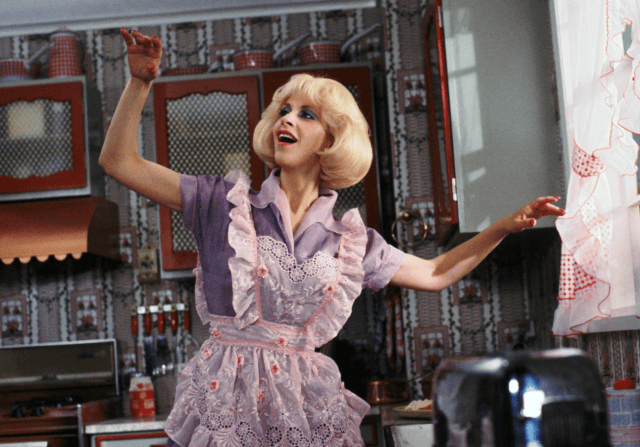
Watch: Ellen Greene Reflects on the Enduring Legacy of Little Shop of Horrors
Frank Oz’s cult classic movie-musical has gotten a new 4K restoration in celebration of its 40th anniversary.