
Review: London Hit Cable Street Thrills, but Rarely Steps Out of Hamilton’s Shadow
After sold-out runs in the UK, this new musical makes its off-Broadway debut.
 |
Off-Broadway
|
|
Off-Broadway
|
May 4, 2026
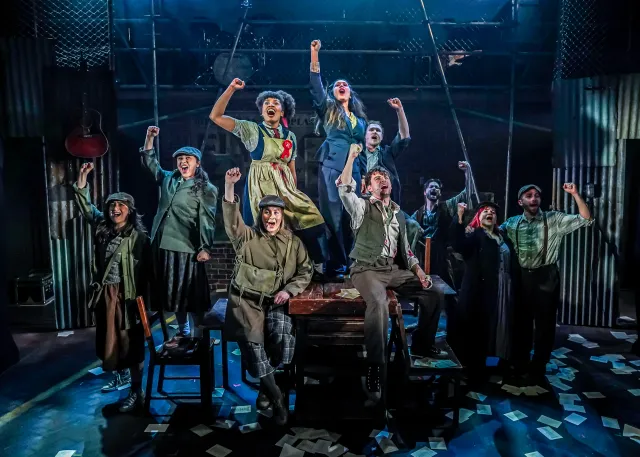
(© Carol Rosegg)
If a legacy is planting seeds in a garden, as Lin-Manuel Miranda once wrote, then the trees inspired by Hamilton are beginning to bear fruit a decade later, for better or worse. The latest show that owes a clear debt to the Miranda-pioneered genre of hip-hop history musicals is Cable Street, a sold-out London hit now making its American debut at 59E59. A story of solidarity against encroaching fascism in 1930s Britain, Cable Street has genuine moments of greatness, but remains too reliant on emulating its forebears to forge its own identity.
With music and lyrics by Tim Gilvin and a book by Alex Kanefsky, the musical dramatizes the 1936 Battle of Cable Street, when 100,000 anti-fascist demonstrators—Jews, Irish Catholics, dockworkers, seamen, communists, and union laborers—joined forces to block Oswald Mosley’s British Union of Fascists from marching through London’s East End. Anticipation for the production was so strong that its 2024 run at Southwark Playhouse sold out before previews began; this Brits Off-Broadway engagement follows a subsequent run at the Marylebone Theatre, a relatively new company known for Jewish-themed programming like Yentl, The Wanderers, and What We Talk About When We Talk About Anne Frank.
Cable Street is built around three fictional protagonists, neighbors in the same tenement: Sammy (Isaac Gryn), a Jewish would-be boxer caught between the wider world and his family’s Orthodoxy; Mairead (Lizzy-Rose Esin Kelly), an Irish baker drawn into the local communist party; and Ronald (Barney Wilkinson), jobless and dealing with an alcoholic mother. Their stories converge as the community mobilizes to fight back against Mosley’s thugs, who seduce Ronald with their promise of making England great again. A framing device places a contemporary tour guide (Jez Unwin) and an American tourist (Debbie Chazen) at the story’s edges, as the past comes vividly to life around them.
The Battle of Cable Street is a compelling historical episode about what happens when disparate people set aside their differences for a common cause, and director Adam Lenson captures that spirit with bursts of theatrical ingenuity, sometimes despite the material itself. Kanefsky’s book sprawls and meanders, with an overlong first act that spends too much time world-building at the expense of character, followed by a second act that dispatches the central battle in just 20 minutes, leaving the show with nowhere urgent left to go. And yet, for a piece this earnest and emotionally unguarded, it’s worth noting that Kanefsky smartly resists drawing overtly bald contemporary parallels, trusting the audience to make the 2026 connections on our own.
Gilvin borrows heavily from the hip-hop musical playbook without significantly advancing it. There are standout moments—a pair of luminous ballads for Mairead, a rousing first-act finale led by Preeya Kalidas, even a buoyant calypso—but they’re undercut by an exasperating reliance on interchangeable rap numbers that blur together and stall momentum. At times, the show slips into near parody, as in a sequence reminiscent of “Das Übermensch” from Operation Mincemeat, but without the same wit. It would also be no great loss to cut the number about newspaper headlines (and its reprise), which sounds strikingly like “Oom-Pah-Pah” from Oliver! Kill your darlings in the service of creating a tighter piece.
The result is a pastiche that rarely feels fully its own. Which makes it frustrating that the underlying craft is evident. The three-piece band punches above its weight, the vocal work is gorgeous, and Gilvin’s arrangements (with Tamara Saringer) show real sophistication. Unfortunately, those aspects are undermined by Charlie Smith’s aggressive sound design, which consistently mistakes louder for better.
Lenson finds remarkable innovation with minimal resources. A desk and chairs transform into a barricade, flung leaflets stand in for the chaos of protest, and swift costume changes (by Lu Herbert) allow a shape-shifting performer like Unwin to move seamlessly from tour guide to Jewish father to fascist leader (Unwin is truly the MVP; you don’t even realize it’s him). The skirmish itself is the exhilarating culmination of all this imagination, the smoky lighting (Ben Jacobs and Sam Waddington) and an austere industrial set (Yoav Segal) turning what was once the inside of an apartment, or the front room of a bar, into a war zone.
In the end, Cable Street feels like two shows joined together, the one Lenson and his cast have conjured through sheer theatrical ingenuity, and the one Kanefsky and Gilvin have yet to completely hammer out. The bones are not just good, but excellent in certain places. Still, until it finds the confidence to step out from under Hamilton’s long shadow, Cable Street remains a promising work not yet fully realized.




source on Google
Featured In This Story
Latest Reviews
See all

Latest Videos

Watch: Zachary Noah Piser Performs "Where You Belong" From Maybe Happy Ending
This record is going right next to Gil Brentley Jazz Orchestra 1957.