
Review: A New Revival of Flower Drum Song Starts Strong Before Losing the Beat
East West Players’ staging looks polished, but David Henry Hwang’s revision feels outdated.
 |
Los Angeles
|
|
Los Angeles
|
April 27, 2026
(© Mike Palma)
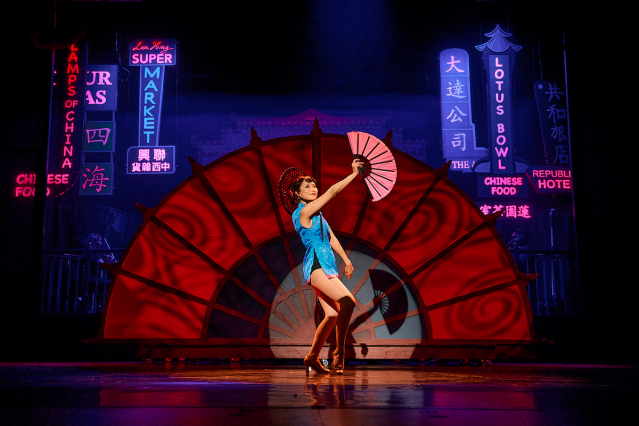
In 2001, the Mark Taper Forum presented a vibrant revision of Richard Rodgers and Oscar Hammerstein’s Flower Drum Song, reframed by Tony winner David Henry Hwang. In the new collaboration between East West Players and the Japanese American Cultural and Community Center, Hwang has revised his book again. This time, however, the results are uneven: the staging often reads as conventional and, at moments, oddly old-fashioned.
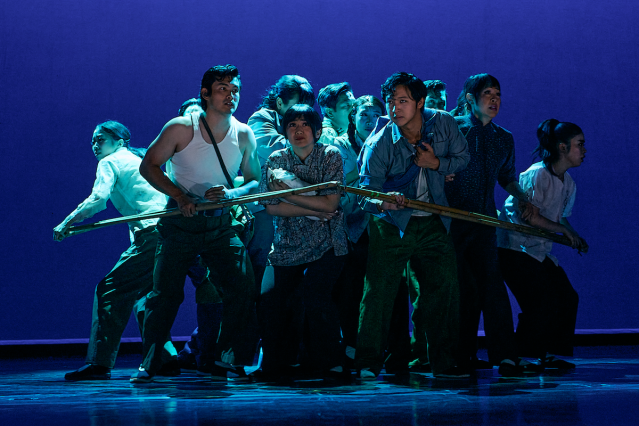
Set in San Francisco’s Chinatown around 1960, the story follows Mei-Li (Grace Yoo), the daughter of an imprisoned Chinese artist, who escapes China by barge and arrives in the United States in search of a family friend. She finds Wang (Marc Oka), a traditionalist running a struggling Chinese opera company, and becomes entangled in the conflict between Wang and his son, Ta (Scott Keiji Takeda), who wants to remake the enterprise into a profitable nightclub with PG-rated “adult” entertainment.
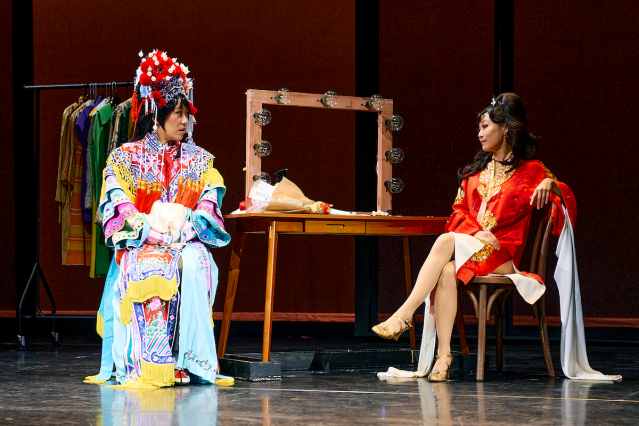
Ta is romantically involved with his lead dancer, Linda Low (Krista Marie Yu), who has embraced a contemporary American identity and tends to avoid partners who remind her of her heritage. As Mei-Li adjusts to a new and more openly expressed culture, she develops feelings for Ta, who carries his own assumptions about old-world customs.
(© Mike Palma)
Rodgers and Hammerstein’s score may not rank among their finest, but it offers several appealing ballads, such as “You Are Beautiful” and “Love, Look Away,” as well as the durable “I Enjoy Being a Girl.” This production uses the Don Sebesky orchestrations and David Chase musical arrangements from the 2001 adaptation (which transferred to Broadway in 2002), reimagining “Fan Tan Fanny” as a risqué a-go-go striptease, and turning “Don’t Marry Me” into a comedy duet for two octogenarians debating whether to step back onto the merry-go-round.
Hwang’s latest revision preserves many major beats from his 2001 version, but Mei-Li is written with less agency and definition. As staged here, Act 1 leans toward the familiar shape of a makeover romance, while Act 2 shifts into backstage-melodrama territory—a pivot that blunts the story’s forward drive. What once played as pointed now lands as generalized, and the evening rarely builds sustained momentum.
Director Lily Tung Crystal delivers a less fluid staging than Robert Longbottom’s 2001 approach (he also choreographed that version’s flashier numbers). The pacing is sluggish, and several sequences feel under-shaped rather than newly considered. The venue’s acoustics further complicate matters, muffling some dialogue and flattening the sound of Marc Macalintal’s orchestra, which plays behind the stage and is frequently masked by a curtain.
(© Mike Palma)
Yoo and Takeda bring strong vibrato and clear affection for the score, though their pairing generates limited romantic spark. Yu lends Linda a coy confidence, but inconsistent breath support does not sustain her in the musical numbers. The energy lifts when Emily Kuroda enters with crisp comic timing, and she shares warm chemistry with Oka. Kenton Chen is also a standout as the opera costumer Harvard, whose long-held dream of becoming a drag performer adds a welcome layer of specificity. As written, the role can tip toward stereotype, but Chen plays it with dignity and purpose.
Design elements provide some of the evening’s clearest storytelling. Jiyoun Chang’s lighting finds a mod atmosphere in the nightclub scenes, with dancers rendered in silhouette behind scrim and in cool-toned washes. Chen-Wei Liao’s understated set includes bamboo shoots representing the precarious barge Mei-Li and her fellow travelers cling to while crossing the Pacific. Ruoxuan Li’s costumes blend early-1960s casual wear with fringe, tassels, and traditional Chinese garments, often in striking combinations.
Given the strength of the 2001 rethinking, a return to Flower Drum Song invites high expectations. Even so, this staging often feels tentative, as if it doesn’t fully trust either the revision or its own point of view. The result is a production that rarely reaches the sense of discovery the material can still offer.




source on Google
Featured In This Story
Latest Reviews
See all
Latest Videos
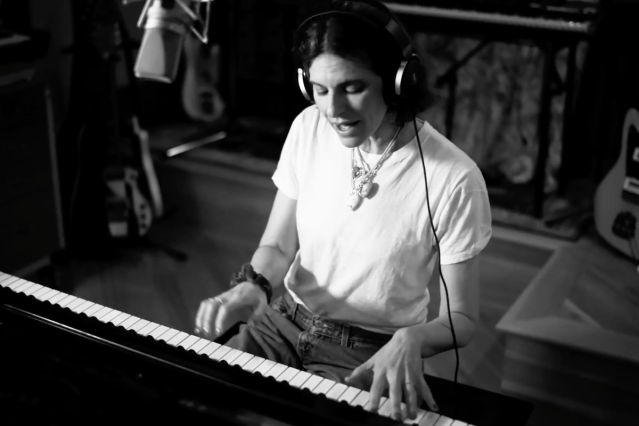
Watch Lindsey Kraft, Featuring Ben Folds, Sing "Beautiful Pain" From the Musical We've Been Here Before
We’ve Been Here Before starts performances on August 4 at SoHo Playhouse.