
Review: Michael Oluokun Wants to Open Your Mind in Have You Ever Thought About
Their interactive show makes its world premiere at the Bushwick Starr.
 |
Off-Broadway
|
|
Off-Broadway
|
May 4, 2026
(© Maria Baranova)
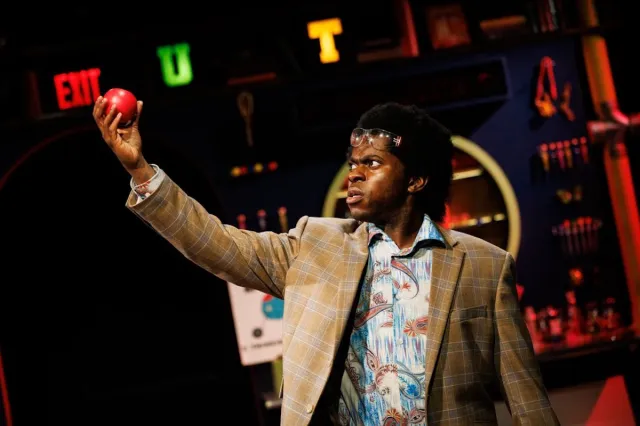
In one section of Have You Ever Thought About, Michael Oluokun, the show’s star and creator, encourages all of us to come up with “cold takes” that, ideally, the entire audience will agree with. During an ensuing two-minute lightning round of audience members yelling out their takes, one of them at my performance offered, “This is the weirdest piece of theater I’ve ever attended.” Though most of the audience signaled their agreement by holding up the green side of their green-and-red voting sticks, I held up the red side of mine instead. If anything, Oluokun’s show, making its world premiere at the Bushwick Starr, could have been much weirder.
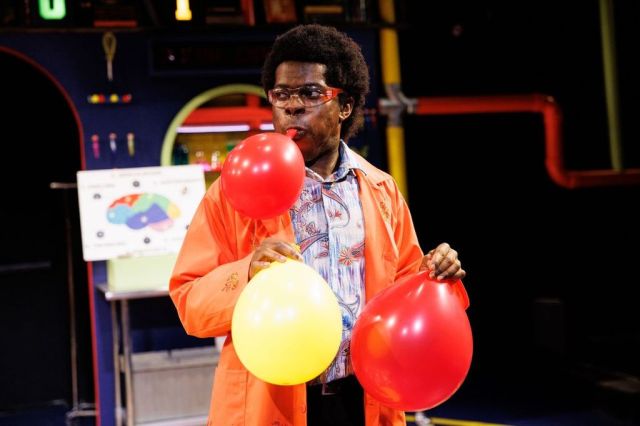
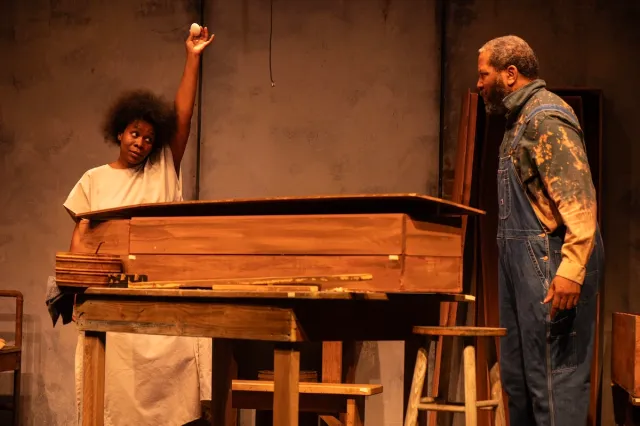
Its premise certainly sounds like the makings of a strange time. On a playful science-laboratory set designed by Emmie Finckel, Oluokun enters clad in a white lab coat with multicolored stains (Nia Safarr Banks is the show’s costume designer). In a grave deadpan, they declare the intent of the “workshop”: to inspire us all to think about … not anything in particular—just “about.” Have You Ever Thought About is built around the idea of forgoing rational thought, of letting your mind roam until you hit upon new ideas, new revelations.
(© Maria Baranova)
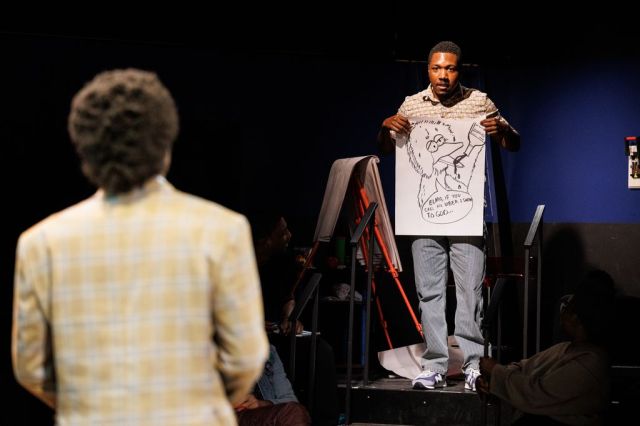
Appropriately, Have You Ever Thought About takes on the form of a variety show, one with heavy interactive components: talk-show segments, question-and-answer sessions, drawing and crafts exercises, and more. A second performer, Myles Madden, occasionally interacts with Oluokun but mostly sits in the stage-left corner, drawing pictures on an easel; during periodic “vibe checks,” he reveals his drawings, inspired by what has occurred onstage up to that point. And before we enter the theater, we are all invited to take seat packs that include a notebook, writing and coloring utensils, three pipe cleaners, a balloon, and the green-and-red voting sticks, all of which will be used at some point during the show. (Based on director Andrew Scoville’s bio, which cites “a passion for integrating science ideas into live experiences,” one wonders how much input he had in coming up with some of the onstage “experiments.”)
Oluokun claims there’s a method to their madness. A third of the way through, they unveil a graphic of a brain divided into six sections called “the six synapses in an about thinker’s brain”: feeling, thinking, application, research, experimentation, and synthesis. Ostensibly, we are taken through each synapse for the rest of the show, which lends a sense of structure to this free-floating farrago. But when, during the “feeling” portion, Oluokun beckons us to do things like rubbing our heads and patting our stomachs simultaneously while our eyes are closed, the line between sincerity and parody becomes razor-thin indeed.
(© Maria Baranova)
There are a couple of moments where Oluokun gets relatively serious. In one segment, a mention of a subway ad recruiting people to become corrections officers leads to a rant, however comically inflected, in which they wonder how much even people of color are willing to compromise for the sake of making a living. And then there’s the second such segment, toward the end. Oluokun’s version of “synthesis” takes the form of a personal monologue in which they talk about their genderfluidity, family history, and Nigerian heritage, before climaxing in an anecdote about a friend’s suicide, one that obliquely hints at feelings Oluokun may have felt. That last confessional episode contrasts with an opening bit in which, under the guise of disclosing information about themself, they spout obvious falsehoods like having Bigfoot and the Yeti as roommates during freshman year at New York University, and helping to create the first Oompa Loompa union at Willy Wonka’s chocolate factory.
Theoretically, ending the show with the most affecting anecdote should bring about a sense of cumulative satisfaction. But the drawback to the show’s feeling of free association is that there’s no build-up to this emotionally vulnerable climax. If this kind of personal therapy was really what Oluokun had in mind all along, one can’t help but wonder how much more powerfully the moment might have landed had they focused on that instead of surrounding it in a stew of half-baked, faux-scientific, faux-philosophical whimsy. Early on, Oluokun straight-up calls Have You Ever Thought About a “work in progress.” We come away feeling as if we’ve merely been a captive audience for a stand-up comedian testing out bits of material under the pretense of a mind-expanding interactive theatrical experience.




source on Google
Featured In This Story
Latest Reviews
See all





Latest Videos
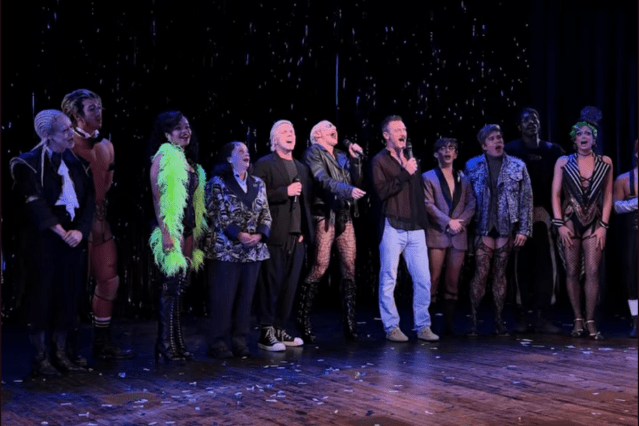
Broadway Cast of The Rocky Horror Show Pays Tribute to Tim Curry
Paul Soileau, Jake Shears, and Luke Evans led the cast in “I’m Going Home.”