
Review: Two Brothers Rush to Fill the Void of an Absent Father in Hymn
Lolita Chakrabarti’s two hander runs at the Odyssey Theater in Los Angeles.
 |
Los Angeles
|
|
Los Angeles
|
May 5, 2026
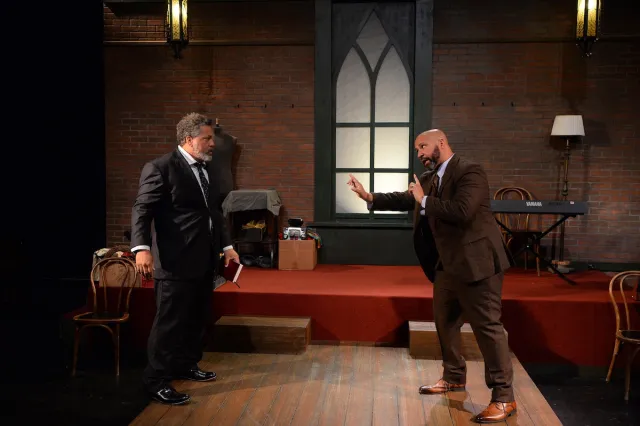
(© Cooper Bates)
Back in the 1950s, a famous novel-turned-play-turned-film asked whether nature or nurture made little Rhoda Penmark a Bad Seed. Now Lolita Chakrabarti’s Hymn asks a related question: does having your father in your life lead you down the right path or not?
Directed by Gregg T. Daniel, this new co-production from the Odyssey Theatre and the Lower Depth Theatre features two intense performances, but it’s ultimately limited by the script’s shortcomings.
Two men meet after a funeral. Gil (Chuma Gault) mourns his late father, while Benny (Jason Delane) believes he may be a long-lost son, Gil’s half-brother. Once paternity is established, the two attempt to fast-track 50-odd lost years. They celebrate together. They merge their families. They even decide to go into business. But tension when they jump straight into intimacy—and that other shoe does eventually drop.
Chakrabarti’s inventive dialogue gives the actors meat to chew on. There’s a strong sense of time – not only the period in which the play is set, but the time Gil and Benny missed growing up together. Chakrabarti portrays them as thick as thieves: dressing up like MTV stars, duetting to the Sugarhill Gang’s “Rapper’s Delight” before heading to the clubs—details that evoke the ’80s, when the brothers would have been teens.
The problem is that the play seems to be missing crucial episodes. Just as the brothers try to speed-run their relationship, we get only glimpses of them. And the people who impact their lives—like Gil’s sisters and wife, and Benny’s wife and kids—never emerge as more than ciphers, exposing the limits of this play as a two-hander.
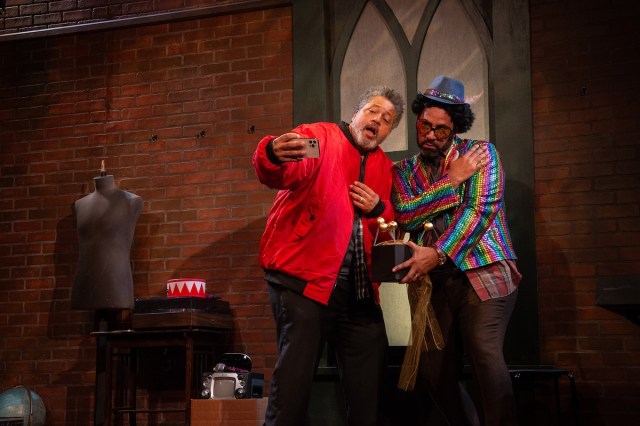
(© Cooper Bates)
Instead, the script leans on symbolic duality: the brothers silently circle each other at the top wearing two halves of a mask; one begins the play sloshed and making a scene, while the other does at the end. One gives a eulogy in the beginning; one does at the end. These feel like tricks rather than storytelling.
Delane and Gault both give powerful performances, and they seem genuinely bonded. Delane carries a skittishness in his eyes and in his hand gestures that suggests a man perpetually on the brink. Gault, meanwhile, projects confidence and self-assuredness, until it cracks when he recounts a confrontation with a privileged woman in a car. Their work makes the conclusion land, even when the script doesn’t quite earn it.
Daniel keeps the production basic to focus attention on the actors. A simple set by Stephanie Kerley Schwartz cleanly suggests both a church and an attic. Wendell C. Carmichael’s costumes reflect each character’s emotional state and stability.
The title may be Hymn, and the play does begin and end with a church elegy, but the real theme is HIM—the father who should have raised him; the father who should have believed in them; the father who failed them both for different reasons. Chakrabarti’s title is pointed, but the script doesn’t fully support what it promises. Still, Daniel and his cast make the evening worthwhile.




source on Google
Featured In This Story
Latest Reviews
See all






Latest Videos
Watch: Ellen Greene Reflects on the Enduring Legacy of Little Shop of Horrors
Frank Oz’s cult classic movie-musical has gotten a new 4K restoration in celebration of its 40th anniversary.