
Review: Ophelia Steals the Show in the National Theatre’s Out-of-Joint Hamlet
Robert Hastie directs Shakespeare’s tragedy at the BAM Harvey Theater.
 |
Off-Broadway
|
|
Off-Broadway
|
May 4, 2026
(© Julieta Cervantes)
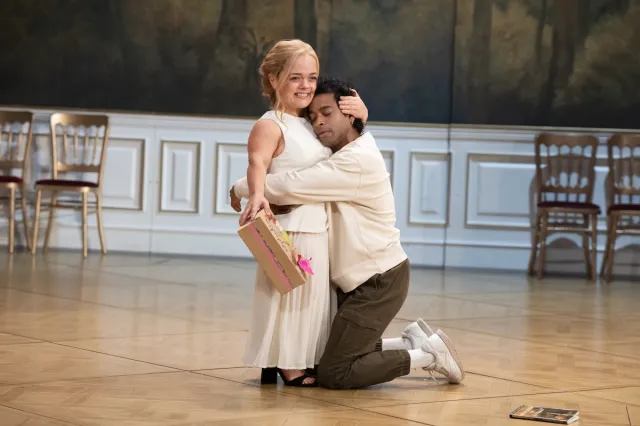
“Only you possess the key,” Taylor Swift sings in her dubious Shakespearean analysis of “The Fate of Ophelia,” but if she were to address those words to Francesca Mills, making Ophelia the lifeblood of Robert Hastie’s sleek, muddled Hamlet, she’d be absolutely right.
Mills shakes away all shadows of past portrayals of Ophelia’s subservient haplessness. Instead, she is the smartest, sanest person onstage, melodramatic in her post-adolescent heartbreak, perhaps, but two steps ahead of everyone else. When her brother Laertes (Tom Glenister) warns her about Hamlet’s overtures, she gives him a sarcastic thumbs-up. She can take of herself.
Instead of mocking the long chain of platitudes delivered by her father, Polonius (Matthew Cottle), Mills’s Ophelia seems to take warm pride in her father’s wisdom. The new joke is that she’s memorized her father’s counsel, but Laertes can’t remember the words. Her overenthusiastic attention invites audiences to listen finally to what the long-winded Polonius is saying: “Give every man thy ear but few thy voice” is actually pretty good advice.
Most potently, in her mad scene, Mills’s meticulous performance suggests that Ophelia adopts insanity as an act self-liberation. Only by shedding the proprieties of court, following Hamlet’s footsteps, and divorcing herself from reality, can she freely express her rage, especially at King Claudius (Alistair Petrie). Her madness is political protest.
In that sequence, she’s also a terrific physical comedian, scurrying away from her attendants as they try to keep her calm. While the production doesn’t comment overtly on Ophelia’s height—Mills is 3’8”—it’s a rare stage opportunity for an actor with a disability to showcase all their body in recrafting a character: Ophelia breaks loose from the Millais painting’s limiting frame.
However, to quote that Swift anthem, let’s “keep it 100”: Ophelia isn’t a substantial enough role to distract entirely from a production’s graver missteps.
(© Julieta Cervantes)
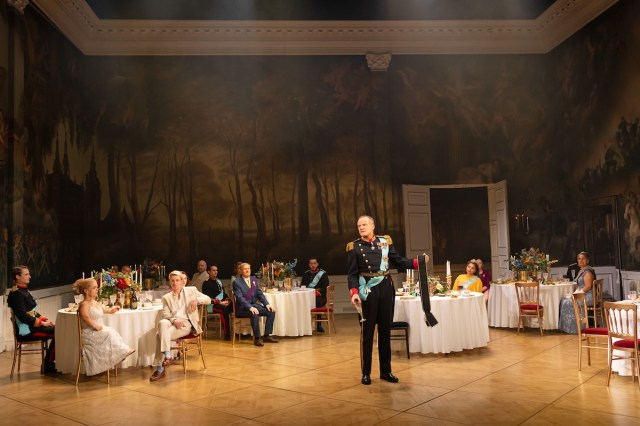
This National Theatre transfer, part of an exciting new partnership with BAM, is, as expected, classily polished. Hastie (Operation Mincemeat) places most of his Hamlet inside an opulent banquet hall boasting high, muraled walls depicting scenes of Danish conquest. An 18-actor ensemble allows for some sweepingly grand transitions.
But while Hastie’s actors, including Hiran Abeysekera (The Life of Pi) in the title role, make the meaning of the text quite clear, there’s not much emotional logic behind the words: we know what everyone’s saying most of the time but not why they’re saying it. Abeysekera’s Hamlet is funny, self-effacing, and quite often petulant from speech to speech, but it’s difficult to trace a consistent personality across scenes or a sense that Hamlet is evolving throughout the play. Plot is more operational than thought here.
What comes across most cogently in Abeysekera’s performance is how much power Hamlet holds, how readily his subjects take orders from him. Demanding to confront his father’s ghost alone, Hamlet grabs a watchman’s pistol and brandishes it until everyone exits: he can do that, he’s the prince. How spoiled do you have to be to demand a traveling theater company insert your own original material into their play with no notice?
Speaking of that theater troupe, the play-within-a-play here is staged as a pretty explicit parody of Jamie Lloyd’s production of Cyrano, with the gray-clad cast ASMR-ing at mic stands in front of a row of orange plastic chairs. But be careful what you’re making fun of: that Cyrano, also performed at BAM Harvey, was a spiritually faithful reinvention, innovative only in the service of story in a way that Hastie’s Hamlet is not. (Also haunting the theater is Thomas Ostermeier’s astonishing German-language Hamlet that rebuilt the play from the ground up at BAM a couple seasons ago.)
(© Julieta Cervantes)
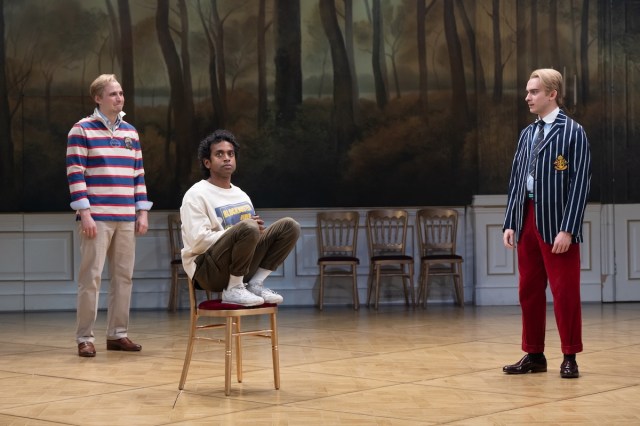
Hastie seems to share Hamlet’s inability to commit to a course of action. The costumes are vaguely contemporary—Hamlet dons a Blockbuster Video shirt—but there’s no tech in sight, no sense that the period means anything. The time is out of joint. So is the tone: Jessica Hung Han Yun’s flashlight design and Alexandra Faye Braithwaite’s jumpscare soundscape are effectively horror-y for the reveal of the ghost (Ryan Ellsworth), but the spookiness has been abandoned even before the specter departs. And the age-old director’s crossroads decision of whether Hamlet goes mad or just feigns madness is muddied by an incoherent staging of Polonius’s death: Hamlet mock-shoots at him with a finger gun, but we hear gunshots and Polonius starts to bleed before Hamlet takes an actual gun out of his pocket. Maybe we’re the ones going mad?
This Hamlet has an uncomfortable, inconsistent relationship with the audience, too. Hamlet can hear Polonius’s asides to the audience, and he reacts with a befuddled perplexity that gets laughs but totally unmoors the scene. Yet elsewhere the whole ensemble freezes during soliloquies as if the audience couldn’t possibly exist within the world of the play. Metatheatrics only work if there are some sort of rules guiding them.
To cap it off, moving “To be or not to be” from the middle of the play to its penultimate scene mainly has the effect of panicking audience members about whether the most famous soliloquy ever written has gone missing. Hamlet holds a gun up to his head in the moment before intermission, but we haven’t yet heard the monologue where he most anxiously contemplates suicide.
Unpersuasive as this Hamlet may ultimately be, there are only great things fated for Francesca Mills after this intrepid performance of Ophelia.




source on Google
Featured In This Story

Latest Reviews
See all
Latest Videos
Alden Ehrenreich Stars in New Carly Rae Jepsen Music Video, Directed by Jeremy O. Harris
“Don’t Leave Me on the Dance Floor” is the latest from the “Call Me Maybe” singer-songwriter.