
Review: The People Versus Lenny Bruce, an Unexpectedly Dull Courtroom Drama
Cause Célèbre Productions presents the first of a trilogy of plays about the career of free speech attorney Martin Garbus.
 |
Off-Broadway
|
|
Off-Broadway
|
May 14, 2026
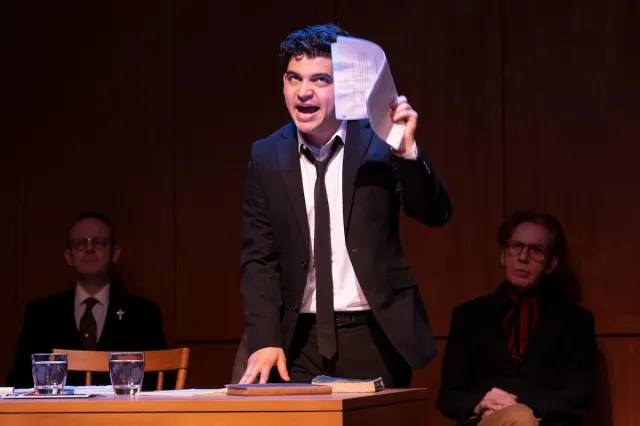
(© Russ Rowland)
Stand-up comedians are the first responders of the First Amendment, rushing into incendiary topics that the rest of us wisely avoid. They are the most solitary of theatermakers, unburdened by a large team of collaborators whispering in their ears that their act is problematic. It’s just the comedian and a mic between the audience and a brick wall; they’ll either laugh or shoot. Comics like Dave Chappelle, Nikki Glaser, Shane Gillis, and Robby Hoffman tiptoe up to taboos and test how free our speech really is—and they are all deeply indebted to Lenny Bruce.
Bruce lived in a time when you could be arrested for what you said in a comedy club, and he was—repeatedly. His 1964 trial and conviction for “obscenity” in New York is the subject of Susan Charlotte’s The People Versus Lenny Bruce, the well-meaning yet disappointingly torpid courtroom drama currently making its world premiere with Cause Célèbre Productions at Theatre Row.
At issue is Bruce’s use of a series of obscene words and phrases: “Shit, Fuck, Motherfucker, Cocksucker, and shit in your pants,” the actors chant in unison like members of a profane secret society. Herbert Ruhe (Dan Grimaldi), the police inspector sent to collect evidence on Bruce, also takes issue with a bit Bruce performed about a man who wants to “urinate into a washbasin.” Grimaldi leans forward and stage whispers this line, which makes it sound yuckier than it is.
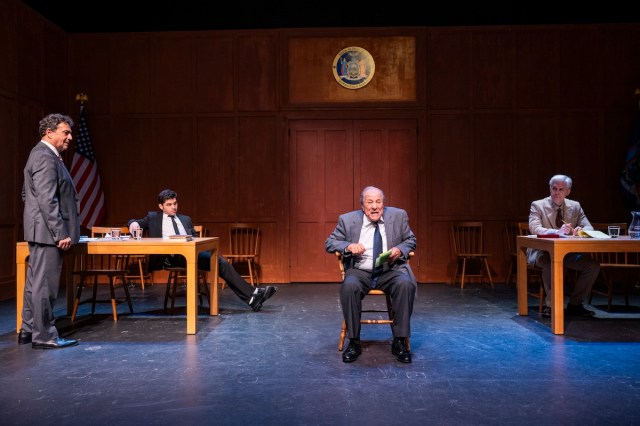
(© Russ Rowland)
Charlotte based her script on the memoir of defense attorney Martin Garbus, and it shows, with Garbus (Stephen Schnetzer) regularly disrupting the proceedings to provide commentary and footnotes. Courtroom dramas work best when the theater of the court is allowed to play out uninterrupted, but it is still possible to thrill with this closely narrated format provided the production has airtight direction and a charismatic lead performer.
Sadly, The People Versus Lenny Bruce enjoys neither. Director Anthony Marsellis fails to land the frequent leaps in time, space, and dimension in Charlotte’s script. Even when the cast does manage to build up some momentum, it instantly deflates in excruciating pauses as Schnetzer struggles to remember the words (he called out for lines multiple times at the performance I attended). What should be an edge-of-your-seat courtroom drama feels a lot more like a law school lecture by an underprepared professor.
Decent performances from the rest of the cast do little to change this: Roberta Wallach is poised and feisty as Broadway columnist Dorothy Kilgallen, brought in as an expert witness for the defense. Timothy Doyle is the encyclopedia photo of a mid-20th-century New York intellectual as cartoonist Jules Feiffer, who presciently argues that Bruce’s act represents an important development in the history of American liberalism. Jonathan Spivey offers a much needed shot of adrenaline as Reverend Forrest Johnson, a Presbyterian minister who also happens to be a fan of Bruce’s act. He is Bruce’s most persuasive witness, and the play temporarily seems to recover during his exchanges with prosecutor Richard Kuh (Ian Lithgow, exuding the tyranny of the old establishment with every crisp mid-Atlantic syllable). But he can only do so much in a supporting part. The People Versus Lenny Bruce is still fundamentally Garbus’s show.
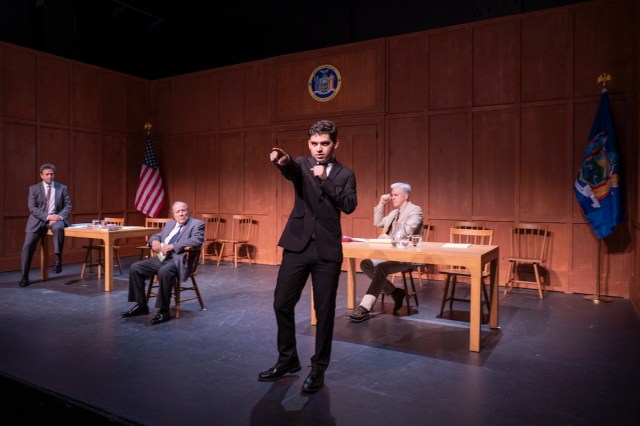
(© Russ Rowland)
This is despite the presence of the title character. Johnny Anthony is a gifted mimic, capturing Bruce’s distinctive inflections and cadence, conveying the authentic voice of the intelligent hepcat troublemaker from beyond the grave. The scenes in which he is temporarily allowed to perform his character’s act feel like watching a young Lenny Bruce—still funny all these years later. But, of course, they do not last, even as Charlotte engages in increasingly ludicrous contrivances to push him into the spotlight.
We’re always on Josh Iacovelli’s adequate courtroom set, a flimsy printout of the seal of New York pasted on wood paneling. Matt Berman’s austere lighting keeps the scene illuminated but doesn’t do much to facilitate the storytelling (one gets the sense that he’s doing what he can with a very limited budget). The costumes evoke the 1960s for the most part, although in his tan suit Lithgow looks like he’s ready at any moment to step into a regional production of To Kill a Mockingbird (the wardrobe consultant is Olga Turka). Spartan design is easy to overlook when the script puts one’s attention in a chokehold. Unfortunately, The People Versus Lenny Bruce lets our minds wander, so we notice.
This is too bad because, despite decades of Supreme Court decisions taking a nearly absolutist view of the First Amendment (even money is speech now), free expression is still under attack in the United States. I’m not talking about high-profile clashes between the FCC and late-night hosts. For the majority of Americans who do not work in network television, the real threat is more insidious, arriving in the form of university speech codes and zealous HR inquisitors. Sure, you won’t be arrested, but you could lose your livelihood, have your reputation destroyed, and face legal fights you cannot afford. Lenny Bruce may have posthumously triumphed in the battle against the state using its cudgel to enforce what naughty words Americans can and cannot hear, but the war for true freedom of expression rages on.




source on Google
Featured In This Story
Latest Reviews
See all




Latest Videos
Watch: Aaron Sorkin, Bradley Whitford, and the Cast of A Few Good Men Talk New Broadway Revival
The playwright reunites with his West Wing star for the first Broadway revival of the career-making drama.