
Review: In Ella Hickson's New Born, Hugh Jackman Will Trim Your Tree
Jackman and his theater company Together present a trio of monologues at the Minetta Lane Theatre.
 |
Off-Broadway
|
|
Off-Broadway
|
May 13, 2026
(© Evan Zimmerman)
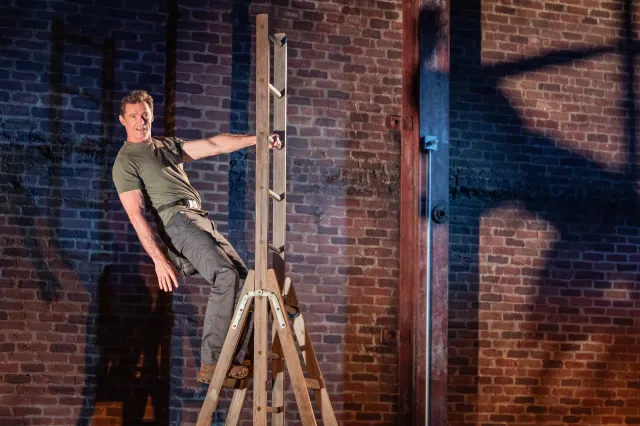
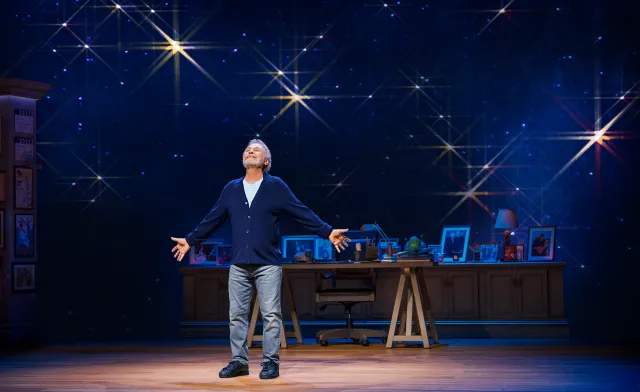
Look, you get what you paid for the second Hugh Jackman steps onstage. Not to objectify the guy, but he’s playing a sexy tree-trimmer, and when his character becomes the focus of Ella Hickson’s New Born, 80 minutes in, he’s wearing a form-fitting green T-shirt, work boots, and a tool belt. When he scales a high ladder and hangs off, Japhy Weideman’s lighting accentuates the ripple of his muscles.
You don’t really need an image like that in a monodrama that could otherwise be performed on a bare stage, a street corner, or in a listener’s earbuds (this is an Audible production at the Minetta Lane Theatre, after all), but director Ian Rickson keeps giving them to us. Rickson has a keen understanding of precisely where and when our interest in Hickson’s trio of 40-minute solo playlets wanes, and then he and Weideman (in collaboration with set designers Brett J. Banakis and Christine Jones) hit us with an extraordinary visual that peps us up.
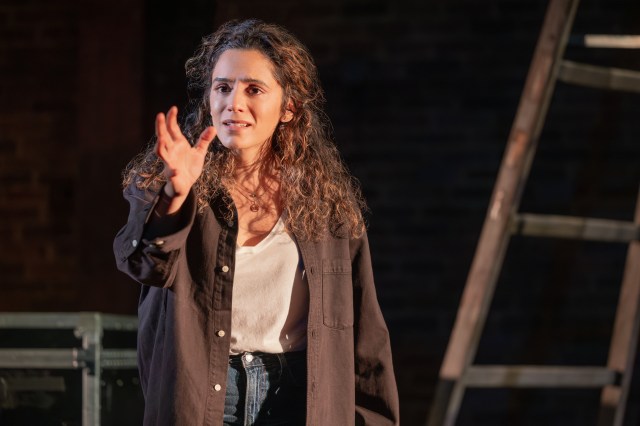
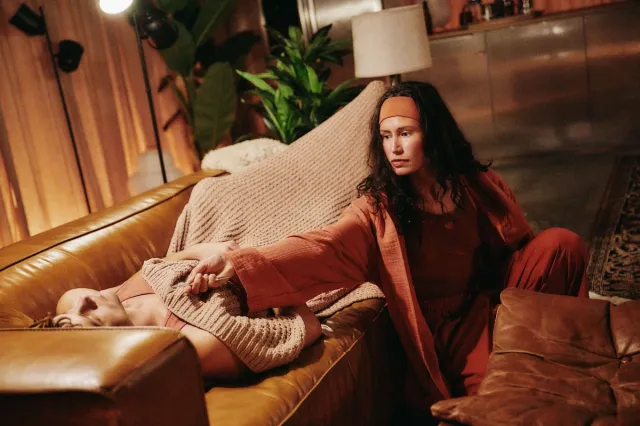
Hickson’s three works are pseudo-thematically connected by the idea of being born again into your life. The first is about an unsatisfied wife and mother (played by Sepideh Moafi of HBO Max’s The Pitt) who becomes the unlikely friend and almost-romantic partner of an internationally famous pop star. The two women meet at a party, share a charged dance, and begin a long and flirtatious text correspondence that culminates in an intimate dinner and a visit to the singer’s hotel room.
(© Evan Zimmerman)
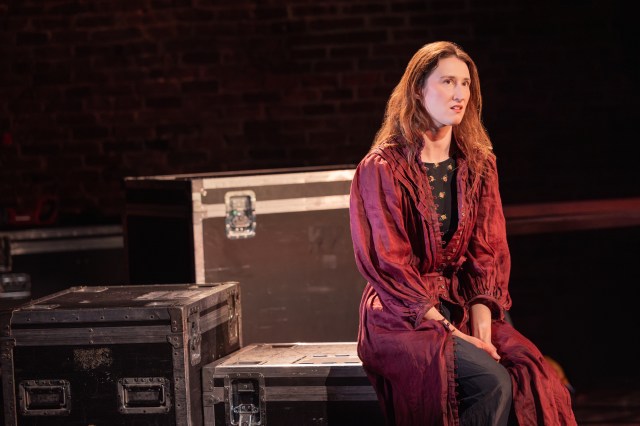
The middle section—set a century earlier in the middle of the American Old West—is a cautionary tale about not judging a book by its cover. We’re introduced to a saloon waitress (Marianna Gailus, Andrew Scott’s understudy in his solo Vanya) who begins a relationship with the gentle best friend of a volatile cowboy who knocked out one of her teeth after her menstrual rag slipped out in front of him. At the same time, there are rumors that the Klan is coming back into town, culminating in the widespread suspicion that the cowboy is responsible for the disappearance of a young Black boy everyone loved.
Jackman’s piece is last up. He plays an Aussie tree surgeon who falls in love with one of his clients. Their relationship is both loving and passionate, and when she bears his child, it’s the miracle he’s always dreamed about. When the baby is finally born, something shifts as the intimacy that once defined their relationship disappears. Jackman’s character must now reconcile the demands of parenthood and the uncomfortable truth that he no longer feels sexually drawn to his partner, even though his love for her remains.
At just shy of two hours, New Born overstays its welcome, and even Hickson’s most compelling ideas are stretched too thin for their own good; each piece could benefit from some judicious edits. Moafi and Gailus find specificity in otherwise familiar frameworks—the former, playing out a wish-fulfillment romance; the latter, part of a revenge fantasy—but the pieces are inert and laden with exposition at the expense of drama.
Jackman’s piece is strongest, a surprisingly candid look at the silent epidemic of male postpartum depression, which I’ve never seen explored before in any kind of media. But it, too, is overwritten and languid, awash in florid prose that pulls attention away from the actor’s surprisingly delicate performance. Even when he called to be reminded of a line amid an extended description of the sky, Jackman, impressively, neither lost his place nor stepped outside of the piece.
That Rickson’s staging comes together in Weideman’s lighting is not surprising, but it is slightly head-scratching that a production ultimately designed to be heard lands best in purely visual terms. New Born might not be the most compelling listen, but it’s a beautiful watch.
(© Evan Zimmerman)




source on Google
Featured In This Story
Latest Reviews
See all

Latest Videos
Watch: Ellen Greene Reflects on the Enduring Legacy of Little Shop of Horrors
Frank Oz’s cult classic movie-musical has gotten a new 4K restoration in celebration of its 40th anniversary.