
Review: Dad Don’t Read This, a Beautiful Simulation of Teen Girlhood
Eliya Smith’s coming-of-age dramedy transfers to the Greenwich House Theater.
 |
Off-Broadway
|
|
Off-Broadway
|
June 23, 2026
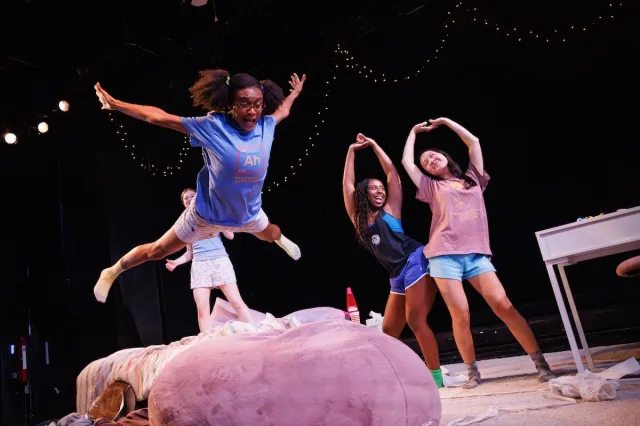
(© Maria Baranova)
Leave it to teenage girls to deconstruct the ethics of simulation theory at the same slumber party they take turns swigging a cocktail of “vodka and gin and tequila and wine and then a different wine and also a little bit of beer.”
Burgeoning playwright Eliya Smith revealed her fascination with these adolescent contradictions in her 2025 off-Broadway debut Grief Camp, a play that delicately orbited the subject of loss. But Dad Don’t Read This, now having an encore run at the Greenwich House Theater after a successful stint at St. Luke’s, gets to the heart of these inscrutable, hilarious, infuriating creatures who move through the world yelling look at me! and don’t look at me! in the same breath.
The show’s self-referential framing device is just that: Mal (Amalia Yoo), a high schooler in 2014 suburban Ohio, writes a play about her quirky friend group and guards the deeply personal project against her father’s prying eyes with a drawn-out, emphatic warning. Doth the lady protest too much? I suspect so. Who hasn’t scribbled a “Do Not Come In” sign in a fit of rage, desperately hoping someone disregards the text in favor of subtext?
What makes Smith’s writing especially satisfying is how she never succumbs to the urge to turn any of that subtext into text. All four girls at Mal’s never-ending pajama party (the locale for our play within a play) drop trails of breadcrumbs that could lead a savvy observer to their internal lives. But volunteer more? That would just be reckless.
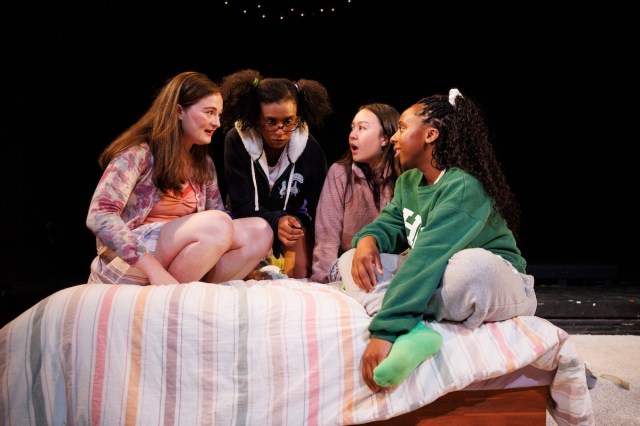
(© Maria Baranova)
Chloe Claudel directs her outstanding quartet with equal restraint. Mal’s parents can be heard yelling just outside the bedroom door, but no one dwells on it much. And where has she been disappearing to every day at lunch? Best to let it go. Meanwhile, skittish Lida (Kayta Thomas, a laser beam of energy) can uninhibitedly throw her body around for a JLo song but can hardly muster the courage to request a smoothie from her host parents.
Sophie (Sophie Rossman, understated and moving) slaps a smile over her depression, anxiety, and traumatic experiences that likely go beyond the disturbing anecdote she shares with her friends. And Noelle (Renée-Nicole Powell with scene-stealing gravitas), the most easygoing of the group, hints at some insecurities via a growing friendship with a taboo queen bee. The four of them love one another in the big, all-consuming ways only teen girls can—but at that age, even best friends aren’t great at cracking coded cries for help.
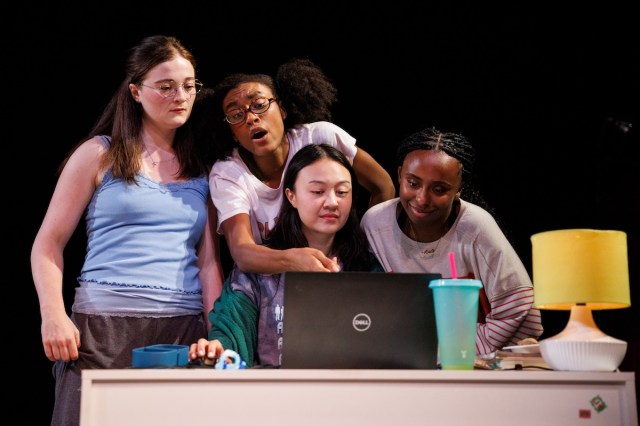
What they do instead is gossip, eat snacks, sneak dregs of gross alcohol, and play the Sims on Mal’s laptop. Yoo, who in 2025 made a memorable Broadway debut in another teen girl dramedy John Proctor Is the Villain, is exceptional as Mal, a character with so many shadows and about faces that a lesser actor could get lost. Warm affection turns to self-absorption turns to vitriol within one conversation.
(© Maria Baranova)
Meanwhile, always lingering in the background is a fevered obsession with the Sim world she spends her days puppeteering. The metaphor isn’t subtle. Smith invokes the addictive game as a risk-free place for her confused adolescents to make big choices and try on different identities (costume designer Olivia Vaughn Hern shows them all doing just that, from Mal’s oversize A Chorus Line shirt to Lida’s graphic T mourning the death of Pluto’s planet status).
Smith’s play, luckily, can withstand a little blunt force. Especially when it allows for moments of surreality (credit to set designer Forest Entsminger and lighting designers Abigail Sage and Finn Bamber for the wall of Christmas lights that sends Mal’s humdrum bedroom into the Sims cosmos). The Sims centerpiece also invites the clumsy but beautiful conversation between Mal and Sophie about the existence of God. Amid all the chatter and game play, it’s hard to tell whether these girls are doubling down on their preferred fictions or poking their heads into vast expanse of the universe. Then again, that’s assuming there’s a difference.




source on Google
Featured In This Story
Latest Reviews
See all







Latest Videos
Jocelyn Bioh, Whitney White, Jasmine Amy Rogers, and Patina Miller Talk School Girls
The playwright, director, and stars of School Girls; Or, the African Mean Girls Play discuss the comedy, sisterhood, and themes behind the new Broadway production.