
Review: The Phantom of the Opera Is as Thrilling as Ever on the Road
The production launched its multi-year North American tour last month in Baltimore.
 |
Baltimore
|
|
Baltimore
|
December 1, 2025

(© Matthew Murphy/Evan Zimmerman)
“Phans” of the original production of Andrew Lloyd Webber’s The Phantom of the Opera can rejoice. The musical’s new touring production has brought back the stunning original design with a better-than-ever cast. With only a few small changes to the set and scenery, this staging is overall what Broadway offered, but with refreshed, rejuvenated performances that makes one feel like they are hearing the “Music of the Night” for the very first time.
The last touring production of Phantom, which played its final performance in February 2020, was a widely contested restaged version, with new design, choreography, and direction by Laurence Connor. Critics and fans were largely dissatisfied with the reimagining, which scrapped the ornate design, balletic movement, and heart-wrenching storytelling of designer Maria Björnson, choreographer Gillian Lynne, and director Hal Prince in favor of a sexier (and simpler) staging.
Nearly three years after Phantom’s closure on Broadway, audiences can enjoy the holy trinity of Phantom design once again, along with a breathtaking cast. Isaiah Bailey’s turn as the Phantom is itself worth the price of a ticket, with a pillowy-soft tenor that soars through “Music of the Night” and rich, baritone depth that grounds “The Point of No Return.” Bailey is the textbook definition of range—not only in vocals, but in his take on the character, which encompasses both the tragedy and the fearsome tenacity of the Phantom with such tenderness that it makes it difficult not to root for him.

(© Matthew Murphy / Evan Zimmerman)
Jordan Lee Gilbert brings the voice of a nightingale to Christine with her birdsong soprano. Like Bailey, she also offers compelling duality to her performance, embodying both the naive curiosity of an ingenue, and the quick-thinking bravery of a heroine. Gilbert and Daniel Lopez as Raoul—a lovable, feisty, but not-at-all aggressive counterpart with a voice as delightful as his demeanor—create romantic chemistry that heightens the love triangle to the level it should always have.
The supporting characters steal the spotlight too, with Carlotta (Midori Marsh) commanding the audience in true prima donna fashion. Her almost acrobatic vocals are so stunning that I can actually declare it was the first time in my 30-some times seeing Phantom that my mind didn’t wander during “Prima Donna.” William Thomas Evans as Firmin and Carrington Vilmont as André are perfectly in tune with each other, both in their singing and comedic banter.
Lisa Vroman, a beloved former Christine on Broadway, sings just as beautifully as Madame Giry, to the point that one wishes the character could have her own solo. And the corps de ballet, led by Melo Ludwig as Meg Giry, all honor Lynne’s original choreography with apt precision and elegance.
The most delightful surprise of all is just how few changes have been made to the show’s design. Down to every detail, Björnson’s costumes look so familiar that they could easily be taken for the Broadway costumes. Though the set is scaled for a much smaller stage, all the core elements remain, with an ornate gold proscenium that assembles mid-air during the title song, and two-dimensional moving set pieces for the operas-within-the-operetta so ethereally illustrated that they look like pop-ups in a picture book.
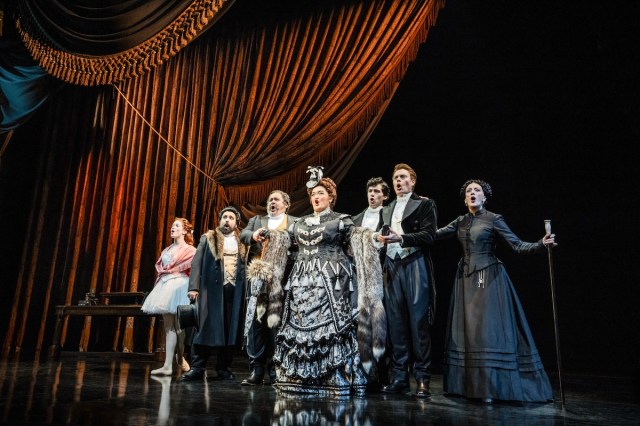
(© Matthew Murphy/Evan Zimmerman)
The boat journey during the title song, with candles alight on the foggy lake, brought tears to my eyes with its haunting beauty, ever the same as before. The “Masquerade” scene—always a highlight—remains a theatrical masterpiece of imagery and enchantment, with a grand staircase, glittering costumes, and stationary mannequins that fool our eyes into seeing a larger ensemble. The scene’s reveal also still elicits a collective gasp as the curtain is pulled back.
The only largely noticeable change is a large Pegasus statue that the Phantom hides behind during “All I Ask of You,” in lieu of the angel centerpiece in the proscenium, from which Broadway’s Phantom would descend into view. Though the Pegasus is not as impressive as its predecessor, it still feels monumental in both size and surprise as it rotates to reveal the Phantom perched atop.
Andrew Bridge’s lighting and special effects are another change casual fans may not catch, but “phans” certainly would, with much bolder, brighter choices that brought true meaning to “a little illumination,” with all-white flashes flooding the theater during the chandelier’s initial rise, punctuating every thud of the bass. The pyrotechnics in the graveyard scene are also vastly improved, feeling much more thrilling—and threatening—as the Phantom launches his attacks on Raoul.
Whether you never had the chance to see The Phantom of the Opera on Broadway, or you saw it on every trip to New York City, this touring production is well worth revisiting Webber’s cherished classic, as it makes it clear exactly why it reigned for so long on Broadway, and will continue to do so wherever it plays.




Featured In This Story
Related Articles
See all
Latest Reviews
See all
Latest Videos
West End vs Broadway: Oh, Mary!—From an Angry Inch to an Angry First Lady, With John Cameron Mitchell and Mason Alexander Park
Mitchell and Park celebrate a decade-long friendship in our latest installment.