
Review: Metropolitan Opera's New I Puritani Dazzles and Confounds
Lisette Oropesa and Lawrence Brownlee power through directorial interference in Vincenzo Bellini’s bel canto favorite.
 |
New York City
|
|
New York City
|
January 2, 2026
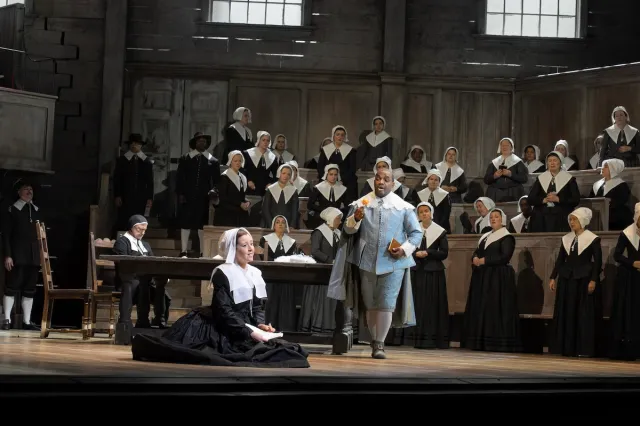
(© Ken Howard / Met Opera)
Few people would claim that early 19th-century composer Vincenzo Bellini was the artistic equal of fellow Italian opera composers like contemporary Gioacchino Rossini or the later Giuseppe Verdi. And yet, many of Bellini’s works continue to be staples in the operatic canon for one simple reason: The man had a knack for gorgeous melodies, fitting for the bel canto (or “beautiful singing”) tradition in which he worked.
I Puritani, Bellini’s final opera before his untimely death at 33 in 1835, encapsulates his strengths and weaknesses: The plot is thin and the psychology silly, but who cares when he gives great opera singers so many chances to shine? It’s too bad that Charles Edwards, the director of the new Metropolitan Opera production unveiled on New Year’s Eve, occasionally gets in the way of the vocal fireworks with some odd staging choices.
Set during the English Civil War in the 1640s, I Puritani, or “The Puritans” in English, focuses largely on Elvira (Lisette Oropesa) and Arturo (Lawrence Brownlee). They love each other despite their opposing political backgrounds. Elvira is the daughter of Puritan commander Gualtiero (David Pittsinger), while Arturo is a Royalist. Elvira’s devoted uncle, Giorgio (Christian Van Horn), has convinced Gualtiero to allow her to marry Arturo instead of Puritan leader Riccardo (Artur Ruciński), which crushes the latter enough to distract him from his duties as a soldier. But when, on Elvira and Arturo’s wedding day, a mysterious noblewoman crosses paths with Arturo and eventually reveals herself to be Enrichetta (Eve Gigliotti), the widow of the recently executed King Charles I, Arturo, seized by a Royalist sense of duty and aided by the devious Riccardo, absconds with the deposed queen, leading Elvira to descend into madness.
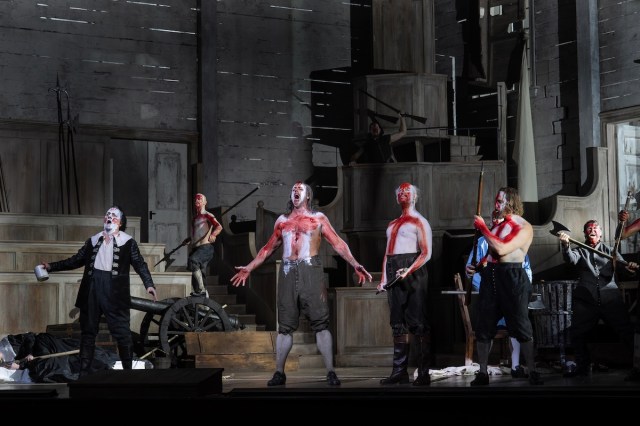
(© Ken Howard / Met Opera)
There’s an interesting theme underlying Carlo Pepoli’s libretto (based on the play Têtes Rondes et Cavaliers by Jacques-François Ancelot and Joseph Xavier Saintine): the clash between political loyalties and matters of the heart. Ultimately, though, I Puritani works better as a love story than as a political and psychological tract.
Edwards, however, appears to be aiming to bulk up the political and psychological aspects of the story with many of his directorial interpolations. In the overture, for instance, he wordlessly dramatizes the initial meeting between young Elvira (Taylor Massa) and Arturo (Addison DeAundre) as well as the death-by-execution of Arturo’s father, Lord Talbot (Richard E. Waits). The love of portraiture over which Elvira and Arturo bond in the overture becomes a running theme, with Elvira seen surrounded by multiple self-portraits she created during the height of her madness in Acts 2 and 3. More dubiously, Edwards has Enrichetta become a friend of Elvira’s, as indicated by the fact that we see Elvira sketching Enrichetta’s portrait while she’s duetting with Giorgio in Act 1. It’s unclear what this character revision adds to the opera’s perspective on the potential incompatibility of political convictions and interpersonal romance that the central Elvira-Arturo relationship hasn’t already suggested.
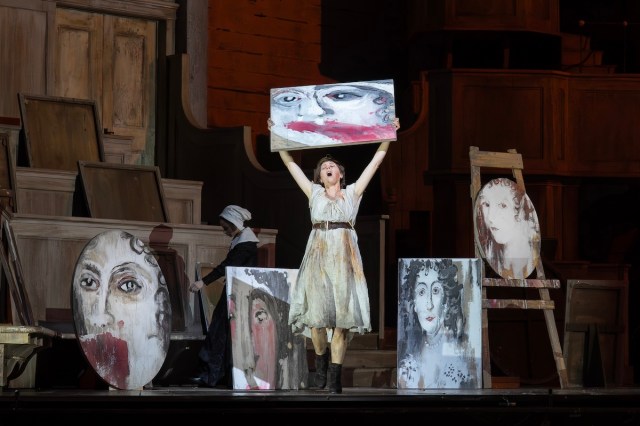
(© Ken Howard / Met Opera)
Edwards also designed the single set for this production, an impressive-looking Puritan meeting house on which lighting designer Tim Mitchell has come up with some genuinely painterly effects to indicate changes in time, emotional temperature, and sudden slips into madness. But Edwards’s attempts to visualize Elvira’s mental deterioration are sometimes undone by strange blocking and movement (Tim Claydon is credited with movement direction). When, in Act 3, Edwards has young Elvira lead the adult Elvira by the hand to Arturo, the strain to make poetry out of their reunion spoils what ought to be the emotional climax of the opera. All of Edwards’s attempts to “help” I Puritani might have worked better if he had fleshed out an actual concept instead of settling for these noncommittal flourishes.
Thankfully, Edwards’s directorial interference isn’t enough to undermine the main attraction of this and all productions of I Puritani: great vocalists singing Bellini’s soaring melodies. Van Horn exudes familial concern as Giorgio, with Ruciński projecting entitled despair as the jilted Riccardo. But the vocal success of this production rests on Oropesa and Brownlee. Oropesa not only negotiates Elvira’s many coloratura runs with stunning ease, but captures the character’s up-and-down emotional states vividly enough to almost make the libretto’s dime-store psychology work. Brownlee matches Oropesa in skill and magnetism, most dazzlingly hitting all his perilously high notes in Act 3. Conductor Marco Armiliato leads the Metropolitan Opera Orchestra with a sure hand, giving the singers plenty of room to strut while still moving the action forward. As long as you ignore Edwards’s sometimes puzzling stage imagery, this I Puritani delivers vocal sizzle aplenty.




Featured In This Story
Latest Reviews
See all
Latest Videos
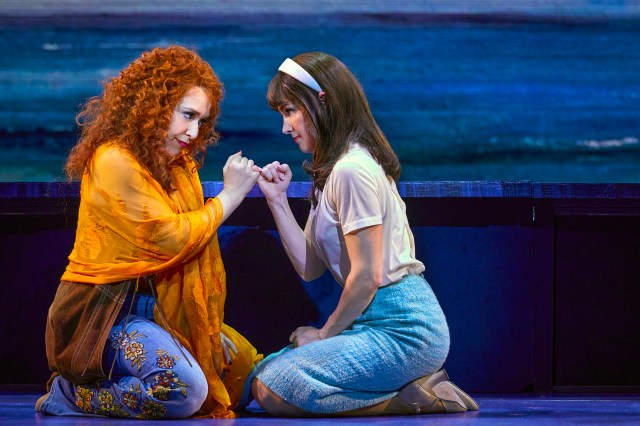
Watch Jessica Vosk and Kelli Barrett Sing a Song From the Upcoming Broadway Musical Beaches
Broadway performances start on March 27 at the Majestic Theatre.