
Review: The Adding Machine, the Right Play in the Wrong Production
The New Group stages a revival of Elmer L. Rice’s 1923 expressionist drama.
 |
Off-Broadway
|
|
Off-Broadway
|
April 14, 2026
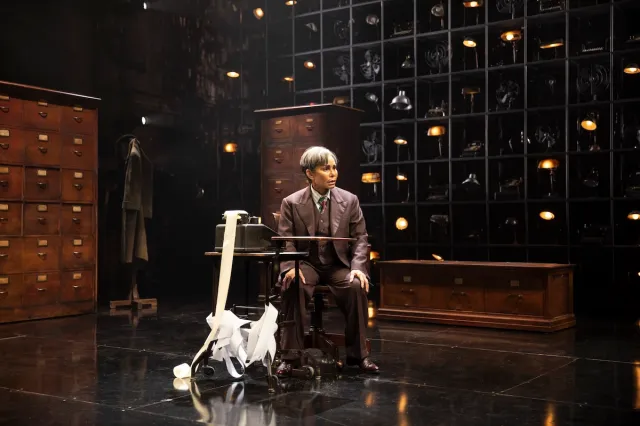
(© Monique Carboni)
It’s always thrilling to encounter an old play that feels like it was written about right now. Elmer L. Rice’s 1923 drama The Adding Machine is one of them. The tale of an office worker whose job is replaced by technology right before he murders the boss, it speaks directly to the anxieties and rage of those staring down the barrel of AI—the exact kind of white-collar employees who buy off-Broadway tickets. That’s surely why director Scott Elliott chose to mount it with his company, the New Group, as the inaugural production at the troupe’s new home. Unfortunately, it’s that most heartbreaking kind of revival: the right play at the right time in the wrong production.
The script, which features revisions by Thomas Bradshaw, now opens with a narrator (Michael Cyril Creighton) speaking of the “heart-warming tale about modern life crushing the human spirit” that we’re about to witness. “You may even recognize a few things from your own life.” This hold-onto-your-hats preamble establishes huge expectations for a gut-wrenching night of theater. And then comes the play.
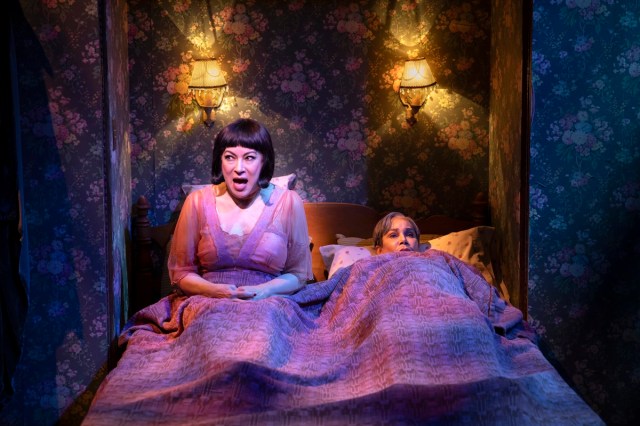
We see Mr. Zero (Daphne Rubin-Vega) tucked into bed, silently brooding as his wife (Jennifer Tilly) natters on about movies, other couples (the ones, twos, and threes), and the “little whore” in the apartment across the airshaft, who used to provide Zero his only source of sexual release. “Imagine my surprise—walkin’ in on my husband, pants around his ankles watching that whore, diddling himself. Talk about sickening,” she screeches.
(© Monique Carboni)
Tilly fully inhabits the role of the castrating wife who buttresses her misunderstanding of male sexuality with clichés. “You’re all I’ve got, I guess,” she says, looking like she just spit out a rancid cherry. It’s what the part needs, but it doesn’t really set up her co-star for success.
The second scene depicts Zero at the office with his colleague Daisy (Sarita Choudhury, barely present). They have worked side-by-side for 25 years adding figures for the store that employs them, and they bicker like an old married couple—although unlike an old married couple there’s stated (if not palpable) sexual tension.
Zero thinks a big raise is finally coming his way, but when the boss (Creighton) approaches him it’s to let him know he is being made redundant by a new adding machine. “Efficiency–economy—business—business—BUSINESS,” he barks, clutching a cigar like a Batman villain.
Zero returns home, collar stained with blood, only to be harangued by Mrs. Zero for not looking presentable in front of the guests at her candlelight supper. Creighton portrays every other character, which is a fine modern solution for a scene that calls for 15 actors, though it’s not quite the hilarious tour-de-force it’s meant to be.
(© Monique Carboni)
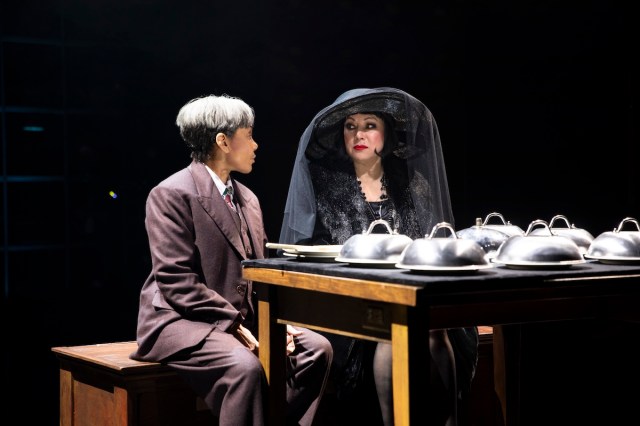
Further scenes depict Zero’s trial and execution. The latter, entirely Bradshaw’s invention, is a biting critique of capital punishment and his most positive contribution. It also gives costume designer Catherine Zuber an opportunity to dress Tilly in fabulous premature mourning attire, providing the best sight gag of the show.
That’s just the first half. It should move like a machine for sorting humans—efficient, unsentimental, irresistible. Yet every scene drags, weighed down by too many words and not enough directorial punctuation. This is a first reading with light staging.
Rubin-Vega, one of the great stage actors of our time (I still have nightmares about Empanada Loca), delivers a performance that is specific and convincing—performative machismo compensating for spiritual (perhaps actual) ED.
But it’s hard not to see the casting of a woman (any woman) in this role as a decision born out of fear—fear of a male actor speaking Rice’s misogynistic language (“women make me sick”), fear of entertaining the notion that straight men have something to complain about, fear of confronting the fact that their unhappiness is not going away and will only worsen as technology disrupts their lives, radically altering our politics in the coming years. Trump is merely an overture. Bradshaw and Elliott seem to think the off-Broadway audience can’t handle this truth, so they queer the canon, cushioning us from the full impact of a voice from the past that we really ought to hear, no matter how politically incorrect he may sound to contemporary ears. It’s a cowardly choice masquerading as a brave one.
(© Monique Carboni)
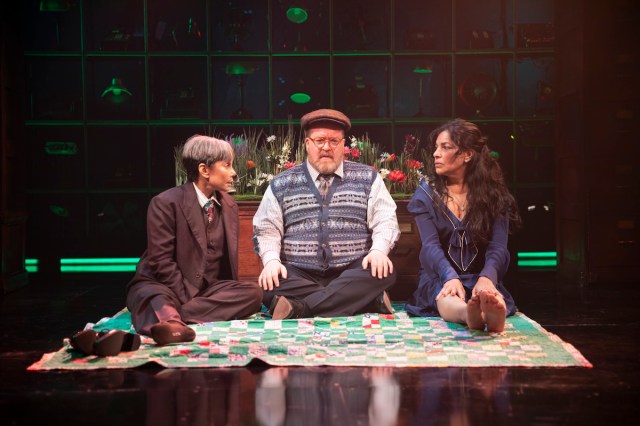
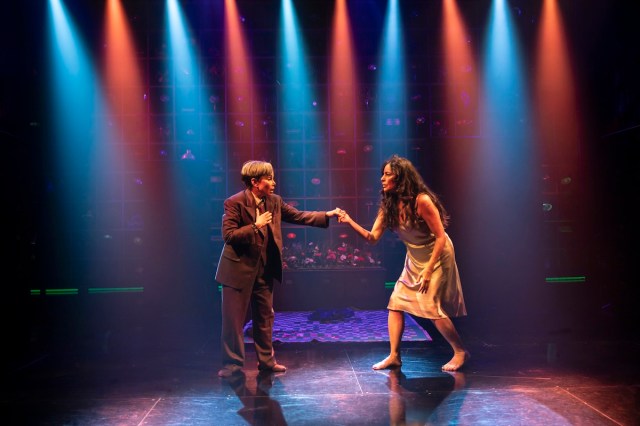
Rice explores the afterlife in the final three scenes, and this is where Elliott’s meticulously designed production, which firmly grounds the setting in the 1920s, becomes a liability. Derek McLane’s set, which uses old wooden file cabinets as building blocks, never allows us to leave the office, which works great in the first half. But to create “a scene of pastoral loveliness,” McLane transforms one of the cabinets into a shallow box of fake flowers. Lighting designer Jeff Croiter surrounds the space with LED tubes. They’re green, but of a hue that suggests a Charli XCX theme night more than the Elysian Fields—expressionist drama conveyed through a shrug.
That scene does at least provide the one moderately moving interaction of the whole play, when Zero and Daisy dance to Radiohead’s “Creep.” It’s a song of unrequited desire in a culture fueled by the lie that consumption leads to salvation. We hear the lyrics, “I want a perfect body. I want a perfect soul,” as Zero and Daisy explore each other’s bodies. And if Choudhury and Rubin-Vega had any sort of chemistry, this moment might feel cathartic. But it’s clear that Thom Yorke is doing all the work.
It’s disappointing because The Adding Machine, in its strange, cynical, wonderfully metaphysical way, has more to say about our contemporary bondage than most new plays presented on New York’s stages. It could be the cry for freedom we desperately need. But all I could hear is the whimper of a theater that is running low on ideas.
(© Monique Carboni)




source on Google
Featured In This Story

Related Articles
See all
Latest Reviews
See all






Latest Videos

Watch the Trailer for Elsinore Starring Andrew Scott
The film is based on the true story of Ian Charleson, who played Hamlet at London’s National Theatre after being diagnosed with AIDS.