
Review: In Clay Molds a Forgotten Legacy Into Something Resonant
Marie-Berthe Cazin comes to life in the solo musical at Signature Theatre in Arlington, Virginia.
 |
Washington, DC
|
|
Washington, DC
|
January 7, 2026

(© DJ Corey Photography)
Working with clay demands precision, patience, and a tolerance for failure—all qualities that define the life of Marie-Berthe Cazin, a forgotten artist at the center of Signature Theatre’s engaging production of In Clay.
The story itself is simply a portrait of this French ceramicist who spent much of her life in the shadow of male contemporaries and partners, especially her husband who often claimed her work as his own.
In this intimate musical, the act of shaping art becomes inseparable from the struggle to claim authorship in a world eager to take credit elsewhere as Cazin tells her story in a modest studio onstage.

The one-woman show rests on the shoulders (and hands) of the marvelous Alex Finke, who carries the weight with commanding grace. Finke is Cazin in every sense. She’s fierce, fragile, furious, and funny. There’s an ineffable quality to her performance that makes Signature’s small ARK Theatre feel impossibly large as she fills it with stories, laughs, anxieties, and triumphs effortlessly.
Recounting the artist’s life, Finke transitions between characters—friend, lover, mentor, rival—without a hint of confusion as to who she is personifying, finding the perfect tone for each influence in Cazin’s life.
Finke also is pitch-perfect with her vocals, staying true to the French accent and the character’s spirit. Whether she’s belting out a jazzy number such as “Spark” or “Fingernails” or quietly confiding in the audience through a tune like “See-Through,” Finke turns what could have been a self-indulgent solo turn into a fully realized dramatic arc. She also shows some immense skill at the pottery wheel, crafting some live art while continuing to tell the story.
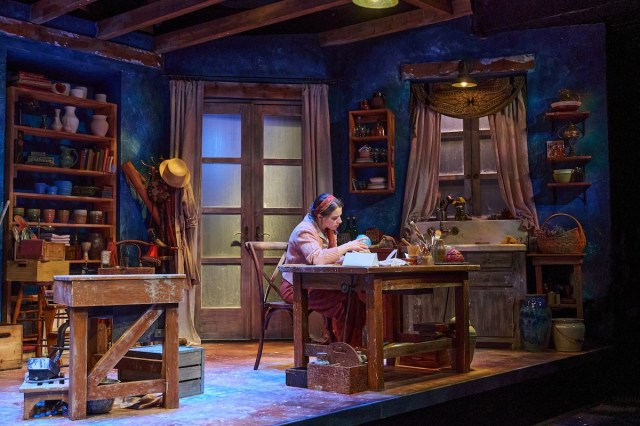
(© DJ Corey Photography)
Director Kimberly Senior turns the small-scale musical by Rebecca Simmonds (book and lyrics) and Jack Miles (music and lyrics) into something expansive in impact, intimate in form and sweeping in emotional reach. The creative team ensures that the audience understands that art isn’t just about finished works but it’s the messy grind of making it in the first place—the hands in mud, the rhythms of creation, the constant negotiation between inspiration and self-doubt. From the moment the wheel whirs and Cazin’s fingers greet the clay, you understand that for her, making art is as necessary as breathing.
Visually, the world of the show is a delight. Scenic designer Tony Cisek fills the stage with objects that feel lived-in: shelves of pottery and stacked canvases, mugs and tools scattered like breadcrumbs leading us into Cazin’s world. The design feels handcrafted, just like its subject, and it draws you closer into her orbit.
Colin K. Bills’s lighting design captures the mutable moods of the studio with bright optimism and dusky reflection, while Shahrzad Mazaheri’s costumes are earthy and boho, signaling a character rooted in creative freedom rather than fashion or trend.
Music director Matt Herbert leads a phenomenal band comprising violinist Madalyn Navis, bassist Joanna Smith, and guitarist Jonny Marquez. The quartet are unassuming on the corner of the stage, but their rich sound makes Miles’s score come to life.

If you’re wondering why you’ve never heard of Marie-Berthe Cazin, In Clay confronts that exact question. Born in 1862, the French painter, potter, and metalsmith was often subsumed under the name of well-known artist Jean-Michel Cazin, a historical miscredit only slowly rectified in the decades after his death in World War I. The book doesn’t treat this as a dry biographical footnote; instead, the writers weave it into the narrative’s pulse and tension. For instance, after a visit from her estranged childhood friend, now a celebrated painter named Henriette Tirman, Cazin reassesses her life, her choices and her place in a world that all too easily wrote her out of its stories.
Still, In Clay is not just about rewriting history, it’s about reclaiming a self that was never given the space to speak. Senior’s staging keeps this front and center with a pottery wheel, positioned prominently, becoming as much a character as Cazin herself. Water flies, clay spins, and every moment of creation feels kinetic and alive.
While the one-act occasionally drifts and revisits familiar ground toward the end, the music gains momentum, reshaping the material—like any ceramic masterpiece—into something more satisfying.
In a time when the arts feel both threatened and more essential than ever, In Clay reminds us why theater matters—not for the spectacle, but for the stories that make us look a little more closely, listen a little more deeply, and see a little more clearly.




Featured In This Story

Latest Reviews
See all


Latest Videos
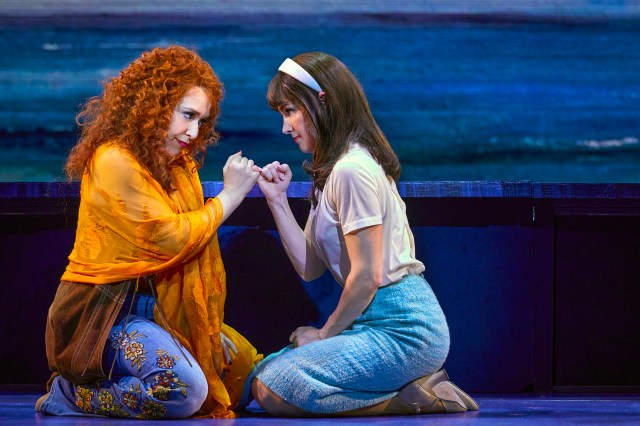
Watch Jessica Vosk and Kelli Barrett Sing a Song From the Upcoming Broadway Musical Beaches
Broadway performances start on March 27 at the Majestic Theatre.