
Review: ICE Cream and Epstein in a Chaotic Reimagining of Brecht’s Threepenny Opera
George Abud’s new adaptation 3penny Opera runs at the Theatre at St. Jean’s
 |
Off-Broadway
|
|
Off-Broadway
|
January 21, 2026
(© Marc J. Franklin)
“Art is not a mirror held up to reality but a hammer with which to shape it,” Bertolt Brecht allegedly wrote. Whether he said it or not, he would have something to say about 3penny Opera, actor-director George Abud’s new adaptation, which bludgeons the fine-toothed anti-capitalist musical satire The Threepenny Opera into the bluntest of political instruments.
The production, presented by Off-Brand Opera at the Theatre at St. Jean’s, espouses some Brechtian-adjacent ideas: ICE is bad; Epstein is bad; Eric Adams was very bad. It’s natural to revisit Brecht’s work when greed-driven rot erupts from the highest levers of power.
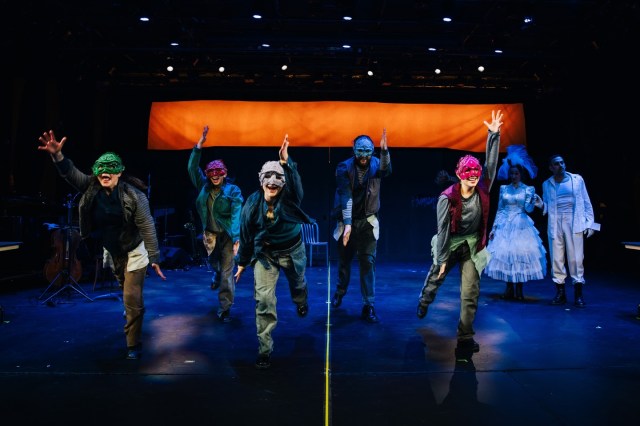
But Abud’s new text begins with the ensemble singing “See the fat man,” in reference to Trump, to the tune of “The Ballad of Mack the Knife”—and things get even less subtle from there: the next verses name-check Kilmar Ábrego Garcia, Pete Hegseth, and COVID.
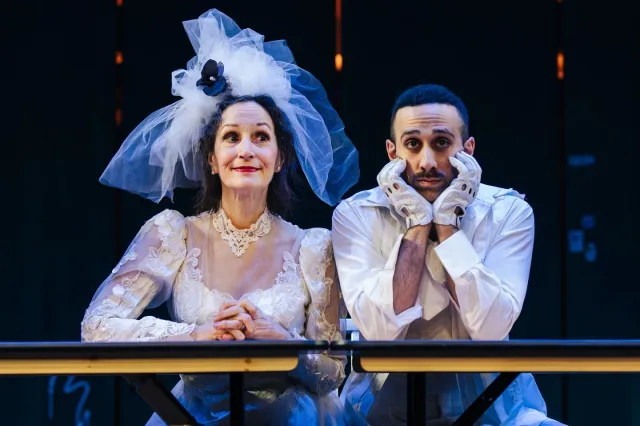
Abud doesn’t translate the original German: almost every song now features on-the-nose lines about immigration raids. Instead of a real adaptation, then, 3penny’s approach to the songs is closer to that of a political parody. But there’s also a bizarre imbalance between preserving Threepenny’s essential structure and totally ransacking its meaning. The story of the entrepreneurial criminal Macheath (also played by Abud) and his underworld juggling of various mistresses, including the prostitute Jenny (Katrina Lenk), doesn’t hold together when forced to align with a depiction of contemporary New York and the presence of ICE agents—referred to throughout as “ICE cream.”
(© Marc J. Franklin)
Who is Macheath even supposed to be now? The Peachum family plots to have Macheath deported by ICE because he isn’t white and wants to marry their daughter (they call him “Saddam Hussein”), but he’s also simultaneously depicted as a Jeffrey Epstein-like figure haunted by a “list” that will announce his heinous crimes to the world. At one point, Abud’s Macheath distracts from those accusations by going on a diatribe about trans girls in women’s sports and later recites a verbatim press conference address from Texas Governor Greg Abbott about the state’s fatal flooding last July. Sometimes he seems to be anti-MAGA; elsewhere he sings about voting for Trump. Scene-by-scene convenience, rather than clarity, seems to dictate Macheath’s character along with everything else in this three-hour show.
“Is he white? No,” Polly Peachum (Barbara Walsh) admits as she explains why she’s married Macheath. “Does that automatically make him a hardened criminal? Yes.” That’s a satirical laugh line, apparently, but it’s strange that the show’s central character of color is a violent immigrant. Macheath gets away with murder, skipping off up the aisle while everybody else in the cast falls to the ground one by one, executed by firing squad in a metatheatrical insertion.
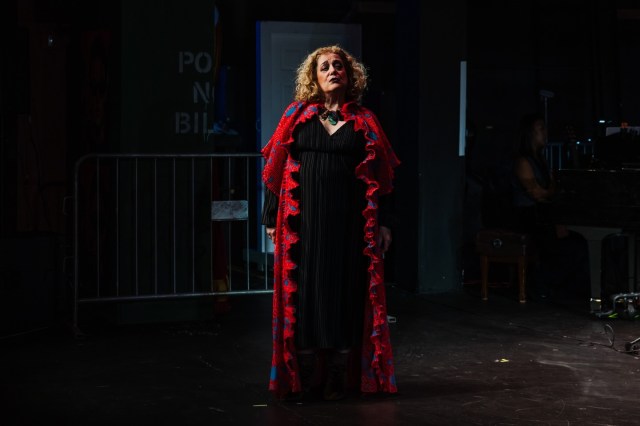
Everyone, that is, except the veteran Mary Testa, who, in the most effective act of protest 3penny offers, smartly refuses to risk her knees for this production and instead stumbles dramatically across the stage to die standing up, collapsed upon the piano. Testa, no theatrical wallflower, is valiant in seizing the means of productions whenever she’s onstage as Lucy Brown, Macheath’s abandoned lover. She’s decided to deliver a boisterously wry, high-camp reading of each of her lines, no matter how dull the humor.
(© Marc J. Franklin)
Abud loads the script with jokes about the non-Equity cast members, Lenk’s Broadway understudy credits, and, especially, the casting of Testa and Walsh as Macheath’s young lovers. Walsh nonetheless makes an endearing Polly Peachum, until she’s hauled off by ICE and replaced by ensemble member Paula Gaudier.
On the other hand, Abud’s Band’s Visit castmate Lenk is perfectly cast, even if she’s thrown off course here by the adaptation’s incomprehensibility and a series of neon wigs. Jenny’s “Solomon Song” is the show’s singular moment of graceful stillness.
Kurt Weill’s music, conducted by Minhui Lee with musical adaptation and orchestrations by Jake Landau, fares significantly better than Brecht’s text. His haunting melody for “Tango Ballad” briefly seduces despite the surrounding shenanigans. Even though the sexy brass edges of Weill’s orchestrations are shaved down for the six-piece band, Landau has fun reimagining Peachum’s second-act solo as a chaotic salsa.
Abud’s too-often befuddling staging occasionally gestures toward Brecht’s theater of alienation. But the point of the alienation is to sharpen the audience’s intellectual engagement so that the story laid out before them might prompt them to take action after the curtain falls. Fighting fascism with art requires a moral message wrapped in robust, coherent storytelling. Whether or not Brecht really made that quip about the mirror and the hammer, he didn’t mean for artists to turn the hammer on us.




Featured In This Story
Latest Reviews
See all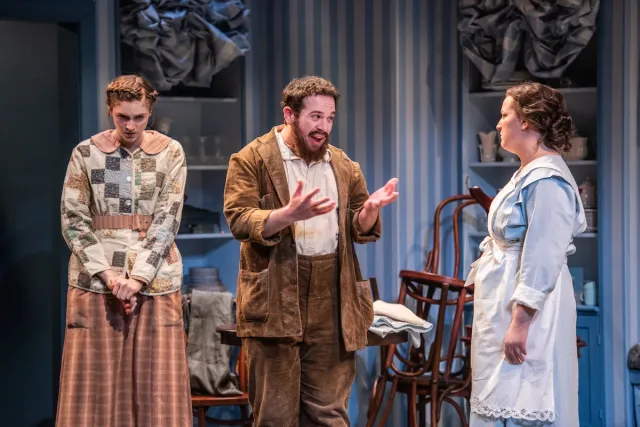




Latest Videos
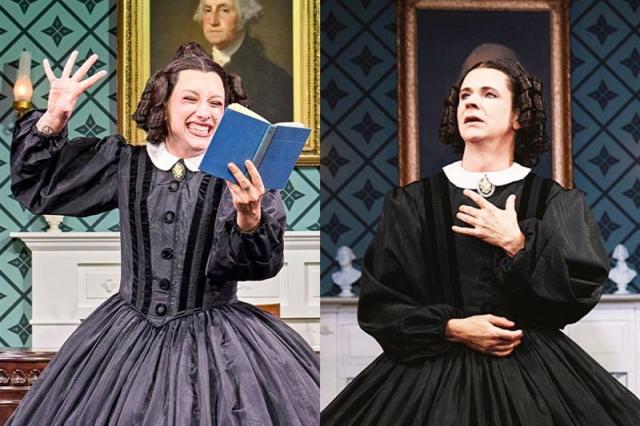
West End vs Broadway: Oh, Mary!—From an Angry Inch to an Angry First Lady, With John Cameron Mitchell and Mason Alexander Park
Mitchell and Park celebrate a decade-long friendship in our latest installment.