
Review: Ian McKellen, Cradle to Grave, in Mixed Reality Play An Ark
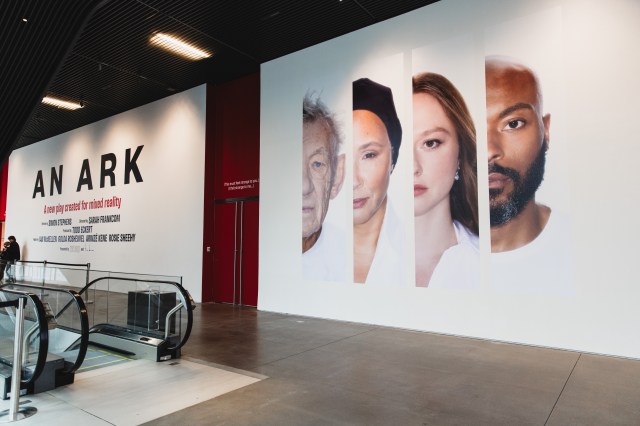
The Shed premieres the latest Simon Stephens drama, presented through goggles by the company Tin Drum.
 |
New York City
|
|
New York City
|
January 14, 2026
(© Fiona Freund)
You enter a long hallway and are greeted by a set of rules:
wipe your feet
check your glasses
store your shoes
enter through the curtain
find a seat
put on your headset
sit back
enjoy the ride
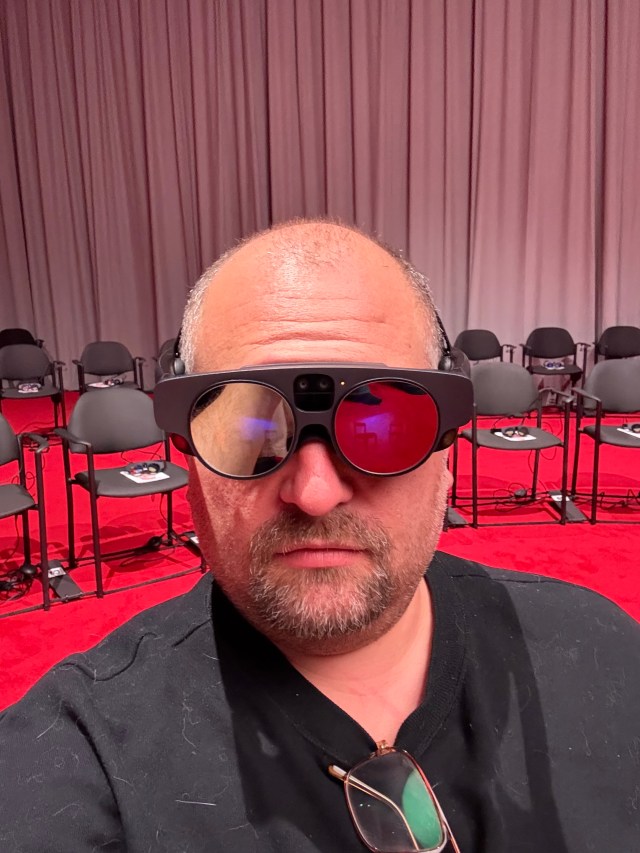
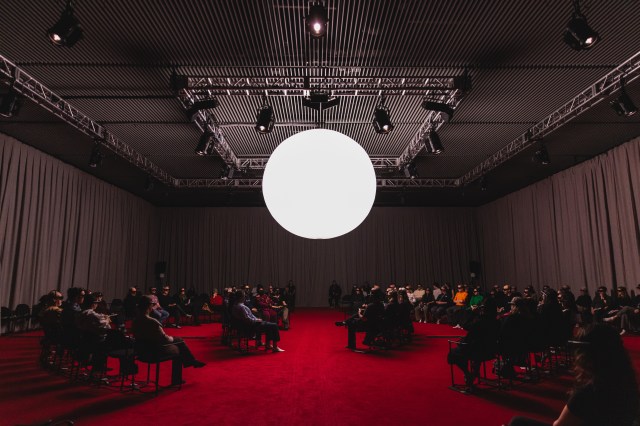
You follow these rules. You let a specialist check your prescription in a microscope that you’d see at the ophthalmologist’s office. You remove your boots and slide them into a cabinet. You take a seat in a long room with blood-red carpeting, a glowing orb dangling in the center. You are given corrective lenses that snap into a headset. You put it on. It takes a few adjustments to make it sit on your fat, oval-shaped skull. It never fits quite right. Now you look like Geordi La Forge, and you’re about to watch An Ark, a 47-minute, second-person point-of-view “mixed reality” drama by Simon Stephens, presented at the Shed by Todd Eckert and his studio, Tin Drum.
(© David Gordon)
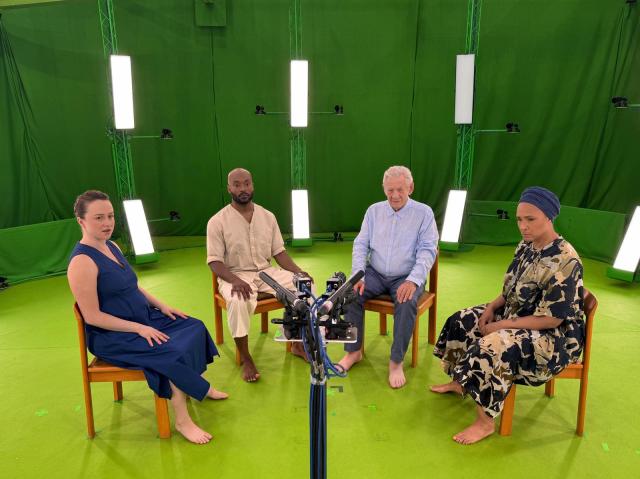
Through your goggles, you see four wooden chairs suspended in midair, though they’re probably meant to be resting on the floor (you’re never quite sure, but it’s not a big enough deal to flag down a technician). When An Ark begins at the appointed time—well, 10 minutes after the appointed time, because even virtual theater starts late, apparently—Ian McKellen appears first, seated directly in front of you (well, floating slightly above you). He stares at you. Then Golda Rosheuvel enters, coquettishly half-smiling at you. Arinzé Kene and Rosie Sheehy follow, taking their seats, also vaguely hovering, also staring you down. It begins.
You watch the latest play by the scribe of The Curious Incident of the Dog in the Night-Time and Heisenberg, which is a cradle-to-grave examination of a life, of various lives, of your life. You are born in a hospital beneath a rainbow. You feel grass, or ocean, for the first time. You are good at sports until you aren’t anymore, and then you kill yourself in despair, or maybe you don’t. You orgasm. You stay at the same job for 10 years and have no idea where those 10 years went. You start making noises when you stand up. Your skin gets wrinkles. You watch your father die. You get sick. You die. In death, you realize how much you loved the world.
Your goggles, and everyone else’s, have blinders on the sides, perhaps to stave off motion sickness, so you can only see two actors at a time, at best. You find yourself craning your neck in either direction when Sheehy or Rosheuvel are speaking. As they drone on about an existence that’s meant to be yours but isn’t, you start noticing the oddities of the spatial video, like how a 52-camera shoot by 4DViews in Grenoble, France, can produce images so lifelike it feels as though McKellen and Sheehy are watching you just as intently as you are watching them, yet remain low-res enough for you to catch the pixelation beneath Kene and Rosheuvel’s feet.
You can make out fine details of Rosheuvel’s forearm tattoo and the blister on Sheehy’s foot, but when they reach their hands toward yours, the gesture somehow goes over your head. You think about why sound designers Ben and Max Ringham pump the play’s audio from overhead speakers, instead of creating the same kind of spatial sound your AirPods deliver. You wonder how the latest technology could feel so advanced and so primitive at the same time.
(© Marc J. Franklin)
You are open-minded enough to applaud the effort of Eckert and director Sarah Frankcom, but you are not convinced that this is an endeavor worth pursuing. You had expected production designer Rosanna Vize to create a full set for the digital performers to engage with, but you quickly realized that while mixed-reality figures can inhabit a space, they can’t truly interact with it, which is disappointing. You wonder just how expensive it was to create a show like this, with up-to-the-minute technology that is nonetheless disappointingly inelegant. You think about having sat in the furthest corners of Brooklyn Academy of Music and the Old Vic and even the Shed itself, and how these exact performers have felt more real from miles away than they do here, supposedly right in front of you.
As McKellen and the play dematerialize, you lift off the glasses, collect your shoes, and trade the labyrinthine hallways of the Shed for the endless escalators at the Hudson Yards 7 Train station. The subway arrives and you try to hold onto what you just saw. You conclude that you’ve basically watched a movie, not simulated the live experience.
You could have just as easily done that at home.
(© Marc J. Franklin)




Featured In This Story

Latest Reviews
See all


Latest Videos

West End vs Broadway: Oh, Mary!—From an Angry Inch to an Angry First Lady, With John Cameron Mitchell and Mason Alexander Park
Mitchell and Park celebrate a decade-long friendship in our latest installment.