
Review: Distant Echoes of Wilde in Harold Brighouse’s Quirky Romantic Comedy Zack
The Mint Theater Company unearths Brighouse’s 1916 play at Theatre Row.
 |
Off-Broadway
|
|
Off-Broadway
|
March 10, 2026
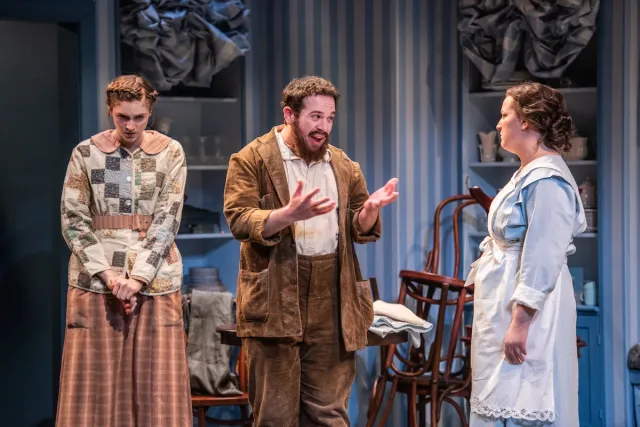
(© Todd Cerveris)
Nearing 30, Zack (Jordan Matthew Brown) still has his head in the clouds. Though his mother and brother Paul “can’t do the wrong thing if they tried,” he says, “it’s just the other way with me.” When he helps at the weddings his family caters, he gets so overcome with emotion that he drops the plates. And he doesn’t dress like the gentleman his mother hoped he’d become. Worse, he admits, “I’m not so frequent at the soap as I might be.”
Zack’s a curious protagonist for a play written in 1916 and even more so for one produced 110 years later. That kind of long-languishing resurrection is the mandate of the Mint Theater Company, dedicated to the restoration and refurbishing of forgotten old plays, but Harold Brighouse’s Zack needs a little more than light dusting to blow away the cobwebs.
The Mint does more than prop up the spines of fading playscripts. Last season’s Garside’s Career, the company’s first Brighouse production, thrillingly breathed life into that political and social satire in a successful act of revivification. And Sally Carson’s Crooked Cross last fall, though somewhat less compelling onstage, was an extraordinary example of how dramatists in centuries past have documented the fall of democracy in real time as it plays out around them.
Zack, in this staging, however, doesn’t transcend the label of historical curiosity. Writing just about 20 years after the premiere of The Importance of Being Earnest, Brighouse seems to have aimed here for a pseudo-Wilde drollery. If he couldn’t quite match Wilde’s barbed wit, Brighouse nonetheless offers a ludicrous cavalcade of characters, all of whom are fairly fanciful in their whims and not-quite-credible actions.
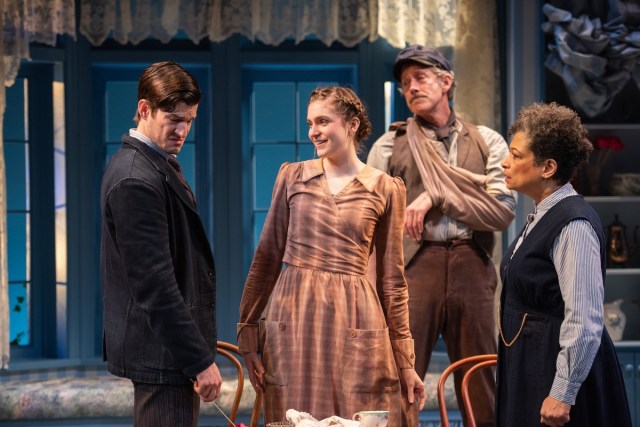
(© Todd Cerveris)
It would probably play best now as an early-20th-century fairy tale, not least because it’s got two hardcore storybook villains. Zach’s mother, Mrs. Munning (Melissa Maxwell), and brother, Paul (David T. Patterson), are repulsively mean to him. “I have my use,” Zack attests, and his mother rejoins, “I haven’t noticed,” before plotting to ship him off to Canada, collateral damage of a scheme to wring money from their rich young relation Virginia (Cassia Thompson). When nasty Paul hears that one of his employees has had an accident, he exclaims, “How dare he break his arm!,” then sacks him: everybody, on the page, is rather silly.
But Britt Berke’s direction is too staid and realistic. Zack himself seems less like just one extreme among a company of extremes and more literally a guy with severe Edwardian ADHD whose neurodivergence isn’t understood or accommodated. That diagnosis, in a time before the DSM, may lurk beneath the text, but Brighouse didn’t have language for it, nor much interest in using his zany comedy to probe the psychological impact of a cruel, abusive parent on an atypical child.
The production also somewhat unmoors Zack from the particulars of its Edwardian setting. Brittany Vasta’s baby-blue drawing room scenery would suggest an attempt at verisimilitude. But all the actors speak in American accents, even though much of the play’s satire centers around English class differences and social-climbing, the sort of period pursuit that seems to require sharply rendered accent work. Some performances have a decidedly 2020s sheen to them, but Maxwell, as close as you can come these days to a Brighouse specialist (she also played a matriarch in Garside’s Career), and Thompson, giving the play’s sharpest performance, come the closest to marrying contemporary clarity with historical poise. Sean Runnette, as the worker with the broken arm, cantankerously wakes things up when he storms onto the scene to demand Zack marry his daughter Martha (Grace Guichard) in one of the play’s more contrived plotlines. “I do hate argument when people have a voice as loud as Joe’s,” Zack says, so agrees to marry Martha to shut her father up.
But Brighouse does have a lovely closing gambit, a tender scene between Virginia and Zack, in which she finally does away with his unkempt beard. Urging him to speak his unexpressed feelings for her, Virginia keeps reminding Zack to look in the mirror at his newly youthful visage: it’s a sort of delicious Wildean conceit that Zack’s own reflection will instantly bolster his self-esteem and he’ll propose on the spot. With Thompson and Brown dissolving the genuine sweetness and the playful absurdity into one credible moment, there’s a glimmer at what Brighouse might have been going for, and Zack, in its final minutes, is alive again after a century away.




Featured In This Story

Related Articles
See all

Latest Reviews
See all



Latest Videos
West End vs Broadway: Oh, Mary!—From an Angry Inch to an Angry First Lady, With John Cameron Mitchell and Mason Alexander Park
Mitchell and Park celebrate a decade-long friendship in our latest installment.