
Review: Coriolanus as a Spectator Sport—Bring On the Jumbotron
Ash K. Tata directs Shakespeare’s classic of class war at the Polonsky Shakespeare Center.
 |
Off-Broadway
|
|
Off-Broadway
|
February 14, 2026
(© Hollis King)
As we hack our way into a future dominated by AI and shrinking attention spans, it’s inevitable that we’re going to see technology not only helping us make new kinds of theater (it always has) but also being theater. Language and plot no longer seem to be enough. Today, for better or worse, we need gadgets to tweak our synapses.
Along those lines, director Ash K. Tata has booted up a production of The Tragedy of Coriolanus with lots of bells and whistles. Copious projections flash across the set. Characters use VR headsets and haptic pistols. And a Jumbotron-like structure projects battle scenes that look like a video game, complete with running social media commentary. Attention engaged!
For a little while, anyway. Blame my ever-diminishing attention span, but I quickly lost interest in Tata’s techno-extratextual commentary on Coriolanus, now running at Theater for a New Audience’s home, the Polonsky Shakespeare Center. I get it, to an extent: it’s impossible to divorce our consumption of politics and civil unrest from the technology we’ve plugged into our brains. But with performances as strong as the ones we get from this cast, I would have welcomed the chance to unplug.

(© Hollis King)
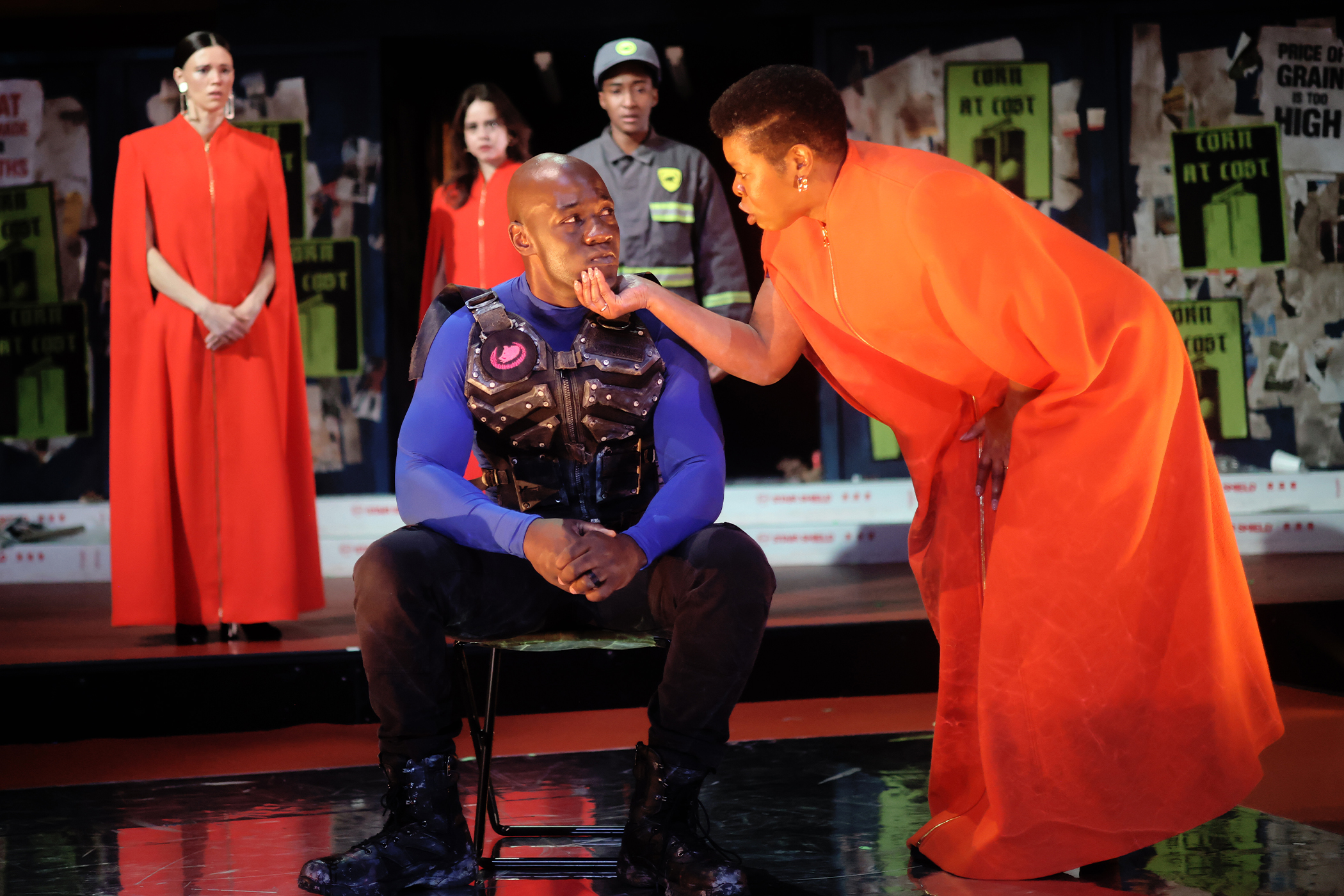
That’s especially the case with McKinley Belcher III, giving a colossal performance as the elitist Roman patrician and warrior Caius Martius. It’s a huge role in one of Shakespeare’s longest plays, but Belcher spikes the ball on this one. He plays the highly decorated defender of the Republic whose home city of Rome is experiencing plebian protests over food shortages. Caius Martius has nothing but contempt for the common folk, but he’s putty in the hands of his fiercely proud mater, Volumnia (a stately and commanding Roslyn Ruff). She’s the type who prefers a dead son to a cowardly one.
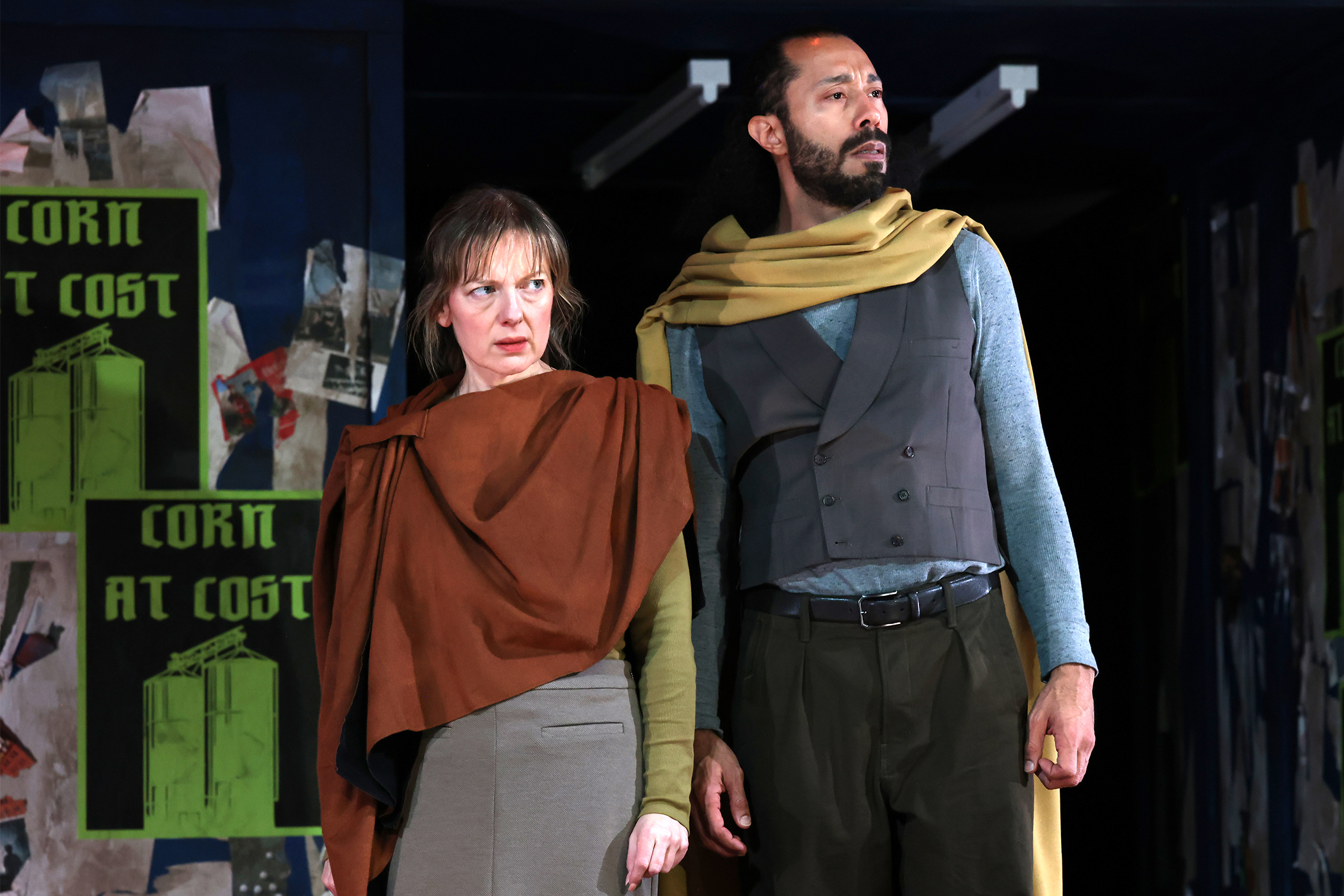
After conquering the Volscian city of Corioli with the help of Titus Lartius (Sarin Monae West) and vanquishing its leader Aufidius (Mickey Sumner, Sting’s daughter, looking like a bird of prey), Caius Martius is dubbed “Coriolanus.” He wants to be consul, but to get the job, he must woo the plebs, led by the tribunes Sicinius and Brutus (William DeMeritt and Zuzanna Szadkowski bringing solid laughs to their roles).
He will not deign to beg for votes, however, so he is banished, and in revenge he offers to help Aufidius sack Rome. Volumnia, joined by Coriolanus’s wife, Virgilia (a stoically poised Meredith Garretson) entreat him to spare the city (and thus also his son, played by Merlin McCormick). When he agrees to call off the raid, Aufidius takes the betrayal to heart, and Coriolanus pays the price.
(© Hollis King)
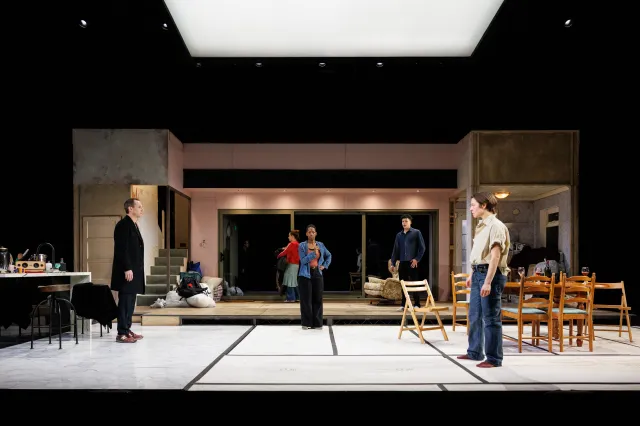
Coriolanus is not one of Shakespeare’s most popular plays, but it’s been popping up more frequently in the past 10 years. You can probably guess why. Tata, who has tried to present the play without clear-cut good guys and baddies, doesn’t tamper much with the text, but the enormous orange curtains that form of the backdrop of Afsoon Pajoufar’s set (a senate house barricaded behind a wall of protest posters), Coriolanus’s orange baseball cap bearing the ironic letters SQPR, and the orange dresses (by Avery Reed) worn by upper-crusters Volumnia, Virgilia, and their friend Valeria (Emma Ramos)—well, you make the connections.
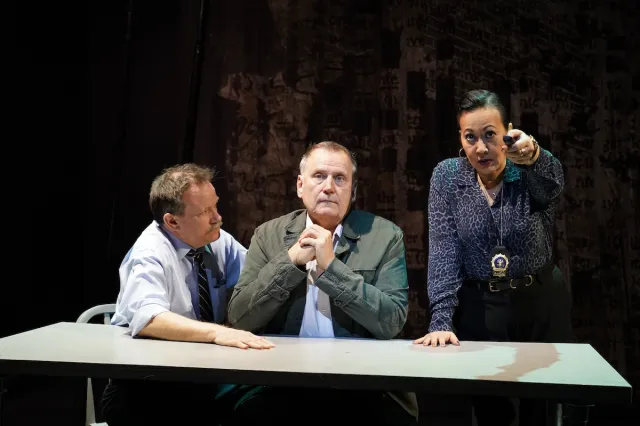
With the heady politics and a three-hour run time, Coriolanus can be a wiggly sit. But to Tata’s credit, this production delves into the play’s humor with gusto, beginning, somewhat shakily, with Jason O’Connell as the patrician Menenius. He delivers the famous “fable of the belly” speech as though he’s being disemboweled, writhing his limbs and slurring his words while the bemused citizens stare on; the scene elicits chuckles for all the wrong reasons. Not so with Kevin Alicea, Jack Berenholtz, and Pomme Koch, who get solid laughs as three surly servants dishing on their bosses. It’s like Upstairs, Downstairs before television screens.

(© Hollis King)
Speaking of screens, I found myself ignoring the Jumbotron thingy high above my orchestra seat until it started shining arena-intensity lighting (by Masha Tsimring) down on Cominius (Barzin Akhavan) as he delivers a long speech. That’s a shame, because projection designers Lisa Renkel and her colleagues at Possible must have spent a lot of time creating the details, which I’m sure were better appreciated from the balcony.
Additional missteps weaken an otherwise muscular production. Brandon Keith Bulls’s energetic sound design sometimes overtakes the actors’ voices or fails to amplify them at all, though it does give David T. Little’s music a chance to shine. And for a play about war, fight choreographer J. David Brimmer’s duel between Aufidius and Coriolanus seems remarkably anemic. It would have been more entertaining to see them fighting in VR goggles.
OK, maybe not. You don’t need gimmicks when your cast is this good. After all, it was Belcher, not technology, that brought a tear to my eye at the end. In the words of Aufidius, “I was moved withal.”




Featured In This Story

Latest Reviews
See all


Latest Videos

Watch Jessica Vosk and Kelli Barrett Sing a Song From the Upcoming Broadway Musical Beaches
Broadway performances start on March 27 at the Majestic Theatre.