
Film Review
Review: Blue Moon, Ethan Hawke and Richard Linklater's Tribute to Tortured Genius Lorenz Hart
Margaret Qualley and Andrew Scott also star in this biopic of the Broadway songwriter.
 |
|
|
|
October 16, 2025
(© Sony Pictures Classics)
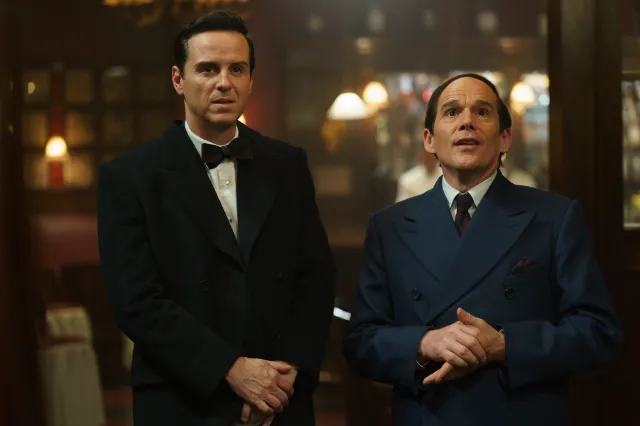
On March 31, 1943, Richard Rodgers and his new collaborator, Oscar Hammerstein II, revolutionized the American musical with the Broadway premiere of Oklahoma! Seven months later, Lorenz Hart, the initial songwriting partner with whom Rodgers penned hits like “My Funny Valentine” and “Manhattan,” was dead from pneumonia, having been found sitting in the gutter on Eighth Avenue during a cold rainstorm. Rodgers and Hart was the past; Rodgers and Hammerstein signified the future.
The image of the lyricist staggering out in the rain opens Richard Linklater’s new biopic Blue Moon, in which his longtime collaborator, actor Ethan Hawke, delivers a wrenching turn as the acerbic Hart, desperate for booze, attention, and—perhaps most crucially—respect from an industry drunk on the latest shiny object.
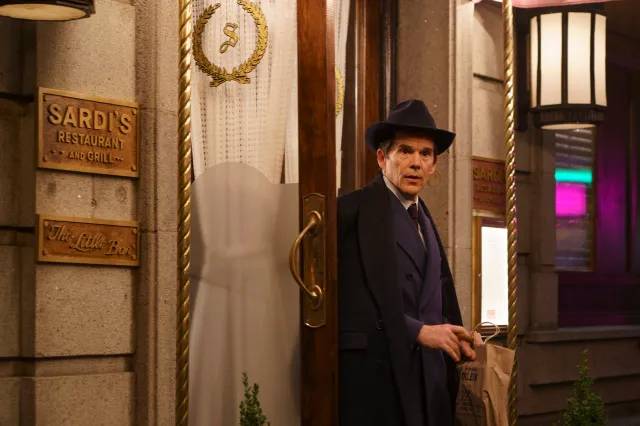
Fittingly, Robert Kaplow has written Blue Moon like a stage play, with a limited number of characters and what basically amounts to a single location, the theater district watering hole Sardi’s. That’s where the diminutive Hart retreats after the first night of Oklahoma! down the block at the St. James, and where he’s thrilled to regale loyal barkeep Eddie (Bobby Cannavale) and pianist Morty Rifkin (Jonah Lees) with stories of how much he hated it.
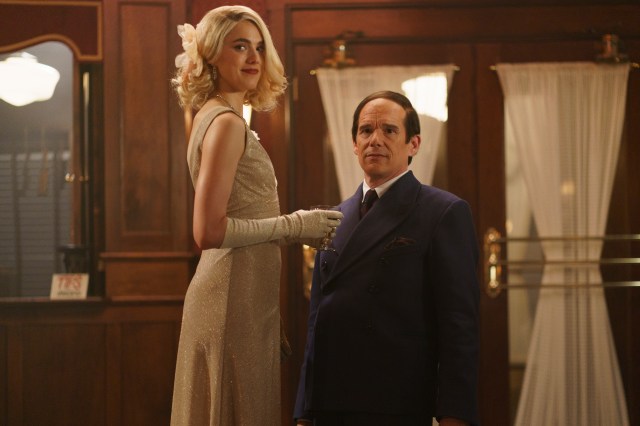
Hart lingers at Sardi’s, awaiting Rodgers (Andrew Scott), Hammerstein (Simon Delaney), and the jubilant Oklahoma! company. He’s also anticipating a rendezvous with worldly co-ed Elizabeth (Margaret Qualley), two decades younger but nonetheless the current object of Hart’s obsession.
This is no sanitized biopic like Words and Music, where Hart was written as straight; instead, Kaplow and Linklater portray him as he was widely believed to be—gay, deeply closeted, voyeuristic, and acting out of unbearable loneliness. Despite Hart’s (misguided) hope for carnal relations, his connection with Elizabeth is less about romance and more about connection—any kind of connection. In a room of people that have forgotten his impact, turned off by his heavy drinking and melancholia, she actually pays attention.
(© Sony Pictures Classics)
The result is a surprisingly layered, deeply emotional character study, undercut at times by some heavy-handed moviemaking: trick shots that shrink the 5’10” Hawke by a foot, a conspicuously theatrical set from production designer Susie Cullen (who built this facsimile of Sardi’s on a soundstage in Ireland), and cinematography that makes the film resemble a PBS archival taping more than a big-screen motion picture.
Then again, Blue Moon is a flick for theater people, so an embrace of the inherent staginess of the subject matter makes sense. Kaplow crams his screenplay with sly references, cameos, and implications, the most noticeable of which comes when Hammerstein introduces Hart to a child friend of his, a neighbor from Doylestown named Stevie, who openly criticizes Hart’s work as a lyricist. Cillian Sullivan is hilariously imperious as the young Sondheim (who would go on to take Hart’s work to task throughout his adult life, calling him “the laziest of the pre-eminent lyricists”).
The movie’s success rests on Hawke’s stooped shoulders, and he really embodies the spirit of a late-night theater argument over a bottle of bourbon. Blustery, bitchy, charming, and unseemly, his Hart is a king of snark who’s desperate for a compliment, despite being his own worst critic. And yet, he’s still gracious enough to congratulate his old collaborator, while pleading for another chance to keep their partnership alive. Scott is excellent as Hart’s sensitive foil, willing to indulge his friend one more time, while firmly laying down the law.
Of course, that last collaboration between Rodgers and Hart is a revival of A Connecticut Yankee. It contained five new songs—the most notable of which was “To Keep My Love Alive”—and it opened on November 17, 1943. Hart showed up drunk to the performance and was dead five days later. Blue Moon serves as an emotional portrait of a man whose lyrical genius has far outlasted his torment.
(© Sony Pictures Classics)




source on Google
Latest Reviews
See all






Latest Videos
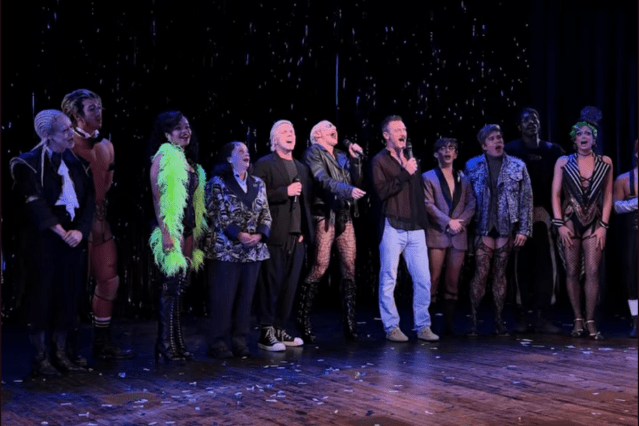
Broadway Cast of The Rocky Horror Show Pays Tribute to Tim Curry
Paul Soileau, Jake Shears, and Luke Evans led the cast in “I’m Going Home.”