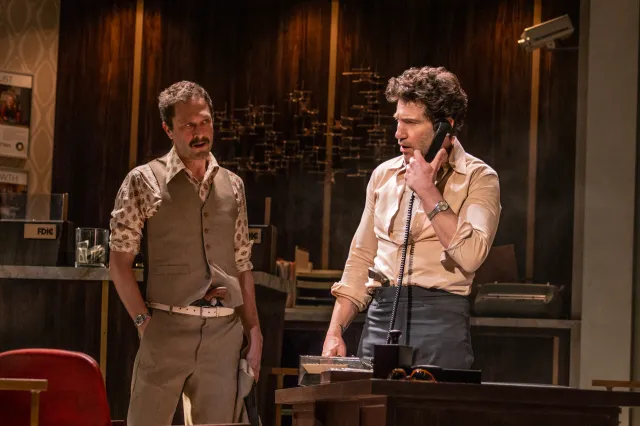
in The Poet of Columbus Avenue
Photo: Corky Lee
Even after a trip from Los Angeles that hurdled delayed flights, lost luggage, and a hurricane downpour, Dennis Escobedo was remarkably calm about the world premiere of his new play, The Poet of Columbus Avenue. As he should be, in the capable hands of his theatrical team, director Ron Nakahara and Pan Asian Repertory Theatre artistic producing director Tisa Chang.
Nakahara and Chang were impressed by the very qualities of Poet that Escobedo himself possesses: charm, intelligence, and youth. He has pitched a perfect game. Without an agent and with little fanfare, Escobedo submitted his script to Pan Asian Rep. Nakahara and Chang liked it, and based on the response of a single reading, the play moved to a full production that begins previews June 21 at Theatre Four.
The Poet of Columbus Avenue is set in San Francisco’s Chinatown, and Nakahara describes it as fresh and well written, a gentle throwback to another age. “Tisa and I were really surprised by it,” he says. “It’s not the sort of script you often see, in town or out.” Four of the five characters are men, but the female lead, Mary, is the spiritual core. “All of the decisions she makes set the action,” Escobedo explains. “The plot grows out of her character.”

Billed as a romantic comedy–with delightful screwball elements–Escobedo likened it to the Cary Grant/Katharine Hepburn comedies of the ’30s and ’40s. He’s been working on it for three years, but it all started with a simple idea: to write a sweet play with an urban, Woody Allen flavor.
Nakahara praises cast members, many of whom he has previously worked with. “They aren’t just comic actors, but accomplished actors,” he says. “It takes a real sense of humor to understand comedy, and not everybody does.” Defining funny, Escobedo admits, still occasionally escapes him. “I find it fairly easy to write, but sometimes I laugh out loud in an empty room. But, inevitably, when it’s read for the first time, nobody laughs. And then there are other passages that may not read humorously, but which play funny, because the actor defines it as part of their character. That’s most rewarding–to have a director and cast bring surprises.”
For Chang, Poet represents a time of transition for Pan Asian Rep, which is on the cusp of change. “We want to expand to better meet the needs of, and to reflect, the population of the 21st century,” she begins. “And this means that the people in this play are young, hip, sophisticated, and American, and that their Asian heritage is almost an after-thought. It’s very right for us to reflect this younger generation’s being, their presence and their dreams.”