
Interview: Watch Anne Gridley Walk Off-Broadway
Gridley’s new show, Watch Me Walk, is a Soho Rep production at Playwrights Horizons.
 |
Off-Broadway
|
|
Off-Broadway
|
January 16, 2026
I spent a day with Anne Gridley once, way back in the golden age of the 2010s. She didn’t know who I was, and I didn’t know who she was, but I remember being captivated by the way she jumped in Nature Theatre of Oklahoma’s marathon work Life and Times: Episodes 1-4.
A founding member of Nature Theater of Oklahoma, Gridley has toured the world in avant-garde productions like Life and Times, which reimagines a young woman’s life as a calisthenics lesson and an Agatha Christie mystery, and Romeo and Juliet, where the performers put on the Shakespearean tragedy based only on other people’s misremembered memories of the play and its text. She’s got two Obies to show for it.
When Gridley was doing Life and Times at the Public Theater during Under the Radar in 2013, she was already dealing with the effects of Hereditary Spastic Paraplegia (HSP). An inherited orphan disease that has no cure, HSP causes progressive stiffness and weakness of the legs, due to the degeneration of the motor nerves in the spinal cord.
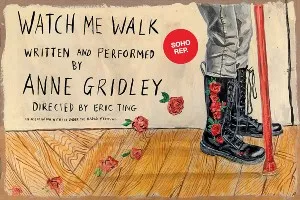
This probably isn’t a disease that you’re familiar with. And in her new show, Watch Me Walk (running through February 8 in a Soho Rep production at Playwrights Horizons), Gridley is going to tell you all about it. Even though she never really planned to.
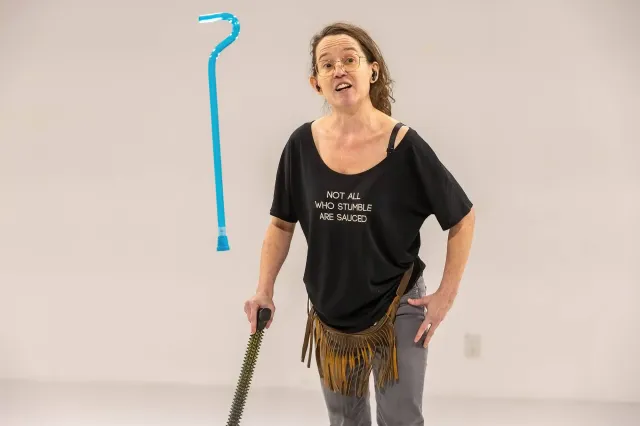
(© Robin Michals)
This conversation has been condensed and edited for clarity.
I understand you came up with the title for the show before you came up with the actual show.
I’ve had the idea of the title for years. I was just like “Oh, wouldn’t that be funny?” I kept telling people in downtown theater “Isn’t this a funny title for a thing that does not exist?” And many of them were like, “Yes, that is a very funny title.” But then, Annie-B Parson recommended it for the Prelude Festival at CUNY. She called me on it, essentially, and then I had to come up with something. [Director] Eric Ting saw that and said that Soho Rep would like to commission the full piece, so then I really had to come up with something.
Artists put themselves on display professionally, but obviously this is a sensitive, personal subject. Hundreds of people are going to know about this rare disease you have running through your family.
It’s considered an orphan disease because so few people have it. Although, because it’s so often misdiagnosed, my favorite neurologist suspects that it might not be as rare as we think.
My mom had it. Her mom, who I never knew, was one of seven, and apparently five out of the seven of them had it. And I have an older brother, but he died when he was 11, so I don’t know if he would have had it, because the type that I share with my mom and grandma doesn’t usually present until adulthood. I grew up not thinking I had it, and then when I started to present with it, I was told it was something else, similar only in that there is no cure.
Love that.
Yeah, so that was fun. I went through that healthcare journey of bad doctors, being depressed about bad doctors, not seeing any doctors, crawling out of that hole, and finding a good doctor who said, “Let’s figure out what this actually is.”
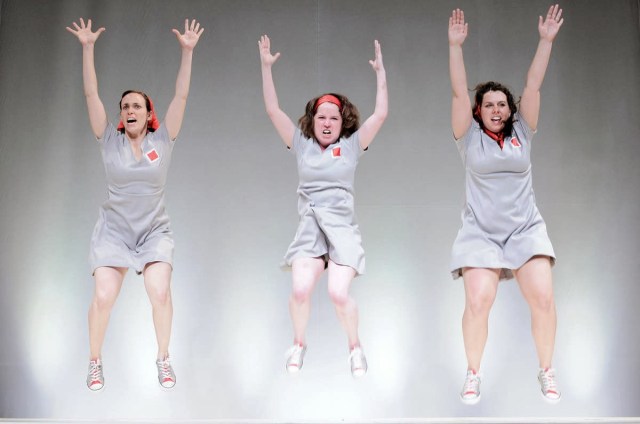
(© Nature Theater of Oklahoma)
So, the first time I saw you perform was in Life and Times at the Public in 2013. And I remember this long sequence where the cast was doing calisthenics and you were jumping all over the place. Where was that in the timeline in relation to your diagnosis?
It was presenting already at that time. That was the “You’ve got spinocerebellar ataxia” [period] but I knew I had what my mom had. I wasn’t using mobility aids, but my balance wasn’t great. And I couldn’t jump as high as my castmates, not just because I’m short, I learned. I think there was probably some sort of stiffness in some of my movements, but I might’ve been using it to make it a character thing for the piece. And maybe the audience was like, “Well, that was an interesting physical choice,” but it wasn’t a choice.
How did a diagnosis such as this affect the art that you make?
Well, I’m grateful that I work in experimental theater. It would be quite different if I worked for New York City Ballet. [Laughs] The downtown or experimental type of theater that I do is more forgiving of body difference. At least, that’s been my experience. It hasn’t been as devastating as it very much could have been for me. That’s not to say it’s without frustrations, challenges, and difficulties. I cannot promise you that I can make it to that part of the stage in two seconds, because I might be cold.
And then you look a lot of these spaces, and you realize that they’re ill-equipped for anyone that’s not upright and functional.
Hilariously not accessible. I just would love a good banister. They’re really helpful for a lot of folks.
What have you heard from people who’ve seen the show in its various stages?
We’ve done a couple of workshops for friendly faces and those have been good. I was a guest teaching artist at Northwestern last spring, and I invited this neuroscientist who I’ve gotten to know, and she invited her lab. One of the lab members brought his kid, and the kid, I guess, was really moved by it. He went to his dad and said “You need to keep working in the lab. It’s ok to miss my soccer game. You need to help find a cure for this thing.” It started as a joke of a title, and here we are.




Featured In This Story
Latest Reviews
See all

Latest Videos

West End vs Broadway: Oh, Mary!—From an Angry Inch to an Angry First Lady, With John Cameron Mitchell and Mason Alexander Park
Mitchell and Park celebrate a decade-long friendship in our latest installment.