
Interview: How Ethan Lipton Adapted The Skin of Our Teeth by The Seat of His Pants
Lipton’s new musical, The Seat of Our Pants, is having its debut at the Public Theater.
 |
Off-Broadway
|
|
Off-Broadway
|
November 12, 2025
If you’ve ever seen an Ethan Lipton show, you know the peculiar pleasure of trying to pin down what you’ve just experienced.
A playwright, songwriter, and performer, Lipton has spent years carving out his own unmistakable corner of the downtown theater scene, with works that balance humor, melancholy, absurdity, and sincerity. His works—including We Are Your Robots, Tumacho, Red-Handed Otter, and No Place to Go—have been presented by the likes of the Public Theater, Clubbed Thumb, and Theatre for a New Audience (not to mention countless open-mic nights that scared many audience members).
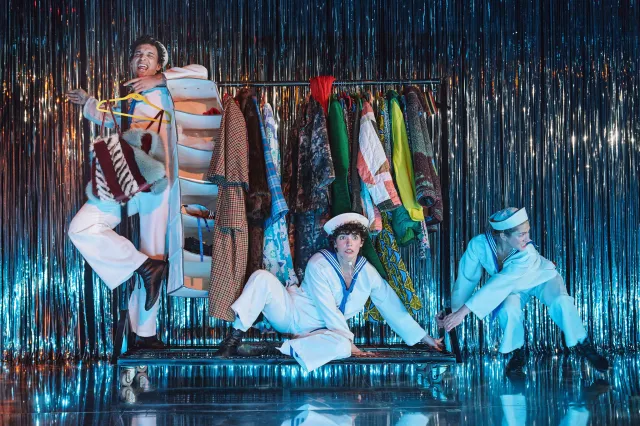
Now, Lipton returns to the Public with The Seat of Our Pants, his musical adaptation on Thornton Wilder’s The Skin of Our Teeth. In true Lipton fashion, this is a look at humanity’s endless cycle of destruction and reinvention told through a lens that’s both human and a little skewed.
We caught up with Lipton to talk about why The Skin of Our Teeth stuck with him, how he writes songs without knowing how to play an instrument, and why he insists on being playful about serious subjects.
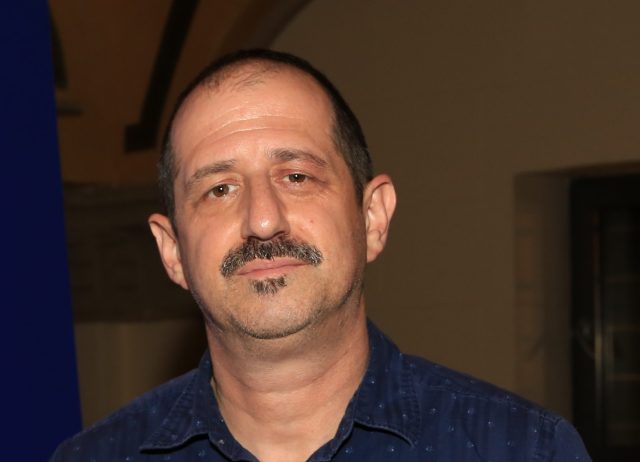
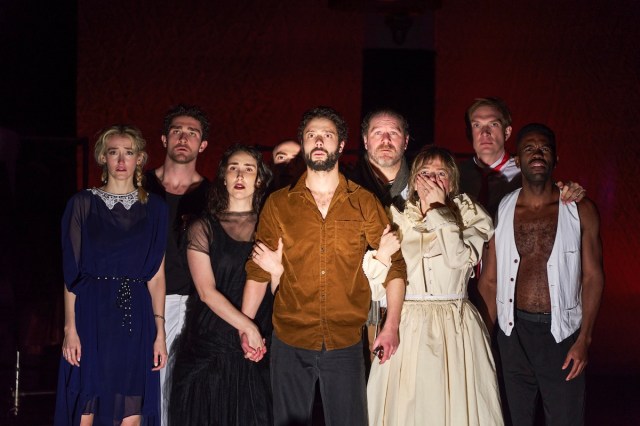
(© Tricia Baron)
This conversation has been condensed and edited for clarity.
The Skin of Our Teeth is one of those plays that I always feel like I enjoy more in theory than in practice.
I’d seen one production in college that I just couldn’t access, and then I read it again with my adult brain and I was really moved by the ambition of it. It’s trying to reach the audience in the heart and the belly, but also in the head. It is so full of ideas. Things are urgent and important, but then there’s dinosaurs. Wilder blends sincerity and irony. He’s looking at the human species from 30,000 feet up. I really like doing my own version of that.
I was going to say, knowing Tumacho and Red-Handed Otter, The Skin of Our Teeth seems like a natural fit for your sensibility.
I’ve had talking cacti and talking animals and robots. I think there’s some part of my brain that doesn’t distinguish between puppets and people—flat surfaces and dimensional surfaces. All that exists in the same universe for me. I try to be playful about serious things.
I’m fascinated by the fact that you don’t write music. You hum into a audio recorder, right?
That’s right.
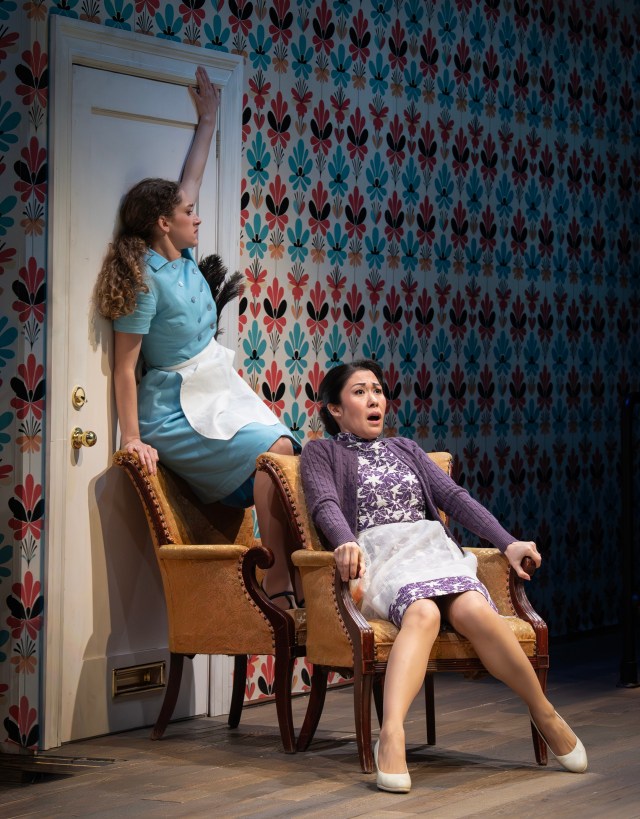
(© Joan Marcus)
How is that possible?
When I started singing in public, I’d been writing plays for 10 years. I had just moved to New York, and I was trying to find my way into the theater. New York is never saying welcome. You have to find your way around. I had written songs to keep myself company. I would write songs on long walks. I would write songs in the shower. I took a couple of big trips in my 20s and I remember walking through some foreign country singing a song to myself. I find refuge in it.
A friend dared me to do some of my songs at a downtown variety show in a warehouse in the meatpacking district. I did a three-song set and I sang a cappella because I don’t play any instruments. There was something about it that made people very uncomfortable. People were like “Oh, no what’s happening? This person who is certainly not a trained singer is just going to keep singing to us.”
But there was a theatrical tension to it. I kept doing it. I’d go to some open mic or burlesque show, and I’d sing a two-or-three-song set. I think I developed some kind of practice through that: if I could imagine it and I could sing it, then it could be a song.
Getting together with my band and working with those guys reinforced that if I could sing it, we could own it musically. After 20 years of doing that, you have some tools in your chest. I have always known when a song felt right and when it doesn’t, even though I don’t have the language in music terms. I get confused by simple things, like talking about a bar or a measure. I can articulate what it is that I’m looking for, to some degree, and I’ve been lucky enough to work with great musicians and arrangers who can turn that into music.
I can’t imagine how much more complicated that is with a property as dense as The Skin of Our Teeth.
Yeah. But there are so many opportunities in it. That’s the thing I kept finding. I listened to the play, and sometimes I heard melody for Wilder’s words that I would shift into lyrics. Sometimes, I unpacked a single idea. Mrs. Antrobus has this song, “Stuff It Down Inside,” which seemed like a core idea of who she was. I was trying to think of what her recipe is for getting through disaster after disaster. There’s this part of her that is old fashioned. The whole family is very old fashioned. They weren’t going to have great insight into how to live like modern people; their superpower was the commitment to the old way of doing things. For her, you figure out what you’re feeling and then you push it down inside and don’t deal with it.
Which is such a 1950s feeling.
Right. And sometimes, that’s the right way to go, you know? So, yeah. I tried to keep listening to what the play seemed to want. I worked on it act by act, and once you have a couple of songs that are speaking to you, you know that the song before and after it has to be doing something different. And the choices start to seem not as difficult.
So many people have tried and failed to turn Skin of Our Teeth into a musical: Comden and Green and Bernstein, Kander and Ebb and Stein. Where do you fit into that lineage?
I figured that if I got it right, good for me. And if I failed, I’d been in good company. I didn’t know any of those people, but I have such admiration for all of them. Obviously, they’re legends. I don’t know that I would describe any of them as offbeat, or as having made work that is open to being off center. I’m never trying to be those things, but I do know that I have a sensibility that’s a little weird, if we’re going to find a term for it.
And Skin of Our Teeth is a weird piece. It is truly a wackadoodle play in the most beautiful and challenging way. I wanted the music to open it up, but I knew that I wasn’t going to try to make it less weird. So, I felt like I had a shot, and if it blew up on me, it was an awesome thing to try.
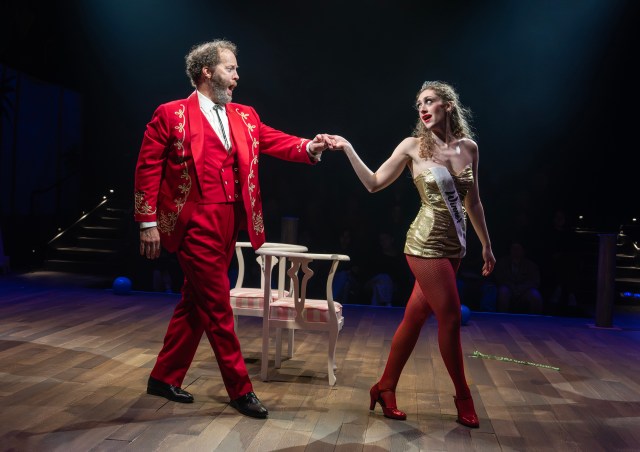
(© Joan Marcus)




Featured In This Story

Latest Reviews
See all
Latest Videos

Get a First Look at Megan Thee Stallion as Zidler in Moulin Rouge! on Broadway
Megan Thee Stallion starts performances on Tuesday, March 24.