Victoria and Frederick for President
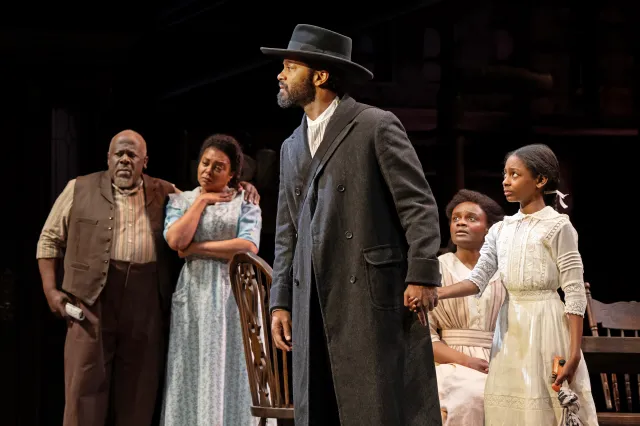
(© Joel Nichols)
What constitutes “fringe”? Now in its 13th year, the New York International Fringe Festival has grown and changed a lot since its initial outing in 1997. TheaterMania interviewed eight participants in this year’s festival to find out how they define fringe, and what makes their shows “fringy.”
For Charles Randolph Wright — who has received widespread acclaim for his work in theater, film, and television — the Fringe is about relearning to do things simply. “Everything is so fast and furious,” says Wright, who is directing Victoria and Frederick for President, a new play by Jonathan L. Davidson that looks at the 1872 Presidential campaign launched by female stockbroker Victoria Woodhull, who named former slave Frederick Douglass as her vice-presidential running mate. “It takes me back to my days doing shows in theaters that had five seats.You can’t rely on the set and everything else to do your work; it’s about the words.”
The piece — which features Antoinette LaVecchia and Mel Johnson Jr. in the title roles — was commissioned for a summer arts festival in South Carolina during the last election cycle, when it wasn’t even certain whether it would be Hillary Clinton or Barack Obama to get the Democratic nomination. “People really responded to the play because the issues were so contemporary,” says Wright. “What I love about this piece is the idea of history and theater being entertaining and also didactic, to think about what happened in the past and how it relates to today.”
A Tony Award-nominated musical from 1968 doesn’t seem like the most obvious choice for a fringe festival, but director/adaptor Ben West is convinced that his revisal of How Now, Dow Jones — starring Fred Berman, Cristen Paige, and Colin Hanlon — is a perfect fit. “The Fringe provides an excellent opportunity to test a work,” he states. “I certainly treat the show as a new musical because we’re developing stuff in rehearsal, adding songs, and taking away things.”
West is quick to point out his respect for the original material and in particular, his love for lyricist Carolyn Leigh. “I actually went back to her old papers, and we’ve included lyrics that were not in the original production,” he states. There are three new Elmer Bernstein-Carolyn Leigh songs, cut from the original Broadway mounting, including “Don’t Let a Good Thing Get Away,” “Where You Are,” and “Touch and Go.” (The latter will be familiar to fans of the cast album, as it was recorded prior to the show being frozen and appears on the disc.)
Similarly, West has revisited earlier versions of the libretto. “There are a couple wonderful scenes which Max Shulman wrote in his original draft, which are so telling about the characters,” he states. “I wasn’t there, and I don’t know exactly what happened, but I just think the musical lost something on its way to New York, and I’m hoping we’ve regained what it lost.”