
Review: Wicked: For Good Flies to Epic Heights, With Cynthia and Ariana at Their Very Best
The conclusion to the two-part movie-musical strengthens Act 2 with Hollywood flair.
 |
New York City
|
|
New York City
|
November 18, 2025
(© Universal Pictures)
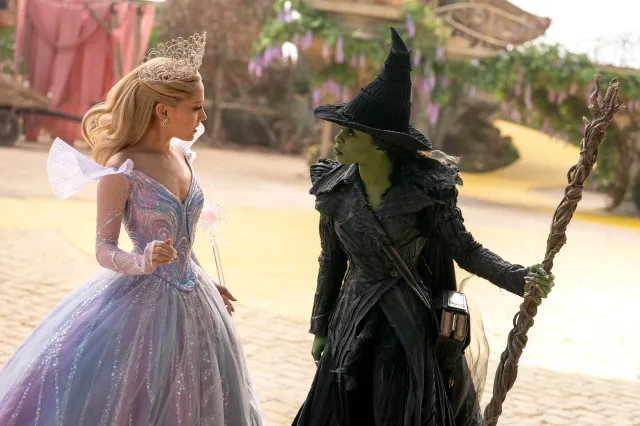
It begins mid-battle, like a superhero movie. A group of animals are laying down a road of yellow brick when there’s a disturbance in the air. It isn’t Iron Man, though, it’s Elphaba, the newly proclaimed Wicked Witch of the West.
This is a character reveal for the ages in Wicked: For Good, Jon M. Chu’s much anticipated conclusion to the cinematic saga that exhilarated the moviegoing world last fall. Darker, sexier, and more emotional than Wicked: Part One, For Good is all action, plugging the holes of the musical’s maligned second act with new songs and augmented story details. Wicked: For Good feels familiar, but it’s painting on a much wider canvas than its predecessor.
When last we saw our witches, Elphaba (Cynthia Erivo) was defying gravity, flying through Oz as the new public enemy number one, while an emotional Glinda (Ariana Grande) realized that things would never be the same. Years later, Elphaba is still trying to expose how the Wizard (Jeff Goldblum at his Goldblum-iest) is a charlatan—suppressing animal intelligence and manipulating the citizenry to maintain power. Elphaba’s sister Nessarose (Marissa Bode), her heart hardened by time and family tragedy, governs Munchkinland with an iron fist, restricting travel privileges to keep Boq (Ethan Slater) close by.
Meanwhile, Glinda has achieved the popularity she’s always craved. Not just serving as the Wizard’s public figurehead—egged on by the conniving Madame Morrible (Michelle Yeoh)—Glinda is finally engaged to her beloved Fiyero (Jonathan Bailey), now head of the Wizard’s guard. Of course, everyone ends up playing a citywide game of chicken when a girl from Kansas (and her little dog, too) inadvertently lands alongside the yellow brick road.
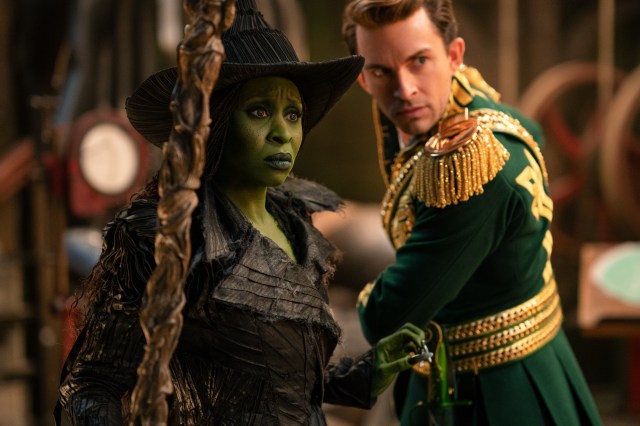
Romantic machinations and personal transformations make up the bulk of Winnie Holzman and Dana Fox’s screenplay, which expands the hourlong second act of the stage musical into a fully realized 130-minute story. Freed from the constraints of an 11pm curtain, the material now has room to breathe, allowing story elements to intensify and deepen—like the rekindling of Elphaba and Fiyero’s relationship. Bet you never expected to find them post-coital, but there it is.
(© Universal Pictures)
Also serving to further develop the story arcs are two new songs by composer and lyricist Stephen Schwartz. “No Place Like Home” finds Elphaba trying to convince the fleeing animals—including her childhood nanny, Dulcibear—to stay in Oz and fight the Wizard alongside her, only to be interrupted by, well, a cowardly lion (Colman Domingo) that Elphaba used to know. Glinda also gets a standalone song, “Girl in the Bubble,” which offers insight into her feelings, a key addition, since it’s ultimately her arc that dominates. Neither song is particularly memorable, but they serve their purposes well. I personally preferred the new mashup of “What Is This Feeling?” and “Popular,” which serve as a precursor to “Thank Goodness.”
Chu directs with his typical maximalism, and his stars meet the challenge as they paint their characters in darker hues. The film belongs to Grande in a sense—Glinda’s journey is the one that’s most visible—and she delivers a layered performance of unexpected technical precession. There’s always something going on behind her megawatt smile, her eyes darting to make sure she doesn’t miss anything. But I could not look away from Erivo, whose sheer magnetism just radiates off the screen, turning numbers like “No Good Deed” into a genuine thrill ride. All told, they’re both even better than they were in Part One, which is no small feat, considering how they essentially shot the two films in tandem.
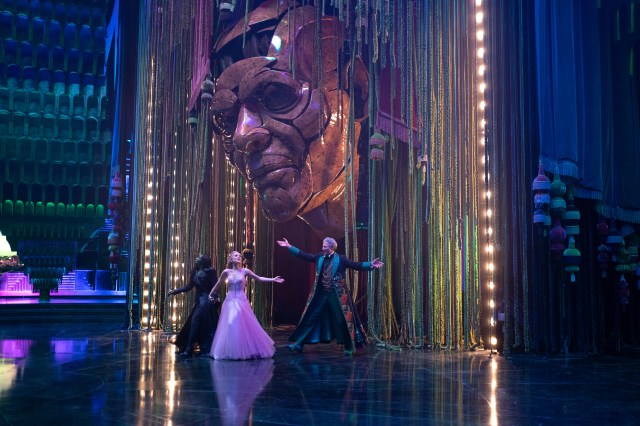
Despite the seriousness of the subject matter, the rapid encroachment of fascism has never looked so good. Paul Tazewell, who won an Oscar for his costumes in Part I, is sure to pull a repeat, if only for the practical ways he transforms Slater and Bailey into two other characters later on. Editor Myron Kerstein keeps the film moving at a rapid clip (there’s no downtime, which is better than I can say for the previous movie), and cinematographer Alice Brooks creates some truly compelling visual moments, a handful of which will make audiences want to stand up and cheer.
I would never claim to be the world’s biggest Wicked fan, but I have to say, these two movies, and especially For Good, really sold me. In fact, I think For Good is the better of the two, landing the emotional payoff as it brings the story home. More focused and heartfelt, it knows what it wants to be, and if you’re a fan, it will leave you changed for … well, you know.
(© Universal Pictures)




Related Articles
See all
Latest Reviews
See all
Latest Videos
Watch: Operation Mincemeat Stars Perform Live Concert in Honor of Final Performance
David Cumming, Claire-Marie Hall, Natasha Hodgson, Jak Malone, and Zoë Roberts played their final show on February 22.