
Review: What We Did Before Our Moth Days, Wallace Shawn on Death and Sex
Shawn reunites with director André Gregory for a talky new play at Greenwich House.
 |
Off-Broadway
|
|
Off-Broadway
|
March 5, 2026
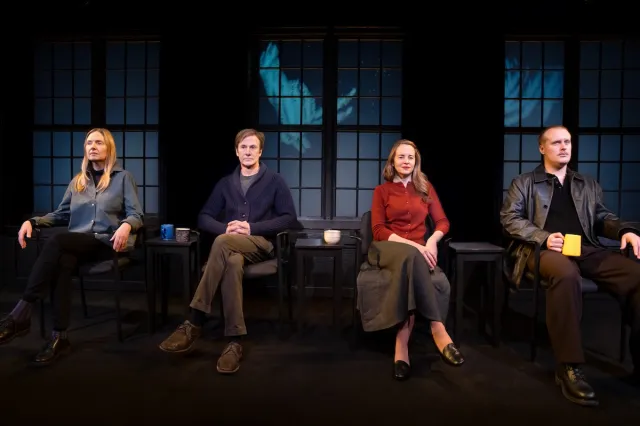
(© Julieta Cervantes)
Four actors file onstage at the top of Wallace Shawn’s What We Did Before Our Moth Days, now premiering off-Broadway at Greenwich House. They sit in grey chairs facing the audience, each with an individual side table for the mugs from which they sip throughout this three-hour drama, which reunites Shawn with director André Gregory, his longtime collaborator and co-star in My Dinner with André.
Fans of that 1981 film, which mostly depicts Shawn and Gregory chatting over a restaurant table, are likely to be delighted by Moth Days, a cerebral play that is overwhelmingly tell with just a soupçon of show. The actors remain seated the entire time as they recount the rise and fall of a family of sensitive intellectuals through a series of gorgeously written and evocatively performed monologues. Audiences should be forgiven for assuming (as I briefly did) that the play had some relation to the storytelling forum the Moth.
Certainly, John Early is putting on his very best NPR voice as Tim, a 25-year-old writer who is the first to speak. He calmly describes the one-off sexual encounter in which he was engaged the moment he learned (via phone call) that his father, Dick (Josh Hamilton), had died. A far more successful writer, Dick had been married to Tim’s mother, Elle (Maria Dizzia), for decades when he embarked on an affair with Elaine (Hope Davis). Tim meets his father’s mistress for the first time over dad’s cooling body.
The old man had managed to keep these aspects of his life compartmentalized, maintaining the appearance of old-school propriety while secretly diving lustily into a world of middle-aged hedonism. But it all comes flooding together on Dick’s “moth day,” an expression Dick devised in childhood to describe the date of a person’s death. Moth Days is a bracingly clear-eyed examination of life choices, and the psychic legacy one person leaves long after they’ve returned to dust.
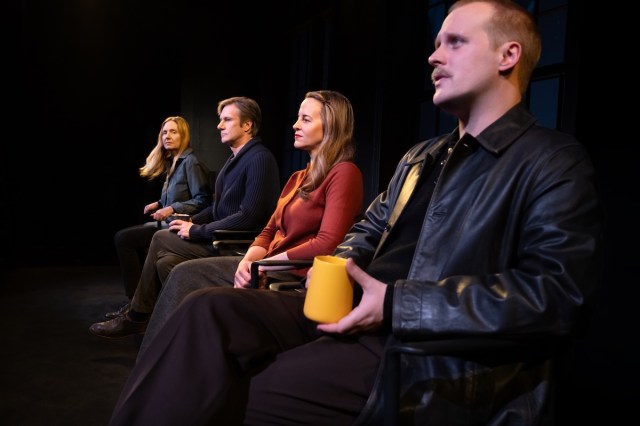
(© Julieta Cervantes)
I normally don’t enjoy this style of theater, with the actors monologuing at the audience while barely acknowledging one another’s existence. It seems to negate the real power of drama, which is putting disparate perspectives in direct dialogue. But Shawn’s strikingly human and unabashedly literary depiction of these four characters is so vivid that I found myself hanging on every word like a child enjoying a fascinating and inappropriately adult bedtime story.
The actors deserve much of the credit. Early sets the pace with his quietly analytical, somewhat emotionally detached Tim. Raised by highly literate people, he seems almost like a spectator in his own life, always ready with the perfect words to describe a situation but never entirely honest about his own feelings. Hamilton exudes the wide-eyed wonder of a man who lucks into a dream life yet still finds himself greedily wanting more. But in his defense, why should we forever be bound by the aspirations we had in our early 20s? Davis certainly makes us understand the attraction of Elaine, her incredulous eyes ever watchful for the cliches that inevitably invade every life (she is also a writer, of “quite unpleasant” murder mysteries).
And yet we can feel Dizzia silently seething as Elle. Couldn’t he at least have chosen a woman with a name that wasn’t so close to mine? Her rage explodes in a powerful monologue in which she reveals that Dick began to see her as possessive. “He’d trained me to worship him, to depend on him, to cling to him,” she says, barely holding back tears, “And now he felt that I’d loved him too much? and I’d strangled him?” Suddenly, we can feel the violence of the individual pursuit of happiness in our throats.
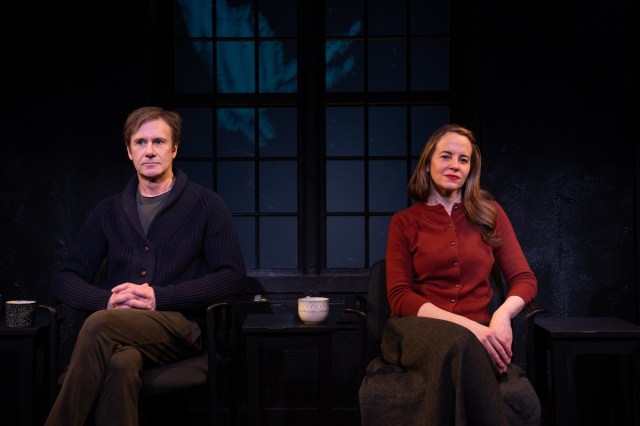
(© Luis Manuel Diaz)
Gregory’s barebones production, which seems to take place in a mythical New York City frozen in the late 20th century, creates the ideal environment in which to contemplate the tension between desire and obligation. Riccardo Hernández’s set suggests a talkback in purgatory, while the muted colors and tasteful fabrics of his costumes would look just as home in 1976 as 2026. Jennifer Tipton’s subtle yet forceful lighting activates and deactivates the characters as they remain seated onstage. Bruce Odland’s original music, which summons us back from the two intermissions, suggests a chorus of heavy breath exercises, which feels appropriate for a play that casts the audience in the silent role of therapist.
Tellingly, Moth Days makes no mention of open relationships, polyamory, or any of the other fashionable delusions we have concocted to convince ourselves that we’ve finally discovered an ethical solution to primeval behavior. Instead, Shawn and Gregory proceed with gentle curiosity, acknowledging that two things can be true. Yes, we are dynamic creatures who don’t stop growing the moment we decide to put a ring on it; but also, for most people, those promises mean something and are themselves the basis for growth, so breaking a vow is akin to removing a vital Jenga block. Navigating both change and commitment is one of the great challenges of life.
So go see What We Did Before Our Moth Days. Bring your husband. Buy a second ticket for your boyfriend! I’m sure you’ll all have much to discuss as you sip from your mugs.




Featured In This Story
Latest Reviews
See all
Latest Videos
West End vs Broadway: Oh, Mary!—From an Angry Inch to an Angry First Lady, With John Cameron Mitchell and Mason Alexander Park
Mitchell and Park celebrate a decade-long friendship in our latest installment.