
Review: Three Great Actors at Sea in Eugene O'Neill's “Anna Christie"
Michelle Williams, Brian d’Arcy James, and Tom Sturridge star in this 1921 Pulitzer winner at St. Ann’s Warehouse.
 |
New York City
|
|
New York City
|
December 14, 2025
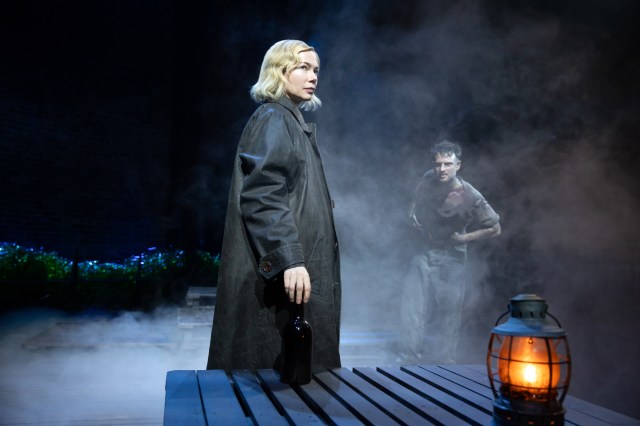
(© Julieta Cervantes)
Look, Eugene O’Neill is a hard playwright to crack. Do him well and you get a thrilling night like the Nathan Lane Iceman Cometh. Do him poorly and you get an endless night like the Denzel Washington Iceman Cometh. The new St. Ann’s Warehouse revival of O’Neill’s 1921 Pulitzer winner “Anna Christie”—a collaboration between leading lady Michelle Williams and her husband, director Thomas Kail—is more of the latter, committing the cardinal sin of theater: it is unforgivably dull from start to finish.
When it’s performed with real passion and heat, “Anna Christie” (the quotation marks in the title are the playwright’s affectation) can absolutely set off fireworks; don’t forget, this is the play that famously sparked the romance between Natasha Richardson and Liam Neeson. Not here, though. This deeply American hooker-with-a-heart-of-gold story lumbers across the stage indifferent to the tragedy deep within its bones. That is to say, I’m not entirely sure Kail and company understand the play they’re trying to do.
Williams plays the title role, a 20-year-old Minnesotan prostitute who reunites with the Scandinavian barge-captain father who abandoned her (Brian d’Arcy James), only for each to discover that the stories they’ve been telling one another are lies (apparently, neither sailor nor prostitute counted as respectable trades a century ago). Still, Chris Christopherson persuades Anna to join him aboard his barge, where they soon rescue Irish stoker Mat Burke (Tom Sturridge) from a shipwreck.
Mat becomes smitten with Anna, leading to a clash with Chris over possession of her. That doesn’t sit well with Anna, who stands up for herself by revealing her past and asserting that she’s nobody’s property to own. The men condemn her, but, in a rare twist for O’Neill, the play ends with a modicum of hope (though the playwright was loath to call it that).
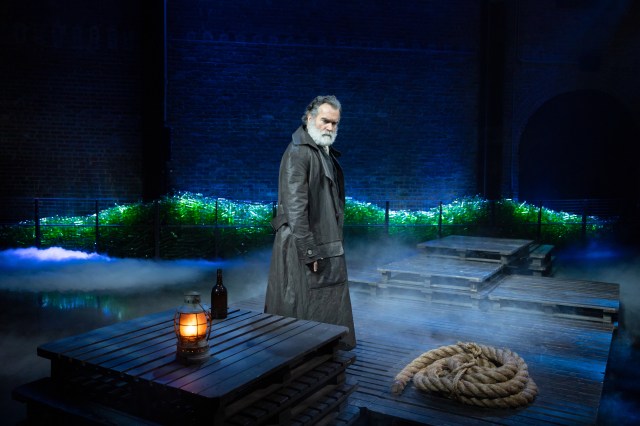
(© Julieta Cervantes)
This “Anna Christie” apparently began with Kail seeking a theatrical vehicle for his wife, and it’s easy to see why she’d be intrigued to follow the likes of Richardson and Greta Garbo. Anna is a shockingly self-possessed and unapologetic woman by 1920s standards. Despite a conclusion that ultimately reverts the character to a different kind of servitude and sort of belies everything she’s accomplished to that point, there’s a lot for an actor of Williams’s considerable dramatic skill to sink her teeth into.
What they didn’t seem to consider is that Williams is a thoroughly contemporary actor, whose 2025 sensibilities don’t jibe with O’Neill’s parlance; you just don’t believe that this woman is from the turn of the last century. That she’s two decades older in real life than Anna doesn’t help, especially in the dowdy way that Paul Tazewell dresses her. Good for her for choosing a relatively obscure O’Neill play instead of offering us the umpteenth Blanche DuBois, but the “aw, shucks” persona Williams adopts is too one-note to excavate the character’s considerable traumas. Mare Winningham, who has a glorified cameo in the first scene as the mistress Chris summarily dismisses with the arrival of his daughter, would probably make a more compelling Anna.
D’Arcy James hits every “Py yiminy” in O’Neill’s text with the requisite singsong, but doesn’t locate much of a character in Chris, the guilt-ridden seaman who blames “dat ole davil sea” for turning people into “crazy fools with her dirty tricks.” Sturridge, stooping around the stage like he’s got sciatica (the choreography, by Steven Hoggett, is wasteful), generates little sexual heat opposite Williams and isn’t particularly convincing in either his threats of violence or his eventual promises of forgiveness. But at least his Groundskeeper Willie dialect is in good company with d’Arcy James’s Swedish Chef.
Kail’s abstract staging offers little sense of time or place, and his designers offer even less specificity. The set, designed by Christine Jones and Brett J. Banakis, is relatively nondescript yet oddly complicated, with a steel girder inexplicably dangling over the actors’ heads and slatted wooden platforms that a quartet of hunky seaman rearrange between scenes (those Tazewell costumes appropriately show off). The thrust stage leads to a surprisingly rookie mistake from a director of Kail’s stature: crucial moments and subtle expressions can be missed depending on where you’re seated, even in the center section where the action is pitched. Composer Nicholas Britell underscores transitions with gloomy cellos and violins, signifying that this is meant to be “serious” theater. At least Natasha Katz’s lighting has something to offer, conjuring the mystical blue-green glow of the sea from a hill of empty beer bottles.
Without a strong directorial point of view to steer the ship, “Anna Christie” ends up becoming a dated melodrama, not, as critic Alexander Woollcott described on November 13, 1921, “a swig of strong, black coffee to one who has been sipping pink lemonade.”
Perhaps it’s just, as Chris would say, “dat funny vay ole davil sea do her vorst dirty tricks.”
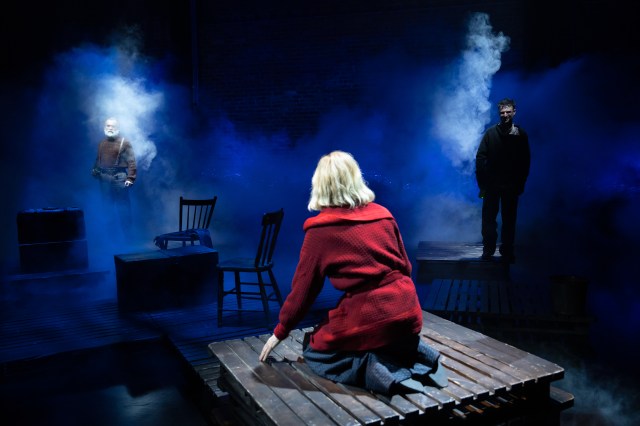
(© Julieta Cervantes)




Featured In This Story

Latest Reviews
See all


Latest Videos
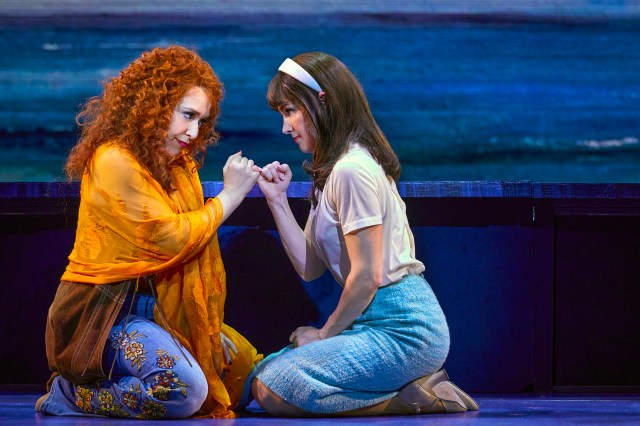
Watch Jessica Vosk and Kelli Barrett Sing a Song From the Upcoming Broadway Musical Beaches
Broadway performances start on March 27 at the Majestic Theatre.