
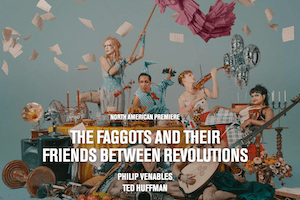
Review: The Faggots and their Friends Between Revolutions, a Queer Mass
Park Avenue Armory hosts Philip Venables and Ted Huffman’s operatic adaptation of Larry Mitchell and Ned Asta’s fable.
 |
New York City
|
|
New York City
|
December 3, 2025
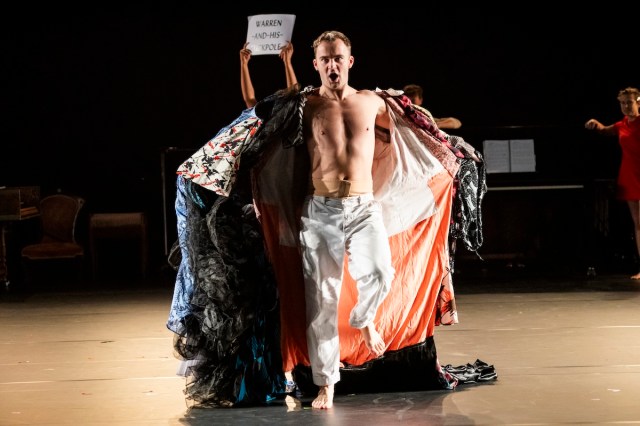
(© Stephanie Berger)
When did the faggots become parishioners? I asked myself this question as my mind wandered, like a wayward boy in church, during The Faggots and Their Friends Between Revolutions, now making its North American premiere at Park Avenue Armory. While Philip Venables’s genre-hopping music is beautiful enough to make a kapellmeister weep, Ted Huffman’s text adaptation and direction commits the cardinal sin of queer art: It is mind-numbingly dull.
Granted, most of the words are lifted directly from Larry Mitchell’s 1977 book, which reads like a child’s treasury of fairy tales in which the princes, princesses, and witches have been supplanted by the faggots, women, and men (the fairies and queens remain). The slim volume is enhanced by Ned Asta’s wild illustrations, which present gay men and their female friends as satyrs and nymphs.
There’s something enchanting about reading Mitchell’s fable of 20th-century sexuality, like stumbling onto the sacred text of a lost civilization (Mitchell was a founding member of the Lavender Hill Commune, which recently received that kiss of death from the state, official recognition). Certain passages jump out like, “The men will only cure diseases they themselves suffer from,” a line that would come to sound pretty damn prescient a decade later. It does not appear in this adaptation.
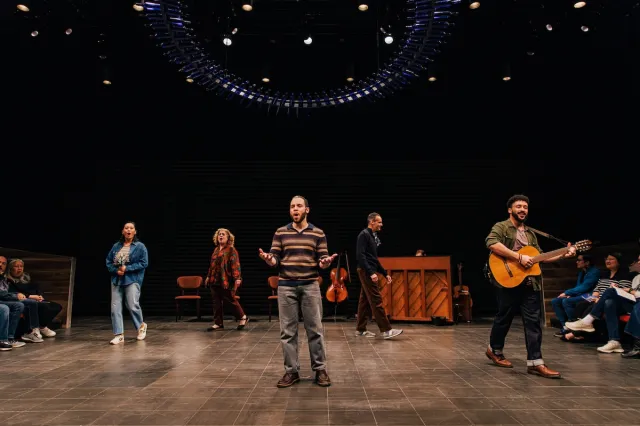
The stage has a transformative power and hearing Mitchell’s words sung and recited by the 15-person cast almost 50 years later lands differently. It’s not a mythological gloss on a tight circle of friends living their ideals. It’s a ritual that feels both spiritually dead and culturally compulsory.
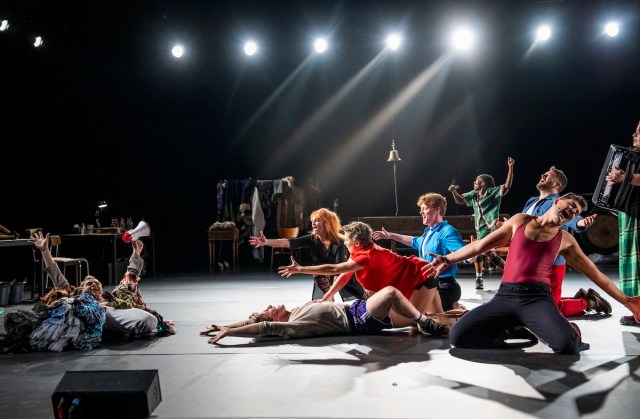
(© Stephanie Berger)
We hear the origin myth of how all were faggots in the beginning, but a fallen faction broke away and, in their avarice and paranoia, became men. A soloist (Danny Shelvey with a lovely baritone) sings of the revelation of the women, who know that in the coming war with men we will get our asses kicked, but will ultimately triumph. We also learn of the sacrament of the anonymous sexual encounter, which I realized between yawns really is more of a “show” than “tell” activity. Blessed is he who cums on the face of the bored.
The cathedral-like enormity of the Armory’s drill hall swallows Huffman’s disappointingly unambitious staging, which is relegated to an open platform with props and instruments arrayed along the periphery. There is much frenetic action leaving little impact. Even as the performers sprint from end to end, it feels like first-pass filler that was never replaced with something better.
An upstage bell is frequently rung between scenes. Occasionally, an actor will break the fourth wall, like when Kit Green teaches the congregation a song about the social construct of madness. “The sane have the keys, the insane do not,” she sings sweetly, inviting us to sing back. Green has a wonderful stage presence and quick wit, almost enough to make this Foucauldian nonsense palatable. But even she cannot transubstantiate this lame call-and-response into the patriarchy-destroying act of communion it so desperately wants to be.
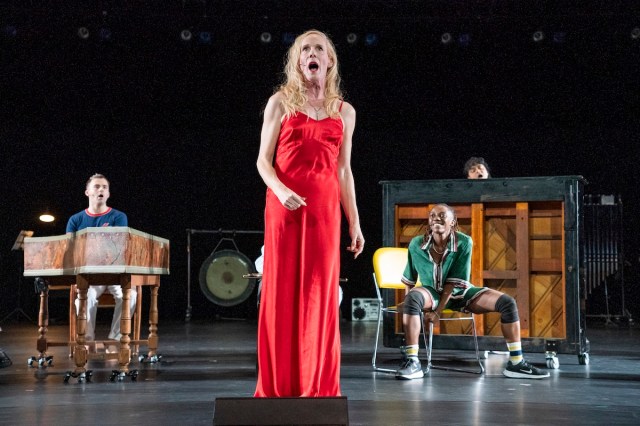
(© Stephanie Berger)
This is Catholicism for queers—with less fabulous costumes, shamefully. While designer Theo Clinkard provides some inspired pieces (a dress made of basketball jerseys), many of the outfits have a forgettable store-bought quality. Although perhaps we in the devastated city have been spoiled by the outrageous couture of Machine Dazzle.
At least this church benefits from a first-rate choir. Music director Yshani Perinpanayagam has achieved the difficult balancing act of creating a sturdy wall of sound (it sounds like there are twice as many voices) without obliterating the individuality of each performer. They more than meet the task of this difficult score.
Composer Venables is a musical magpie. Sometimes he sounds like Bach (there’s a harpsichord!), other times Philip Glass, and still other times Antônio Carlos Jobim. It suggests a rich culture cultivated over centuries, which is correct as the faggots have been central to the arts since time immemorial. But as The Faggots and their Friends proves, they can’t all be timeless gems.
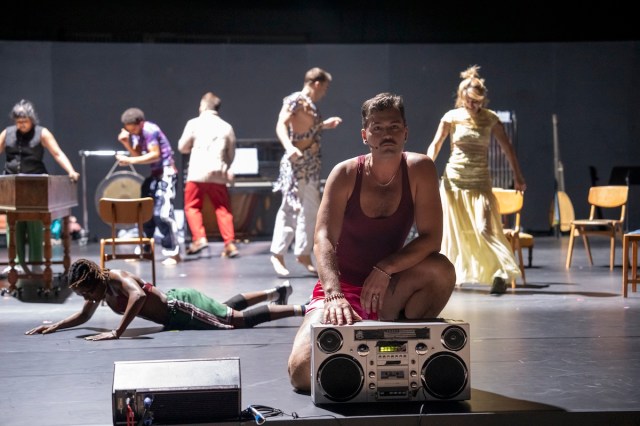
(© Stephanie Berger)
Huffman’s greatest liberty is the addition of a new story, about how the men tricked the faggots into becoming like them by encouraging them to join the military and sign marriage contracts. While Mitchell died in 2012, before the Windsor and Obergefell decisions, it is a fair assumption that he would have endorsed this tired complaint of the anti-assimilationist queers, who always seem to be the kind of pampered people who can afford the luxury of separatism. Not once does our author consider how the faggots are doing more to transform marriage from the inside than they ever did in exile.
And that’s a shame, because it’s right there in the source material: “The faggots never tire of fucking with the men’s minds. Once all the faggots let their hair grow long, wore necklaces made of silver and shells and clothes of colorful, elaborate fabrics. They looked so stunning that the men over-looked their principles and began to look stunning also. When the men looked like the faggots, the faggots cut their hair, put on black leather and looked like the men used to look. The men were annoyed and pretended not to notice.”
This is the puckish, transgressive spirit that this play completely lacks (this passage is also excluded from Huffman’s adaptation).
The Faggots and Their Friends may still win converts as the people born in this century usher in a sexual Renaissance by rediscovering the wisdom of the ancients—specifically that sex is what you do, not who you are. But this calcified ritual of an identity-obsessed culture is just preaching to the choir.




Featured In This Story
Latest Reviews
See all
Latest Videos
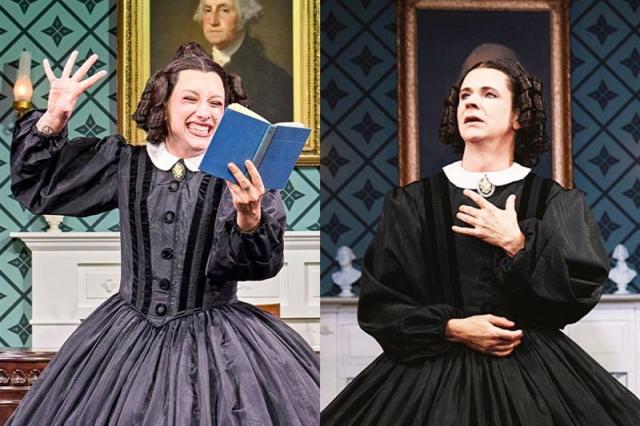
West End vs Broadway: Oh, Mary!—From an Angry Inch to an Angry First Lady, With John Cameron Mitchell and Mason Alexander Park
Mitchell and Park celebrate a decade-long friendship in our latest installment.