
Review: The Bathroom Attendant, a Vegas Caper for the Epstein Era
Tom Kelly’s play makes its world premiere at 124 Bank Street Theatre.
 |
Off-Off-Broadway
|
|
Off-Off-Broadway
|
August 19, 2026

(© Scott Fetterman)
We see the Las Vegas strip from the single window of the studio apartment. It glitters in the distance like a mirage in the desert as viewed from this shabby cell where dreams go to die, one of many in a complex that houses Sin City’s working poor … at least some of them work.
Johnny Knight (Dan Patrick Brady) is a bathroom attendant at the Mob Museum, but he used to be a prize fighter. A poster for the 1984 Golden Gloves tournament at Madison Square Garden hangs proudly over his pitiful kitchenette. His best friend and neighbor, Tina (Kate Miller), is a retired porn actor. Crushed beer cans litter the floor around his torn-up piss-yellow couch (excellent work on a budget by designer Scott Fetterman). A drained bottle of Lagavulin is the only remaining evidence of his last paycheck, much of which went to a loan shark. Now in his late 50s (the play takes place in 2018), he is trapped in a cycle of vice and debt, with no clear means of escape.
But then opportunity literally knocks on his door in the form of Connor (Evan Klein), the son of an old neighborhood buddy from Brooklyn. He’s on vacation in Vegas and he recorded video of a major baseball star beating up his underage date (Mari Blake) in the parking garage of the Bellagio. While Connor has already been offered six figures from TMZ for the video, he plans to extort even more from the athlete—chump change for baseball’s 500-million-dollar man. He’s cutting Johnny and Tina in, because he suspects their Vegas connections could help. Connections … in a place like this?

(© Scott Fetterman)
It takes the entire first act (much of it laden with unnecessary exposition about Johnny’s glory days) to get there, but that’s the basic premise of Tom Kelly’s The Bathroom Attendant, now making its world premiere with SparkPlug Productions at 124 Bank Street Theatre. Boldly (if shaggily) written and unevenly acted, this Vegas caper is that rarest of off-off-Broadway wonders: a play heterosexual men can truly enjoy.
Some of that has to do with Kelly’s willingness to delve into America’s seedy underworld, a place the theater, besotted with identity politics and dominated by the children of the upper-middle class, rarely acknowledges. The Bathroom Attendant is about characters awash in deprivation and resentment, the two forces driving America’s present social decline. That makes it a worthwhile and occasionally fascinating watch.
Under the steady if unspectacular direction of Andrew Block, the actors achieve varying levels of success with this opportunity. As Johnny, Brady does seem like a man who has been hit in the head a few too many times, though his line delivery is frustratingly one-note. Miller’s heartfelt and hilarious performance feels convincingly lived-in. She’s a hooker with a heart of gold who offers her modest home as a refuge for young women on the verge of traveling a similar path. As Connor, Klein artfully walks the line between youthful naivete and media savvy, making us wonder if his autistic kid-brother schtick is all a ruse; he’s like a human bobblehead, dressed head-to-toe in Mets gear and nodding enthusiastically on every line. And Blake is heartbreaking as Bambi, capturing both the vulnerability and volatility of a young woman who rightly suspects that no one has her back, so she must take care of herself.
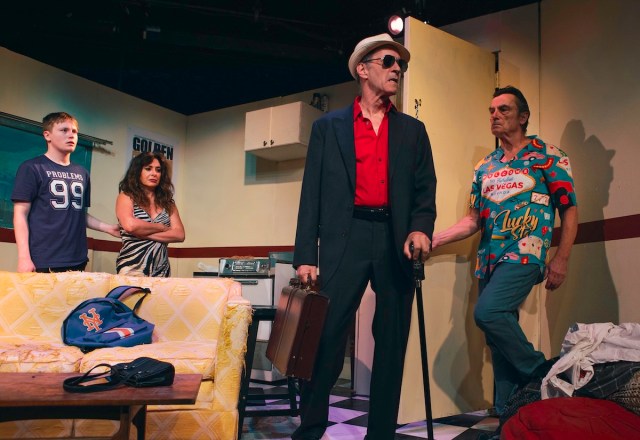
(© Scott Fetterman)
Only in the second act does this play’s antagonist finally make an appearance: Jon Krupp plays Marcus, the athlete’s shadowy fixer, who arrives at Johnny’s door to deliver an important message not just from the MLB star, but the entire American ruling class:
“All life is not equally important,” he states, describing his client’s victim as, “a fifteen-year-old whore and druggie. What will she do with that life? Cure Alzheimer’s? Write an opera for the ages? Sit on the fucking Supreme Court? She is going to suck dick, steal, shoot up and nod off on the street.”
I can only imagine how maddening it must be for Kelly to hear these lines, night after night. He clearly wanted Pacino playing Roy Cohn in Angels in America, but instead he got Krupp punching every syllable like he’s Howard Cosell calling a bout. The opposite of menacing, it’s a performance that only becomes slightly more convincing once Marcus can no longer speak and is relegated to groaning behind the couch.
That’s a shame, because The Bathroom Attendant does have something profound to say about the disposability of human life in America. We root for the man who broke his body for sport, the older woman who sold her body for sexual titillation, and the child who experienced both sexual exploitation and bodily harm at the hands of a spoiled millionaire who knew he could get away with it. This is a real thing that happens every day, and unwavering public interest in the Epstein files proves that Americans are ready to talk about it. So why does the theater mostly look away?
With this admittedly flawed yet perfectly watchable play, Kelly is at least addressing the issue with a direct punch. More playwrights should follow his lead.




source on Google
Featured In This Story

Latest Reviews
See all







Latest Videos

Watch the Trailer for Elsinore Starring Andrew Scott
The film is based on the true story of Ian Charleson, who played Hamlet at London’s National Theatre after being diagnosed with AIDS.