
Review: School Girls; or, The African Mean Girls Play Brings ’80s Fashion and Ageless Politics to Broadway
Denée Benton and Jasmine Amy Rogers are rivals in Jocelyn Bioh’s Ghanaian high school comedy at the Samuel J. Friedman Theatre.
 |
Broadway
|
September 28, 2026
(© Matthew Murphy)
When School Girls; or, The African Mean Girls Play had its off-Broadway world premiere at MCC Theater in 2017, Jocelyn Bioh was firmly in the category of “emerging playwright.” By the end of that run, or multiple sold-out runs as it eventually became, she had emerged. Audiences fell in love with her sharp eye for behavior and even sharper ear for comedy, a combination that earned her a 2024 Tony nomination for Jaja’s African Hair Braiding. A Broadway revival of School Girls, now at MTC’s Friedman Theatre (directed by her Tony-nominated Jaja collaborator Whitney White), not only closes the loop on Bioh’s breakout play, but confirms that New York audiences do, in fact, know how to pick ’em.
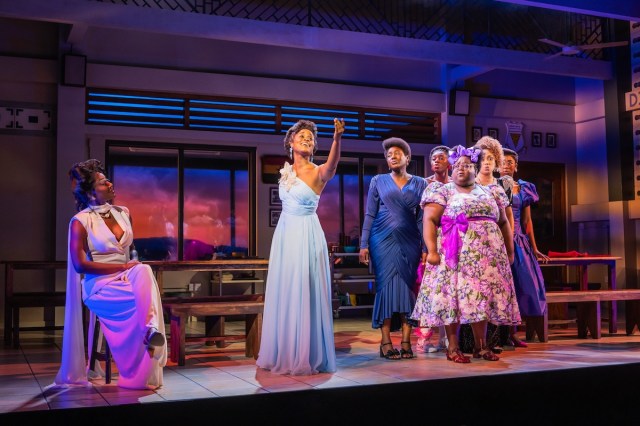
Set in 1986 at the Aburi Girls Boarding School in Ghana, School Girls follows classic Queen Bee Paulina (Denée Benton) and her four kowtowing apostles as they prepare to audition for the Miss Ghana pageant (Lucia Aremu, Erin Morton, Nia Otchere-Sarfo, and Jordan Rice are squealing, gossiping perfection as this core clique). Paulina’s path to victory is clear until Ericka (Jasmine Amy Rogers), a light-skinned Ghanaian raised in the American Midwest, threatens to snatch both the pageant spot and all Paulina’s lemmings with her winning smile, bottomless wardrobe, and unmatched knowhow about Chinatown knockoffs. War is Paulina’s only recourse.
Much like its Mean Girls namesake, School Girls imbues high school politics with the gravity of global diplomacy (or anti-diplomacy) and lets the laughs fall where they may. It’s a tried-and-true formula, but export it outside the US, and it gains another layer. At the Aburi Girls Boarding School, high school politics aren’t so detached from global politics, even with modest uniforms, snack-food bans, and neutral-toned spaces keeping Western influence at bay (Teresa L. Williams teases a bit of open African sky behind her simple cafeteria set). Pop music, fashion magazines, skin-lightening creams, and yes, beauty pageants, still manage to slip through the back door like Trojan Horses of American imperialism. Most sinister of all is the fact that last year’s targets are this year’s perpetrators.
(© Matthew Murphy)
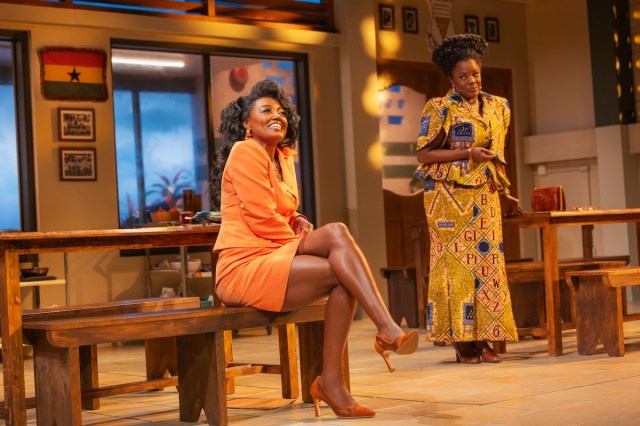
Waltzing in with her power suit and glossy weave is Eloise Amponsah, Miss Ghana 1976, played by Patina Miller with the haughty joie de vivre of a classic ’80s villain (wig designer Nikiya Mathis and costume designer Qween Jean have some ’80s fun while reminding us how political style truly is). Ms. Amponsah—the mean girl of yore to the school’s current Headmistress Francis (an excellent Heather Alicia Simms)—is ready to win her own glory by making a Ghanaian girl’s dreams come true. But only a Ghanaian girl who can satisfy Western tastes. Corn-fed Ericka is the answer to all her prayers. And what better way for Ericka to be embraced by the country she’d like to claim as her own than to bring it international glory as Miss Ghana?
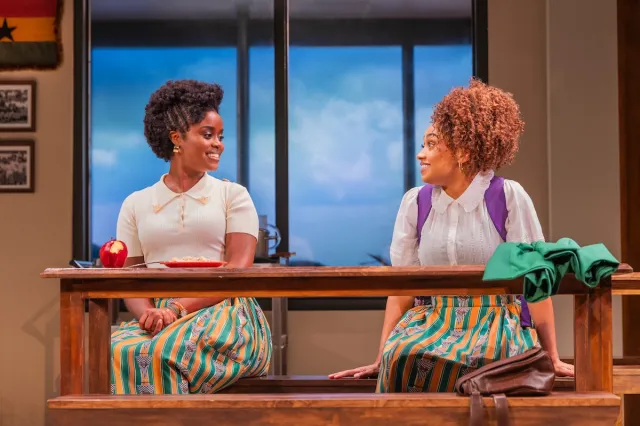
Benton and Rogers—each a radiant presence with resting Disney Princess Face—are perfectly matched rivals. As Paulina, Benton is unflinchingly cruel. She even draws gasps for her especially barbed comments toward Nana (Morton, hilarious and heartbreaking), her most amenable sidekick who’s grateful for the warmth of Paulina’s ambient light.
(© Matthew Murphy)
And still, her coup is painful to watch, even as Rogers’s gentle kindness and quiet vigor make you want to snag an invite to her makeover party (Broadway will get plenty more of Rogers’s sweet side later this season when she stars as Maria in The Sound of Music). The pièce de résistance is a sing-off between these two powerhouses. Both, of course, are extraordinary vocalists and musical Tony nominees (Benton for Natasha, Pierre & the Great Comet of 1812 and Rogers for BOOP!), but the vocals aren’t necessarily what you’ll leave talking about.
School Girls, it turns out, was only the first of several works where Bioh displayed her a fascination with dreamers. Nollywood Dreams had a travel agent reaching for Nigerian film stardom. Jaja’s African Hair Braiding showed a literal Dreamer managing her family’s hair salon and her mother’s green-card wedding. Every head-in-the-clouds character, to Bioh’s eye, is as foolish as they are lovable. As worthy of merciless mockery as they are of deep admiration. She just had the good fortune of figuring out a decade ago that hope looks silly on everyone, but teen girls wear it best.




source on Google
Featured In This Story

Related Articles
See all
Latest Reviews
See all


Latest Videos
Watch: Ellen Greene Reflects on the Enduring Legacy of Little Shop of Horrors
Frank Oz’s cult classic movie-musical has gotten a new 4K restoration in celebration of its 40th anniversary.