
Review: Predictor, Starring Caitlin Kinnunen, Adds Meg Crane to the Herstory Books
Jennifer Blackmer’s play about the inventor of the first home pregnancy test runs at AMT Theater.
 |
Off-Broadway
|
|
Off-Broadway
|
December 16, 2025
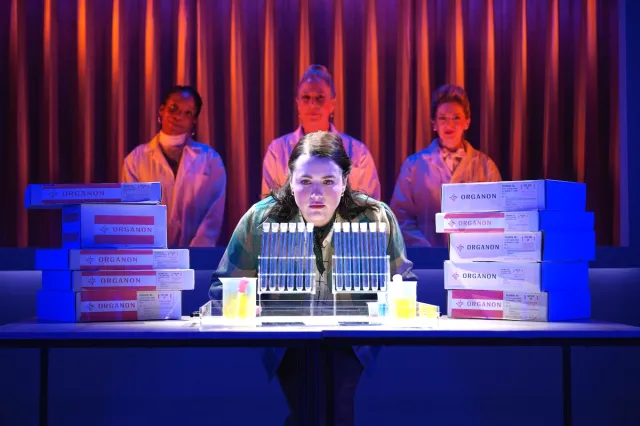
(© Valerie Terranova)
A corporate zombie hovers over a woman as she nervously holds pen to paper. “Sign here, please,” says the shill. “It’s a standard contract. Nothing to be afraid of.” Now, of course, is where the audience starts to scream “Don’t do it!” Who cares what that document says? We know capitalist villainy when we see it.
It’s only the first 20 seconds of Jennifer Blackmer’s historical play Predictor, about Maragret (Meg) Crane, the unacknowledged inventor of the first home pregnancy test. And still, it’s clear that both Blackmer and director Alex Keegan have chosen to paint this story in primary colors.
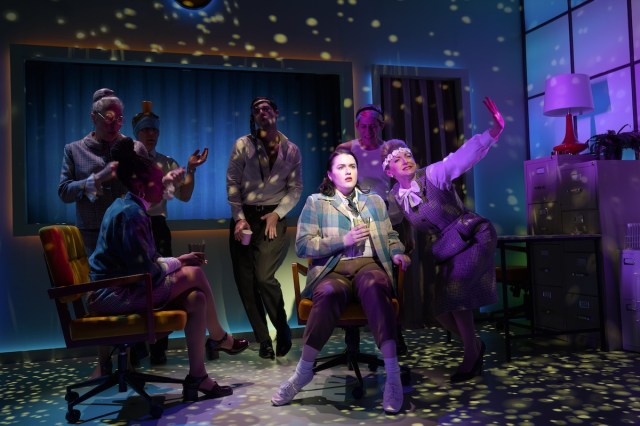
There’s an attempt to mix in a few psychedelic hues through the metatheatrical framing device of a 1960s game show parody, Who Made That, where our hero Meg (played by the infinitely lovable Caitlin Kinnunen) is left drowning in a sea of male bravado and pomade (set and props designer Cat Raynor has some retro fun here). But Predictor’s zany side antics feel like just that—a spoonful of sugar to make the medicine go down.
To be clear, there’s nothing inherently medicinal about this narrative. Hidden Figures, Code Girls, Rocket Girl. Brilliant women thwarted, sidelined, and degraded by men in suits is its own literary genre, and a successful one at that. We love exhuming untold stories from their layers of patriarchal sediment and setting history to rights.
Predictor, for all its dramatic faults, scratches that itch, and no matter your feelings about the play itself, you’ll leave glad to know Meg Crane’s name and her role in fighting for women’s bodily autonomy in pre-Roe America. Fighting being the operative word, since Meg finds a new man ’round every corner ready to douse her flame of inspiration.
We meet her as a young artist who’s landed a freelance job as a product manager for Organon Pharmaceuticals (John Leonard Thompson plays her casually misogynistic boss, Martin Stamper, as well as the slick game show host of her dreamscape). She’s underpaid, underutilized, and totally uninspired—until one day when she gets a tour of the company’s lab where doctors send urine samples for pregnancy tests.
(© Valerie Terranova)
The process seems simple enough, so why not let women do this in the privacy of their own homes? From there, it’s a battle to get the idea greenlit, to participate in its development, to get her own prototype approved, and to get anything at all past the new egomaniacal project head Jack Mullins (Eric Tabach, giving the punchable performance the role demands).
Between kooky interludes satirizing the puritanical mores of the 1960s that made the idea of this home test such a scandal, we also get earnest flashbacks to Meg’s Catholic upbringing (Alicia Austin provides the period costuming). These scenes give us a look into her past as a free-thinking troublemaker (though she still chokes on the word “pregnant” as an adult) with a mother locked into domestic life at just 20 years old (the versatile Lauren Molina delivers these emotional moments as Meg’s mom and some of the show’s broadest comedy as her various other characters).
Is it a backstory that explains why someone might be impelled to invent a home pregnancy test? Maybe. But without any of those motives driving the action we see onstage, it’s just another square in a patchwork quilt that’s hoping chaos can pass for design.
What we’re left with is a single character surrounded by a swirl of illusions, memories, and buffoons. Even Meg’s supportive roommate Jody (Jes Washington) and eventual love interest Ira (Nick Piacente, playing the designated nice guy) are just foils meant to propel Meg to her next Herculean labor. We only realize how much we’re missing the presence of flesh-and-blood humans when Washington appears again as a character named Lillian, a woman desperate for one of Meg’s home tests that neither of them knows is still a decade away from the shelves.
Lillian, too, is simply a mouthpiece for the women who would find a bit of freedom in Meg’s invention, but Washington makes her a whole person in just a few minutes of stage time, and Kinnunen’s strangled silence speaks volumes. And yet, when Meg later gives up the patent to Organon for a dollar she never even sees (yes, that opening sequence was as menacing as you thought), she assumes a quaint martyr status, finding solace in the fact that her invention was never for her—it was for people like Lillian. It’s a tidy ending that should have just been allowed to remain unsatisfying. After all, we’re watching a play about a woman denied her due for over 50 years. I feel comfortable speaking for all women of all generations: Let her rage.




Featured In This Story

Latest Reviews
See all





Latest Videos

Watch Jessica Vosk and Kelli Barrett Sing a Song From the Upcoming Broadway Musical Beaches
Broadway performances start on March 27 at the Majestic Theatre.