
Review: Picnic at Hanging Rock, an Australian Unsolved Mystery
Hilary Bell and Greta Gertler Gold bring their musical adaptation of Joan Lindsay’s novel to Greenwich House.
 |
Off-Broadway
|
|
Off-Broadway
|
December 18, 2025
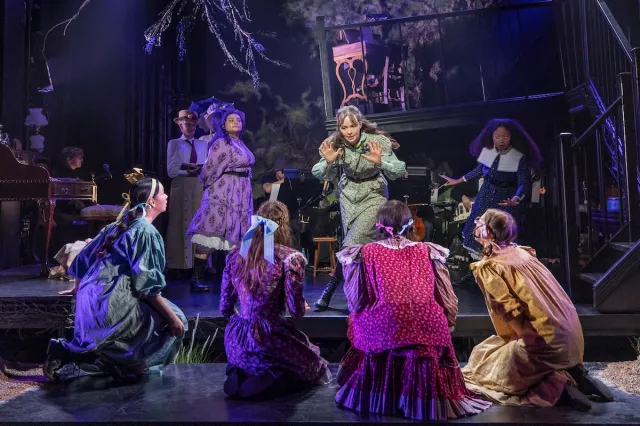
In real life we creatures of modernity recoil from the unknown. If it cannot be reduced to atoms and numbers, we don’t want any part of it. But when it is safely confined to the page, screen, or stage, we lustily dive in head-first, eager to brush against the otherwise intangible. That partially explains the enduring popularity of Joan Lindsay’s 1967 novel Picnic at Hanging Rock, which is better known through Peter Weir’s 1975 film, a gem of the Australian new wave. The novel has now been adapted into a stage musical which is making its off-Broadway debut at Greenwich House Theater.
A mystery with no satisfying conclusion but loads of big female emotion, Picnic at Hanging Rock would seem like ideal source material for a dark and contemplative two-and-a-half-hour musical. But like the title geological formation, musical theater can be unexpectedly perilous, as the creatives behind this show have surely discovered by now.
The story is set around a girls’ boarding school run by Mrs. Appleyard (Erin Davie, severe but not nearly enough) in Victoria, Australia in 1900. Sara (Sarah Walsh, convincingly adolescent) joined the school from an orphanage. She has no friends besides Miranda (an effortlessly fey Gillian Han). But everyone loves Miranda.
On Valentine’s Day, the girls take a field trip to Hanging Rock, though Sara is forced to stay behind with Mrs. Appleyard to practice her scales. It proves to be a fateful visit as Miranda leads Irma (Tatianna Córdoba), Marion (Kate Louissant), and Edith (Carly Gendell) on a hike onto the rock. Only Edith returns that afternoon.
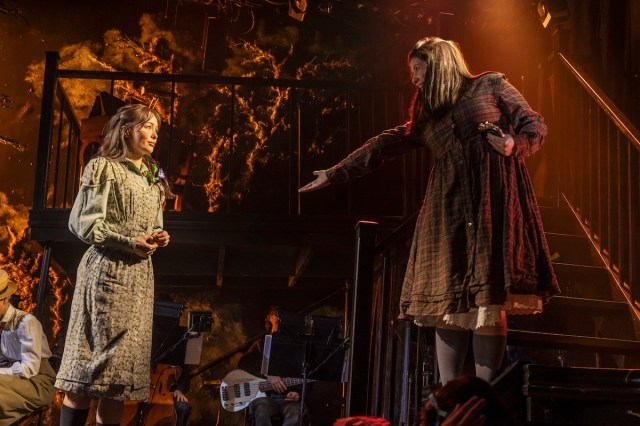
(© Matthew Murphy)
Don’t expect to ever find out what happened to the others, or why Edith saw their chaperone/math teacher, Miss McCraw (Kaye Tuckerman, her face appropriately frozen in a sour pucker), charging up the hill in her undergarments. The young men who just happen to be visiting the rock at the same time, little Lord Michael (Reese Sebastian Diaz) and his indigenous guide Albert (Bradley Lewis), are no help, and feel more superfluous here than they did in the film. The unsolved mystery is part of the allure of Hanging Rock, and the writers attempt to make a theatrical meal out of that, with diminishing returns.
Greta Gertler Gold’s music is a wooly tangle of melodies and complex harmonies. It’s difficult material, performed well under the conducting of Anessa Marie Scolpini, and makes a striking setting for Hilary Bell’s lyrics, which effectively communicate the story and themes without any shimmering moments of brilliance.
Clutching a calculus book, McCraw sings, “What pattern are we part of? / Destructive of benign? / How I’d love, / What I’d give / To see the Grand design.” And there we have it, a rational Victorian woman pining for clarity right before a completely bizarre, thoroughly unexplained phenomenon.
Bell, who also wrote the book, does a decent job of conveying the clash of Apollonian and Dionysian impulses that powers this story, with a side of unfulfilled lesbian desire to give it some kick. She also includes an acknowledgement of the indigenous people of Australia that was certainly not a part of the film—although one suspects that the power we’re dealing with defies the mythology of even the oldest civilizations.
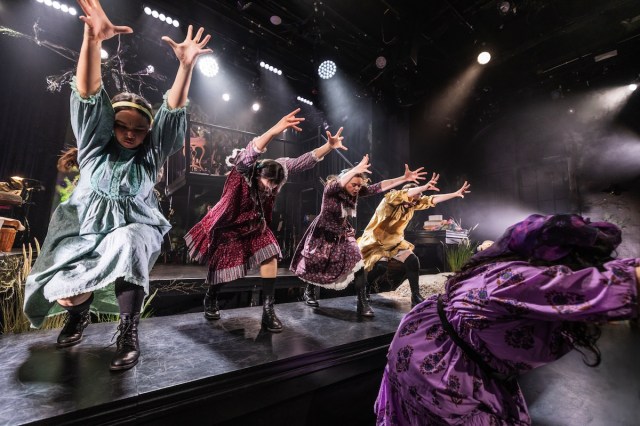
(© Matthew Murphy)
Director Portia Krieger’s production embraces the darkness, with Daniel Zimmerman’s twisted staircase of a set crowding the limited stage space while still providing levels on which the actors perform Mayte Natalio’s writhing, Bacchic choreography. Barbara Samuels’s lighting is essential to distinguishing the overlapping scenes on this limited real estate. Ásta Bennie Hostetter’s initially prim costumes become increasingly Gothic as we enter the second act. Sound designer Nick Kourtides pipes is the noise of the Australia bush, the relentless hum of cicadas taking on an increasingly mechanical, almost extraterrestrial quality. We know what he thinks happened to those girls, even if the rest of the creative team resolutely declines to forward a theory.
The uncanny mood Krieger is attempting to create is the theatrical equivalent of Francium, an unstable element that we can only behold for a short while under the best circumstances. But with a second act weighed down by introspective ballads and witchy group numbers, the whole endeavor threatens to curdle into camp. Once Irma shows up in her Little Red Riding Hood cloak (Ásta, what were you thinking?) it’s all over. We’ve left Spring Awakening and are now firmly in the realm of the musical vampires.
Suffering from too many sound-alike songs and too few moments of genuine horror, Picnic at Hanging Rock at least uses the stage as a place to revel in the unexplained and contemplate our own insignificance to the grander (dis)order of the universe. Trust the science? No. Not in the theater. As a wise Australian once said, we come to this place for magic.




Featured In This Story
Latest Reviews
See all
Latest Videos
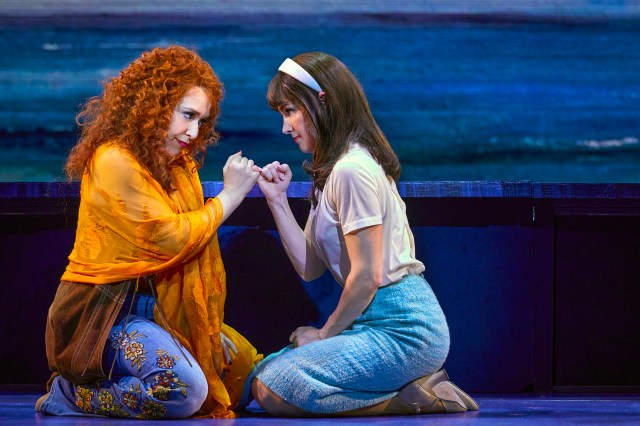
Watch Jessica Vosk and Kelli Barrett Sing a Song From the Upcoming Broadway Musical Beaches
Broadway performances start on March 27 at the Majestic Theatre.