
Meet the Team Behind A24's New Play About the Infamous Scat Porn 2 Girls 1 Cup</i?
Playwright Eliya Smith and the Goat Exchange’s Chloe Claudel and Mitchell Polonsky discuss the new work Two Girls and their upcoming collabs at Under the Radar.
 |
Off-Broadway
|
|
Off-Broadway
|
October 12, 2026
Playwright Eliya Smith really came to our attention in 2025, with the off-Broadway debut of her play Grief Camp, about a summer camp for teenagers touched by death. A play with a novel subject like that was followed by a work of even more promise, the summer 2026 hit Dad Don’t Read This, a depiction of teenage girlhood through the lens of The Sims. The latter was presented by Smith’s frequent collaborator, the rising experimental company the Goat Exchange, run by artistic directors Chloe Claudel and Mitchell Polonsky.
Smith and the Goat Exchange are collaborating once again on Two Girls, a new two-character play inspired by 2 Girls 1 Cup. Thankfully, this A24 production at the Cherry Lane Theatre isn’t a reenactment of the infamous scat porn, but a cultural history about its impact, particularly on young men. And this is just the beginning of what’s shaping up to be a huge end to the year for these artists, who are making major waves on the downtown theater scene.

(© Abbie Sage)
This conversation has been condensed and edited for clarity.
Eliya, when did you first discover 2 Girls 1 Cup?
Eliya Smith: I honestly didn’t know a lot about it. If I had known the substance of the video, I don’t think I would have made this. It’s so much grosser than I thought it was going to be. But I’m very interested in the legacy of porn. We’ve had a couple generations that have come of age in the era of internet porn, and I was thinking about how that impacts the way you move through the world and treat other people. This video felt like an interesting entry point because of its ubiquity. I knew what I wanted the play to be, and it was pretty clear to me that it should be a Goat Exchange show.
Chloe and Mitchell, tell me about the Goat Exchange and how you all came to work together?
Chloe Claudel: Mitchell and I met when we were in college. We took a directing class and then we just started making shows together and never stopped. We were on the same wavelength pretty quickly. It’s been 10 years since then, and we’ve collected a group of collaborators that we work with constantly. These include, of course, Eliya—
Mitchell Polonsky: Who was in one of our very first shows when she was a sophomore—
Chloe: Which was a combination of Woyzeck and Life of Galileo. And then Eliya wrote the book for a children’s disco musical of The Emperor’s New Clothes that we did at A.R.T., so we started working with Eliya and never stopped.
Mitchell: We try to approach [our projects] with a lot of naiveté. If we’re interested in something that’s been done a lot or has older source material, we come at it from wanting to figure out what it is. When we approach new writing, which, I think, is mostly stuff with Eliya, there’s not that big a difference.
Chloe: The theatrical language we develop [in a production] emerges from the nature of the text. We approach a pretty wide range of materials [in our work]. [For example] Time Passes for Ellen Brody is a combination of a large passage from To the Lighthouse and just the wife’s lines in Jaws. There couldn’t be two more different pieces.
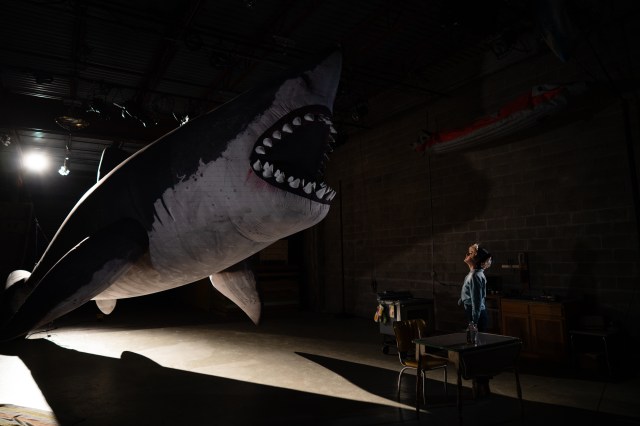
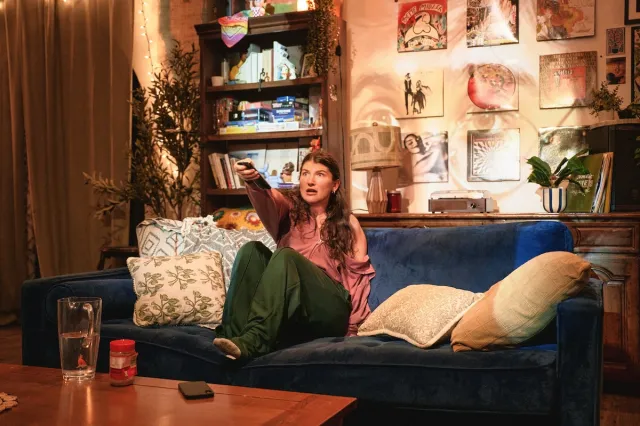
(© Abbie Sage)
Where does Two Girls fit into that ethos?
Eliya: I wanted it to be this series of interviews with men, because I am very interested in the male gaze, and I wanted it to have Chloe and Juliana [Sass], another actor we work with a lot, switching off who played who.
Chloe: Basically, Juliana and I switch between playing Eliya, the interviewer, and the boys she’s interviewing.
Eliya: A lot of the people I talked to encountered this video when they were so young that I don’t think they meant to be participating in this legacy of objectifying and commodifying women’s bodies. I sort of approached it from a perspective of…I don’t know if there are any villains here, but we live in a world that we’re all contributing to this.
Chloe, you’re codirecting and starring; Mitchell, is codirecting and designing sound. How does that contribute to the creation of the piece?
Chloe: It’s an interesting task. I’m used to it because that’s how I’ve worked with Mitchell from the start. It’s just part of my practice. There’s always a part of me that’s asking what the piece needs as I’m on stage, so the things go together. Practically, it means that I rehearse like an actor. I kind of wish that we could afford for me to have a stand in so I could watch it more, but we can’t. Juliana is also engaged in figuring out the rules of the show with us. But I step out when I can. Mostly, I can’t, and I just try to imagine what it looks like from the front.
Eliya: Chloe, often in this play, is playing me, so we’ve been trying this new thing where I stand there as a character we call Chloe-Eliya, so Chloe can see it.
Chloe: And Eliya would be like, “I liked it when I/you walked this way.” It’s kind of like we’re creating a directorial vacuum that everybody in the room has to fill. It’s a collaborative company structure.
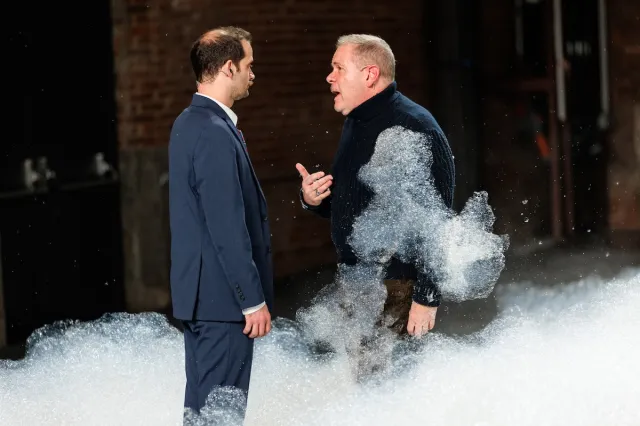
(© Valerie Terranova)
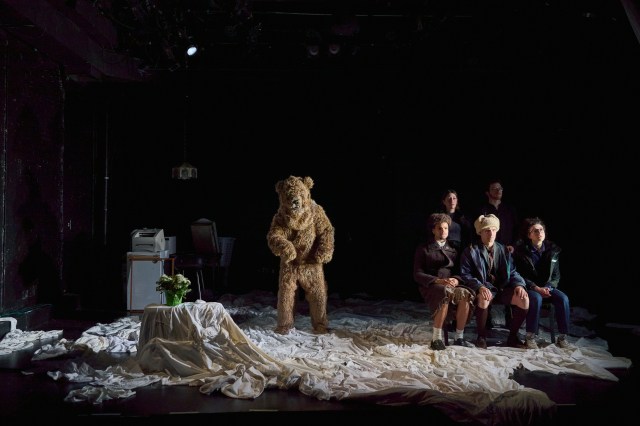
You are reviving two slightly older pieces, Deadclass, Ohio—which Eliya wrote—and Time Passes for Ellen Brody, for Under the Radar this January. How did that doubleheader come about?
Mitchell: They came to us asking about those two pieces. And actually, they proposed the rep idea, too. That was interesting for us because we had never thought about those two pieces in rep, necessarily.
Chloe: That’s so true.
Mitchell: We work with an amazing group of designers, like Forest [Entsminger, sets), Olivia [costumes], and Finn [Bamber] and Abby [Sage, lighting]. And with these two shows in particular, they both have certain visual features that exist within them, but which are used in very contrasting ways. So, we’re really excited to figure out the design world for these two shows and how the remnants of one might feel like they’re [part of the other], even though they’re distinctive plays.




source on Google
Featured In This Story

Latest Reviews
See all




Latest Videos
Watch the Trailer for Elsinore Starring Andrew Scott
The film is based on the true story of Ian Charleson, who played Hamlet at London’s National Theatre after being diagnosed with AIDS.