
Interview: Sting's Last Ship Sails Back to New York City
The Grammy-winning rock star discusses the first major revival of his Tony-nominated musical.
 |
New York City
|
|
New York City
|
June 8, 2026
(© Mark Senior)
Twelve years ago, Sting brought his passion project to Broadway. The Last Ship opened at the Neil Simon Theatre in the fall of 2014, and I was an outlier among my critical colleagues, who met this story about demise of the shipbuilding community in Sting’s native Wallsend, England, with a decided chill. I called it a “soul-stirring portrait of a bygone generation,” with “sweeping melodies and evocative lyrics.” They were less kind.
Like many a musical, The Last Ship couldn’t find an audience, shuttering after just 105 performances, despite Sting himself joining the cast as a means of goosing ticket sales. He did earn a Best Score Tony nomination for his troubles, a modest vindication that suggested he was indeed onto something.
One can’t accuse Sting of giving up. He could have easily licked his wounds by focusing solely on his side job as a 17-time Grammy-winning Rock God. Instead, he kept pushing the ship forward. Dispensing with John Logan and Brian Yorkey’s original script and Joe Mantello’s Broadway staging, Sting enlisted Lorne Campbell, then the artistic artistic director of the Newcastle-based Northern Stage, to write and direct a new version. That was in 2017.
(© Mark Senior)
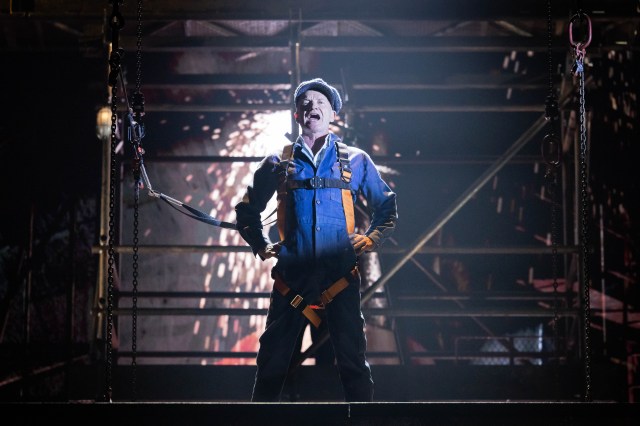
The evolution of The Last Ship reflects the theater’s existence as a living organism: “It’s never finished,” Sting says reflectively. “When I was given the opportunity to rebuild it, I took it.” This version played Newcastle and toured industrial cities like Liverpool, Leeds, and Sheffield. In North America, it went to Toronto and Los Angeles and San Francisco, where it was forced to close again, but for very different reasons. “I watched that ship sail into San Francisco Harbor,” Sting remembers, “The plague ship. And I thought, ‘This is a portent of ill.'” They were shut down during a matinee not by sales this time, but by the start of the Covid-19 pandemic.
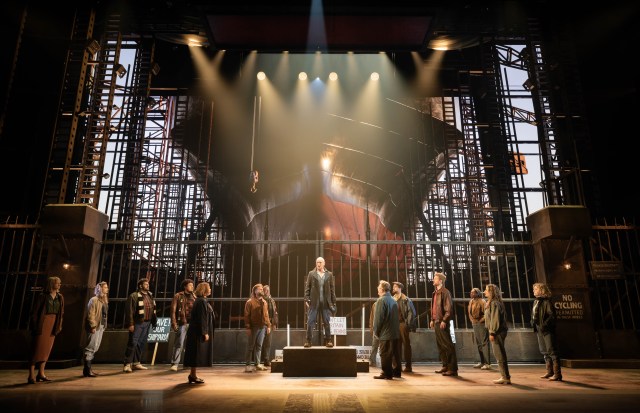
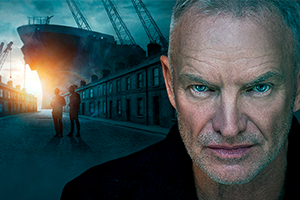
Like Sting said, a musical is “constantly evolving.” In 2024, the writer Barney Norris came on board to create a version of The Last Ship using Campbell’s and Logan and Yorkey’s scripts as a jumping off point. This version of the show brings it up to a near-operatic scale, especially fitting because, after a world tour, The Last Ship will run at the Metropolitan Opera June 9-14. Directing is Leo Warner, founder of the design studio 59 Productions, which created sets and projections that are so intricate, you can barely tell where one starts and another ends. “They have an entire ship built on that stage. It’s overpowering, It’s a real ship, and we launch it,” Sting says.
“I don’t want to define it,” Sting adds, clarifying that a venue doesn’t define a production. “It’s not an opera, but we have the emotional ambition of an opera. And I think we finally got the scale of the shipyard to the dimension that it really was.” Norris, he says, “sorted the book out, tying a lot of ends that weren’t quite tied together.” Among the changes were the removal of a dying priest character who had served as the piece’s original moral backbone and the gender swap of the protagonist’s son into a daughter. The songs have been reordered and reworked, a handful have been added, and some musical material that was cut from the Broadway production (an “injustice,” according to the composer) was restored.
(© Seth Walters)
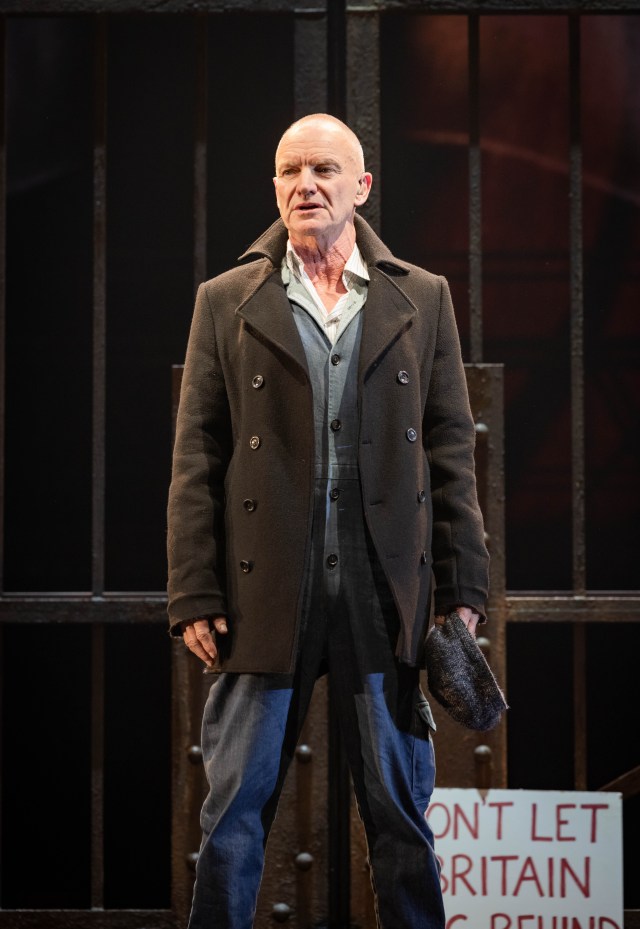
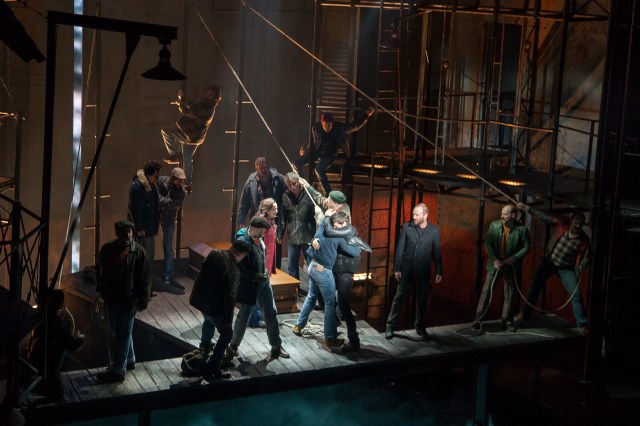
Sting is back playing the role of Jackie White, the shipyard foreman, which he was forced to inherit back in 2014 from his old friend, Jimmy Nail. Sting, who “never intended to be in this play in the first instance,” and who was devastated, he told me more than a decade ago, by the prospect of kicking his best friend to the curb to keep the show afloat for a few extra weeks, has grown accustomed to the part after all this time. “I become Jackie White and I’m singing in my own dialect, which I don’t do very often. I enjoy the challenge of channeling a character other than Sting up there, and hopefully people forget pretty early on that it’s Sting performing.”
Most of the actors will be making their New York debuts, though there’s at least one other headliner who will be familiar to audiences here: Sting’s good friend and long-time collaborator Shaggy, the reggae singer best known for the hit “It Wasn’t Me.” Shaggy will be playing a new character, the “Wallsend Ferryman,” whose function in the show is obvious if you know your Greco-Roman mythology.
“I bullied him into doing it,” Sting says with a laugh, adding that Shaggy is “perfect for the role. He brings such a sense of fun to a dark piece. He’s loving it. Even though he’s never been a stage actor before, he’s a natural.”
Is the Met a daunting prospect for a man who has sold out arenas across the world for 50 years? “You think about all the people who have sung here, the greatest singers of any century, and there you are. I don’t take it for granted at all.”
It helps that the reception to this Last Ship has been much warmer than it was originally. “We’ve had amazing responses in Amsterdam and Paris. Rave audience reactions, rave reviews. I’m feeling quite bullish about it.”
(© Mark Senior)




source on Google
Featured In This Story
Latest Reviews
See all







Latest Videos

Jocelyn Bioh, Whitney White, Jasmine Amy Rogers, and Patina Miller Talk School Girls
The playwright, director, and stars of School Girls; Or, the African Mean Girls Play discuss the comedy, sisterhood, and themes behind the new Broadway production.