
Review: Hadestown Gets a Magnificent Film Capture
The original Broadway principals star in the proshot, now showing in movie theaters.
 |
London
|
|
London
|
July 23, 2026
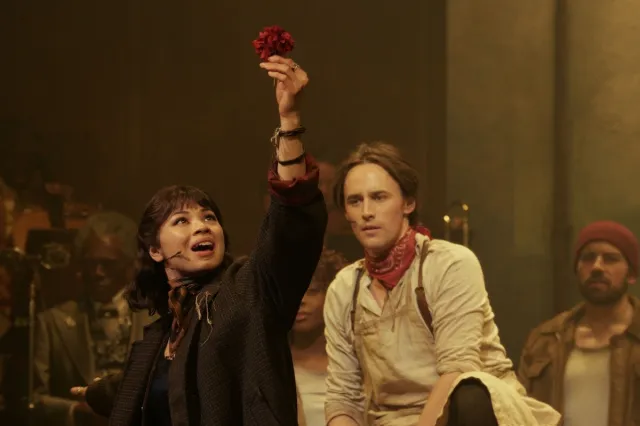
(© Crosswalk and LD Entertainment)
Broadway tickets are expensive, and most people cannot afford them. That’s not going to change anytime soon. Theaters are also limited by their seating capacity, meaning they physically cannot accommodate a mass audience the way film can. So what can theatermakers do to escape niche cultural relevance?
The best solution right now is to create and distribute high-quality film captures of stage productions—and an excellent one has just been released of Anaïs Mitchell’s Tony award-winning musical Hadestown, now screening at a movie theater near you.
The proshot features the original Broadway principal cast reunited on the stage of London’s Lyric Theatre. Reeve Carney plays Orpheus, the sweet-voiced son of a muse who is writing a song to make the flowers bloom again. The climate has been erratic due to the rocky marriage between goddess of vegetation Persephone (Amber Gray) and lord of the underworld Hades (Patrick Page portraying the kind of all-powerful tycoon his character from The Gilded Age wishes he was). Orpheus is inspired by the beautiful young Eurydice (Eva Noblezada), but she is poor and desperate enough to accept a position way down in Hadestown. So Orpheus sets out on an unprecedented mission to rescue her.
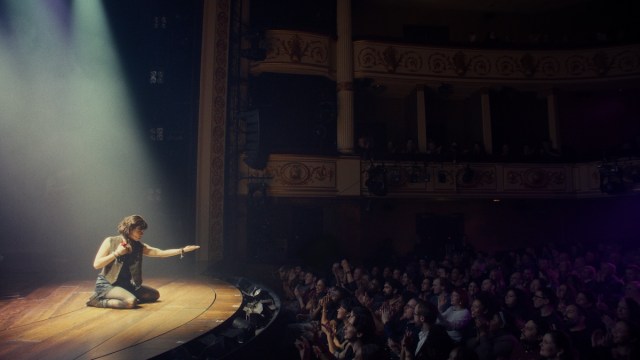
It’s ancient Greek mythology wrapped in the unmistakably American sound of Dixieland jazz and folk. André De Shields, reprising his Tony Award-winning performance as Hermes, immediately sets the tone, holding the audience rapt as he slowly takes the stage for the opening number, “Road to Hell.” De Shields is one of the most captivating performers working today, and this film helps us understand what it is like to be in a room with him.
(© Crosswalk and LD Entertainment)
We can feel the electricity passing between Carney and Noblezada, the rush of infatuation that makes one feels as though they can defy the gods and survive. We also sense the far more complicated love shared by Hades and Persephone, a push-pull of attraction and revulsion forged over millennia. Gray and Page, both veterans of the 2016 off-Broadway production, feel like an old married couple here (the film was shot over three performances in 2025), their growing antagonism tempered by the ghost of the puppy love we see so clearly in their young counterparts.
During their second act duet, “How Long?,” the camera shifts focus from Gray to Page in one steady shot, gorgeously conveying the contest of wills between these two immortals, as well as two extraordinary performances that have only grown stronger since Hadestown opened on Broadway in 2019.
Director Brett Sullivan’s beautifully shot film is full of such revealing moments, offering us close-up perspectives that only those onstage could typically appreciate, while also giving us a sense of what it is like to be in the house. Gray and De Shields are particularly skilled at working the audience, and Sullivan’s film captures those special moments of connection across the border of the stage.
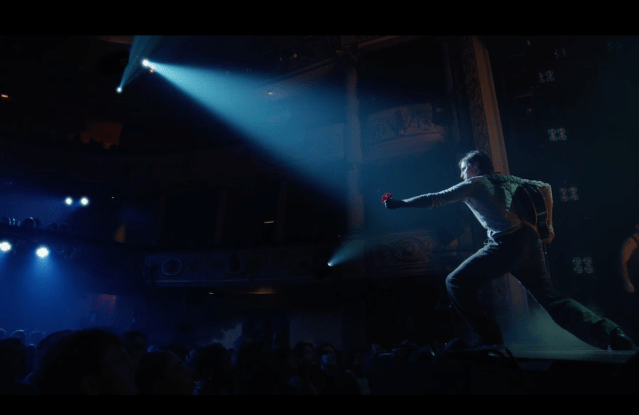
Members of the workers chorus (Lauren Azania, Tiago Dhondt Bamberger, Waylon Jacobs, Christopher Short, and Ryesha Higgs) emerge as individuals, smiling at the arrival of spring or toiling on the wall, depending on the season. They perform David Neumann’s whirring, churning choreography on Rachel Hauck’s ever-moving multi-level set, disappearing in and out of the shadows of Bradley King’s wizardly lighting.
Sullivan gives special attention to the onstage band, all of whom are introduced during “Our Lady of the Underground,” a kind of cabaret number for Persephone. Trombonist Daniel Higham has some especially nice moments.
I also enjoyed hearing the full range of the awesome three-part harmony delivered by the Fates (Bella Brown, Madeline Charlemagne, and Allie Daniel), whose role in driving the story forward is brutally clear here.
(© Crosswalk and LD Entertainment)
Rachel Chavkin’s inventive staging is as alive as ever, and the collaboration with her designers is ongoing. Page injured his Achilles tendon shortly before filming, so he wears a boot on his left foot and walks with a cane—all seamlessly integrated into Michael Krass’s glittering pinstripe suit. He’s MechaHades, a kind of steampunk Darth Vader. What could have been a disappointing setback is thus transformed into a brilliant bit of visual storytelling in this tale about the CEO of Hell, who wants to bulldoze the natural world, replacing all with machines.
That might remind you of some of our current lords of tech, who have been quite open about their desire to replace human workers with robots and AI. I have been critical of Mitchell and Chavkin’s antique Leftism, the way their pseudo-Brechtian musical takes aim not only at Trumpist nativism but the kind of sooty industry that doesn’t much exist in the United States anymore.
But it seems that, a decade after I first saw Hadestown, our most brilliant minds in tech and industry can only envision a future of economic growth powered by machines, with little room for us. Let that be a testament to their lack of creativity, and this musical’s enduring value as a rallying cry for the human spirit.
Hadestown is set to play movie theaters for five nights only, but I hope this excellent film capture lives on somewhere that is accessible to a wide audience—not just those of us fortunate enough to be able to afford a ticket to the live theater.




source on Google
Related Articles
See all

Latest Reviews
See all



Latest Videos
Watch: Ellen Greene Reflects on the Enduring Legacy of Little Shop of Horrors
Frank Oz’s cult classic movie-musical has gotten a new 4K restoration in celebration of its 40th anniversary.