
Review: Jeremy Jordan in Just in Time, Broadway’s Fantasy Nightclub Act
Jordan, Debbie Gravitte, and more lead the new cast of the Bobby Darin musical.
 |
Broadway
|
|
Broadway
|
July 22, 2026
(© Evan Zimmerman for MurphyMade)
Confession: I never thought Just in Time would last this long. I was sure that the audience for a Bobby Darin jukebox musical would quickly exhaust itself, closing the show shortly after the 2025 Tony Awards. But it’s now summer 2026 and Just in Time is still going strong, with Jeremy Jordan stepping into the starring role following the departure of original star Jonathan Groff in March and a brief run by Matthew Morrison.
Groff, who co-conceived of the musical with Ted Chapin and was nominated for a Tony for his performance, was undoubtedly key to its success. But does Just in Time work with another star in the central role? In the case of Jordan, the answer is an emphatic yes. With his dark hair, troublemaking grin, and heartthrob voice, Jordan in many ways feels like a better fit to play Darin, a singer who knew how to command the stage and forge a personal relationship with his audience, whether live in a nightclub or over the airwaves.
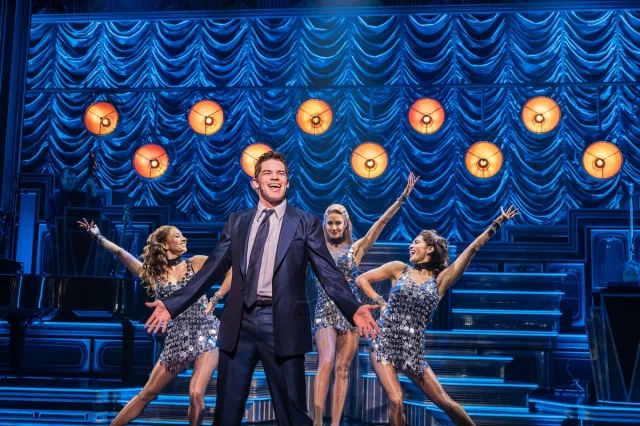
That sense of effortless charm is established from the very beginning in Warren Leight and Isaac Oliver’s clever book, which takes the form of a nightclub act, with an announcer on mic introducing us not to Bobby Darin, but Jeremy Jordan. The star cracks a few jokes about his recent run of stage roles—“I’m just trying to make it to curtain call alive”—before informing us that he won’t here either, as Darin died in 1973 at the age of 37. It’s classic Brechtian alienation technique dressed up as audience banter, with the magic of cabaret resurrecting the spirit of one of America’s great crooners in the body of one of Broadway’s great leading men.
(© Evan Zimmerman for MurphyMade)
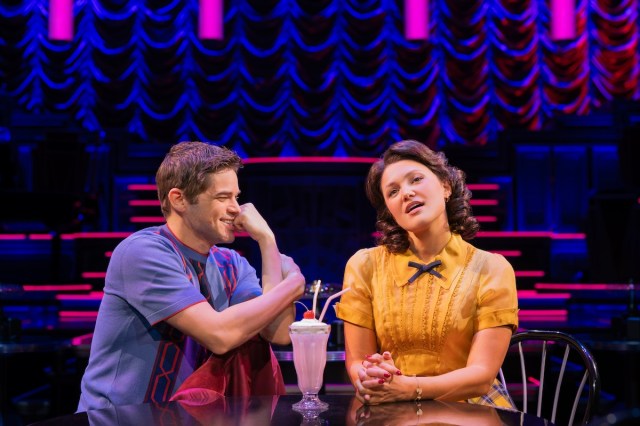
Narrated by Jordan as Darin, Just in Time follows the life of Walden Robert Cassotto (Darin’s real name) from childhood in East Harlem. He introduces us to his mother Polly (Debbie Gravitte exudes the simple joy of the ex-vaudevillian) and anxious sister Nina (Emily Bergl, who originated the role, still makes the audience gasp with her heartbreaking performance).
He starts writing commercial jingles, but his career really begins to take off following a collaboration with Connie Francis (Olivia Holt, perfectly balancing sweet but firm, as so many female artists must to survive in the entertainment industry). We get the sense he wants her because he cannot have her, a typically male pattern of desire that will plague Darin throughout his short life.
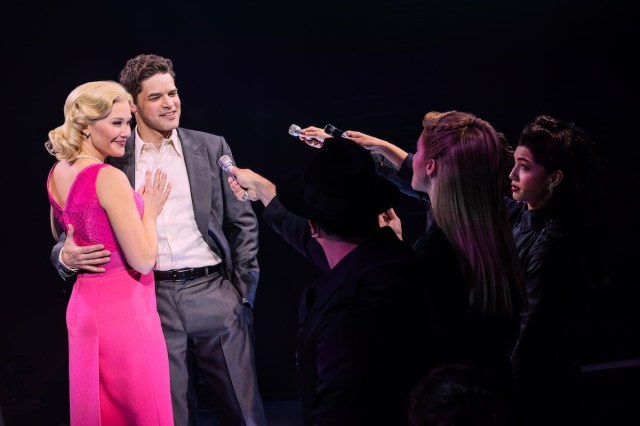
In the second act we meet Darin’s eventual wife, movie star Sandra Dee. Carrie St. Louis inhabits the role with real fire, making us feel the pain of playing the trophy wife, literally sitting in the front row at Darin’s shows night after night, pretending to laugh at the same jokes. It makes one intimately understand why Bennifer could never work. Stars like Darin, Dee, and Francis can never tolerate second billing.
(© Evan Zimmerman for MurphyMade)
While so many other jukebox musicals feel like estate-sanctioned propaganda, Just in Time offers a fairer assessment of its long-dead subject. Yes, Leight and Oliver’s book is sympathetic to Darin, as any script driven by first-person narration would be, but it doesn’t shy away from the unsavory aspects of his personality, specifically his overweening narcissism and tendency to value relationships mostly by how much they could advance his career. This is a man who sent an employee to tell his wife that he was divorcing her—a genuine asshole, but what a voice.
Jordan proves more than up to the task of delivering radio-ready renditions of Darin’s great hits. His “Mack the Knife” is both cool and jagged, with spiky accents poking out of the smooth melody like hidden daggers; “Splish Splash” is zany good fun; And I cannot get his rendition of “Dream Lover” out of my head, a quality that would make any record executive fall in love.
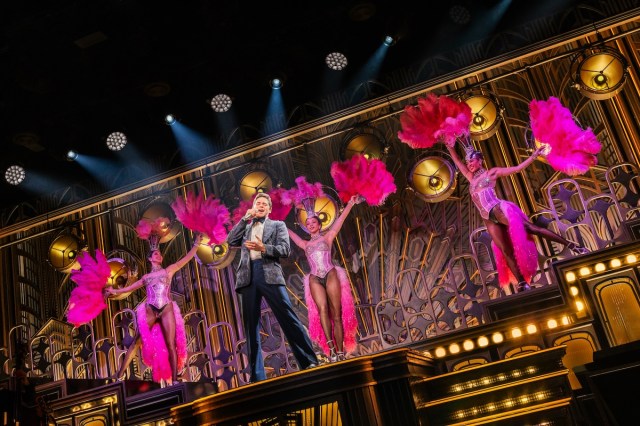
Jordan feels completely at home in Alex Timbers’s production, which transforms Circle in the Square into a nightclub in purgatory (Derek McLane designed the snazzy set). Justin Townsend’s lighting facilitates the jump cuts of the script, which Timbers stages seamlessly, bringing a downtown director’s resourcefulness to Broadway. Peter Hylenski’s sound facilitates lyrical clarity while also creating some of the more terrifying moments in the show, when we are made privy to Darin’s beating heart. Catherine Zuber’s costumes, visions in glitter and feathers, evoke the great nightclubs of yesteryear, a time long before the Copacabana was home to Magic Mike. It was also a time that coincided with Broadway’s golden age, which I suspect is one of the reasons this musical has done so well.
Times Square is plagued with anxiety that Broadway is slowly transforming into a tourist attraction that can only mount tribute acts to its storied past, like a Vienna orchestra that performs waltzes in powdered wigs. Certainly, there is more of a market for that than the preachy new musicals presented at some of our more venerable not-for-profit theaters. But Just in Time offers a middle path, deploying frontier stage technology and innovative storytelling to breathe new life into America’s cultural heritage. It’s easy to see why Jordan, one of Broadway’s reigning marquee stars, was attracted to that.
(© Evan Zimmerman for MurphyMade)




source on Google
Featured In This Story
Related Articles
See all
Latest Reviews
See all








Latest Videos
Watch: Ellen Greene Reflects on the Enduring Legacy of Little Shop of Horrors
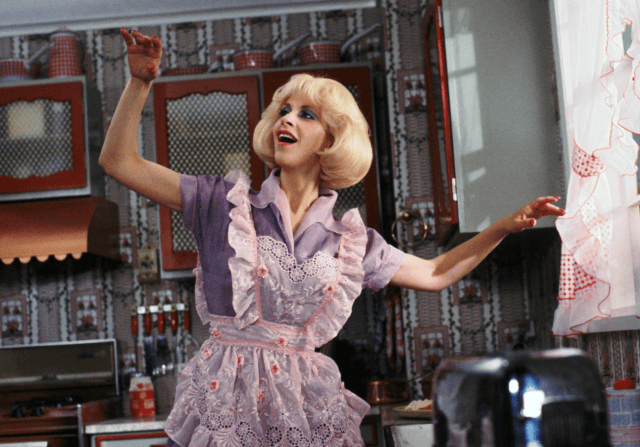
Frank Oz’s cult classic movie-musical has gotten a new 4K restoration in celebration of its 40th anniversary.