
Interview: Jessica Lange's Passion Project Was a Long Day's Journey to the Screen
The Tony winner discusses the struggles that came ith bringing Eugene O’Neill’s masterpiece to the screen.
 |
New York City
|
November 25, 2026
Jessica Lange has fought tooth and nail to get a new film adaptation of Eugene O’Neill’s Long Day’s Journey Into Night off the ground. And despite her considerable Hollywood clout, not to mention her pair of Oscars, a trio of Emmys, and a Tony (for playing Mary Tyrone in O’Neill’s masterpiece in 2016), it’s proved way harder than she expected.
Lange describes what she and the team endured as a “series of unfortunate events.” When filming commenced in Ireland, funding for the project, directed by Jonathan Kent, almost immediately fell through, and it took weeks to find a new backer (Lange and cast members Ed Harris, Ben Foster, and Colin Morgan stayed put). When they started shooting, they endured weather-related damage to the set. Namely, “the roof blew off the garage.” And now that it’s long done, she’s fighting to get it seen. It will be released on streaming platforms beginning December 4, but a cinema release has proved elusive, despite what our critic called “unequivocally, the benchmark for all performances of the role, in film and onstage, and the one to which all will be compared.”
“It’s been a crazy ride,” Lange remarks as she ponders how the business has changed. “Why should it be this hard?”
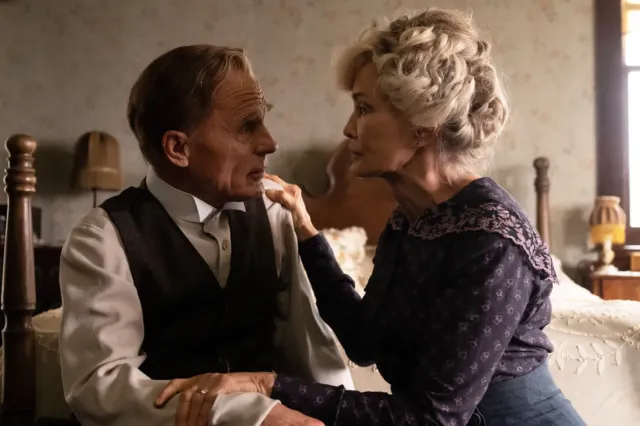
(© Quiver Distribution)
This conversation has been condensed and edited for clarity.
Going all the way back, at what point did you and Jonathan Kent start talking about making a film of Long Day’s Journey Into Night?
Probably sometime during the run of the play when we did it on Broadway. We talked about filming it just to have a record of it. The process of talking about it to getting David Lindsay-Abaire involved to do the screenplay to the time we started shooting was six years. And then from the time we shot it after a series of unfortunate events until now is another four years. So, it’s been 10 years in the making. A whole decade. And now we have a film but nowhere for it to be seen.
Tell me about that.
It’s kind of inconceivable. We’re not dealing with an unknown. We’re talking about O’Neill’s greatest play and a wonderful cast. I mean, why should it be this hard? I guess the business has changed so dramatically that doing a film like this is not… It’s not easy to do anymore. I don’t know. Why is it this hard?
I don’t understand the eccentricities of the film business.
I guess I don’t understand them anymore either.
Having done two runs of the play, how do you reconcile as an actor going from the full four-hour version to the abridged 110-minute version that David created?
That was the hardest part for me. David kept the whole piece intact in the screenplay, but there’s a repetitive nature to the play. It’s cyclical. They go through all the blame, recriminations, forgiveness, guilt, and then it repeats itself and repeats itself. Obviously, that was what was lost going from four hours to two hours. That’s what worried me the most, because you don’t want to lose any O’Neill. The language gets inside you. Suddenly, we would come to a line that was no longer there, and I’m sure they were all sick to death of me saying “Wait a minute, you can’t cut that line.” It was a compromise in the end, and it doesn’t feel, when I watch it, like we sacrificed anything.
I would imagine that part of an actor’s fun in coming back to a piece is playing opposite new actors, which you’ve done on every occasion in Long Day’s Journey Into Night. How did you develop this family with Ed and Ben and Colin, as opposed to your stage counterparts?
The great thing is that Ed, Ben, and Colin are all might actors. It was just adjusting, because, obviously, Michael Shannon’s Jamie is considerably different than Ben Foster’s, but they both embody the essence of the character. More than anything, it’s the voice. You’re hearing it a different way, after doing it for months, eight times a week.
Was that house you shot in a real house, or was it a studio?
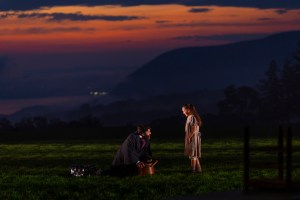
No, it was a practical set. They created this whole house on a cliff overlooking the Irish Sea, doubling as Connecticut in 1912. I’ve always felt that the house is the sixth character, and the moment I saw that set, it had a quality. It was haunting. What was so great about shooting it out there was the silence. It wasn’t like being on a soundstage. It was just the silence of nature and how the house embodies that silence for Mary, especially in the emptiness, the vacantness. She talks about the loneliness when the men go out, and that house lent itself to that element, much more than you can get on a stage in the theater. You’ve got those windows looking out, and the fog. There was something wonderful about it.
Is Mary Tyrone a role than be influenced or changed by your mood or feelings during the day?
Absolutely. I remember one time when I was doing the play in London, it was my mother’s birthday. My mother had been gone for a long time. I came into the theater that night and I could feel this whole other element to it that I’d never felt before. It will accommodate whatever you bring to it, as long as you are being honest.
I think about what O’Neill wrote in his dedication to [his wife] Carlotta, “this play of old sorrow, written in tears and blood…with deep pity and understanding and forgiveness.” That’s the key, that forgiveness, that pity, that he feels for these four characters. He says, “all the four haunted Tyrones.” There’s not a false moment in it. It’s so true. And I think that’s rare.
Would you play her again?
I could do it ’til the end of time and never feel like I had come to the end of that character. She is inexhaustible. I don’t think I could [actually] do it again, because what’s possible? I could take it on the road? Do the bus and truck? No, I mean, I think I’ve done it. But if the opportunity ever arose to do another production if it, I’d have to really think long and hard about it. It’s an extraordinary piece. And the fact that I’ve been given this opportunity, this gift of playing her, on three different occasions? That’s what you dream of as an actor.




source on Google
Related Articles
See allLatest Reviews
See all







Latest Videos

Watch: Dolly Parton's Broadway Family Remembers Their Time With the Country Music Legend
Katie Rose Clarke, Carrie St. Louis, and more share memories of the days they spent in rehearsal with the icon before her passing.